
Food chains and food websSpec B15.2.1, B15.2.2, B15.2.3, B15.2.10
In short
A food chain shows the transfer of energy from one organism to the next, beginning with a producer, and a food web is a network of interconnected food chains. Each arrow points from the organism that is eaten to the one that eats it. Overharvesting and introducing foreign species change food webs and affect other populations.
- Food chain
- Shows the transfer of energy from one organism to the next, beginning with a producer.
- Food web
- A network of interconnected food chains.
In a food chain the arrows show the transfer of energy. Each arrow points from the organism that is eaten to the organism that eats it. The chain always begins with a producer.
 (opens full size in a new tab)
Arrows point from the food to the feeder. Grass → rabbit means the rabbit eats the grass and energy passes to the rabbit.
Food webs
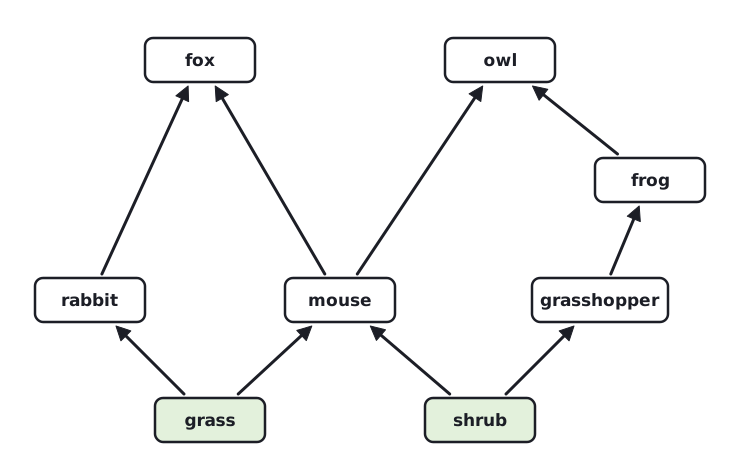
Most organisms eat more than one type of food, and are eaten by more than one type of predator. A food web shows these links as a network of interconnected food chains.
To interpret a food web, trace each food chain from a producer, following the arrows. You can then say what an organism eats, what eats it, and what might happen if one population changes.
 (opens full size in a new tab)
Supplement (what this means)
Supplement: only for the Extended papers (2 and 4). Core students can skip it. What the labels meanHuman impact on food chains and food webs
Supplement (what this means)
Supplement: only for the Extended papers (2 and 4). Core students can skip it. What the labels meanFood chains and food webs can be used to describe the impact humans have on an ecosystem.
Supplement (what this means)
Supplement: only for the Extended papers (2 and 4). Core students can skip it. What the labels mean- Overharvesting of a food species, such as overfishing, reduces the population of that species. Predators that feed on it have less food, so their populations may fall. Species that the harvested species eats may increase in number.
- Introducing foreign species to a habitat adds a new organism to the food web. It may eat native species, so their numbers fall, or compete with them for food, so those species have less food and their populations fall.
Supplement (what this means)
Supplement: only for the Extended papers (2 and 4). Core students can skip it. What the labels meanFor 'what happens if' questions, work along the arrows. Say what happens to the organisms that eat it (less food) and to those it eats (fewer eaten, so more of them). Mention that effects can be indirect.
Written and checked against the Cambridge IGCSE Combined Science (0653) specification · Updated October 2026