

What homeostasis isSpec 4.5.1
Cells in the body can only survive within narrow physical and chemical limits. They need a constant temperature and pH, and a constant supply of dissolved food and water. The body therefore has control systems that constantly monitor and adjust the composition of the blood and tissues.
- Homeostasis
- The regulation of the internal conditions of a cell or organism to maintain optimum conditions for function, in response to internal and external changes.
Homeostasis maintains optimal conditions for enzyme action and for all cell functions. If conditions drift too far from the optimum, enzymes work more slowly or stop working, and cells cannot carry out their reactions.
In the human body, homeostasis includes control of:
- blood glucose concentration
- body temperature
- water levels
These control systems are automatic. They may involve nervous responses or chemical responses (hormones).
Parts of a control systemSpec 4.5.1
All control systems include three types of component.
| Component | What it does | Examples |
|---|---|---|
| Receptors | Cells that detect stimuli (changes in the environment) | Temperature receptors in the skin |
| Coordination centres | Receive and process information from receptors | The brain, the spinal cord and the pancreas |
| Effectors | Muscles or glands that bring about responses which restore optimum levels | A muscle that contracts; a gland that secretes a hormone |
The sequence is: stimulus, receptor, coordination centre, effector, response. The response restores the optimum level, which the receptors then detect again.
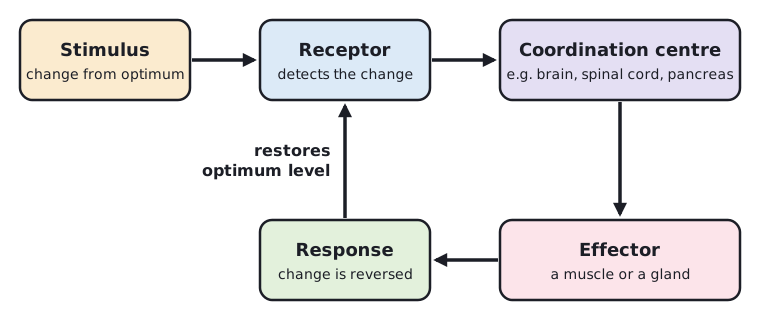 Tap to enlarge
Quick check
Define homeostasis.
Show answer
The regulation of the internal conditions of a cell or organism to maintain optimum conditions for function, in response to internal and external changes.
Name three things controlled by homeostasis in the human body.
Show answer
Blood glucose concentration, body temperature and water levels.
What do receptors do?
Show answer
They detect stimuli (changes in the environment).
Name the two types of effector.
Show answer
Muscles and glands.