

EnzymesSpec 4.2.2.1
Enzymes catalyse specific reactions in living organisms. A catalyst speeds up a reaction and is not used up. Enzymes are large protein molecules, and each one has a special shape.
Each enzyme has an active site. The shape of the active site is what makes the enzyme specific: it only works on one type of molecule, called the substrate.
The lock and key theory
The ‘lock and key theory’ is a simplified model of how enzymes work.
- The substrate collides with the enzyme and fits into the active site, like a key into a lock. The shapes are complementary.
- The enzyme catalyses the reaction while the substrate is in the active site.
- The products leave the active site. The enzyme is unchanged and can be used again.
Scientists also use other models to explain enzyme action. If a question describes a different model, use the information given in the question.
Temperature and pH
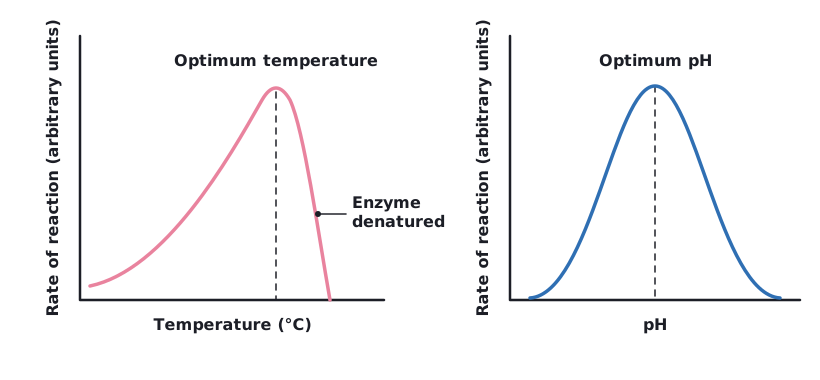
As temperature rises, the reaction gets faster because the particles move faster and collide more often. Each enzyme has an optimum temperature where its rate is highest.
If the temperature is too high, or the pH is too acidic or too alkaline, the shape of the active site changes. The substrate no longer fits. The enzyme is denatured, and it cannot be changed back.
| Condition | Effect on rate |
|---|---|
| Temperature below the optimum | Rate increases as temperature rises |
| Optimum temperature | Rate is highest |
| Temperature above the optimum | Rate falls quickly because the enzyme is denatured |
| Optimum pH | Rate is highest. Different enzymes have different optimum pH values |
| pH far from the optimum | Rate falls because the enzyme is denatured |
 Tap to enlarge
Rate calculations
When the end point is a colour change, such as the loss of starch, you can use rate = 1 ÷ time taken. A shorter time means a faster rate.
Rate of an enzyme-catalysed reaction
An enzyme makes 12 cm³ of product in 3 minutes. Calculate the rate of reaction in cm³ per minute.
- Use rate = amount of product ÷ time.
- Rate = 12 ÷ 3.
Answer: 4 cm³/min