
In short
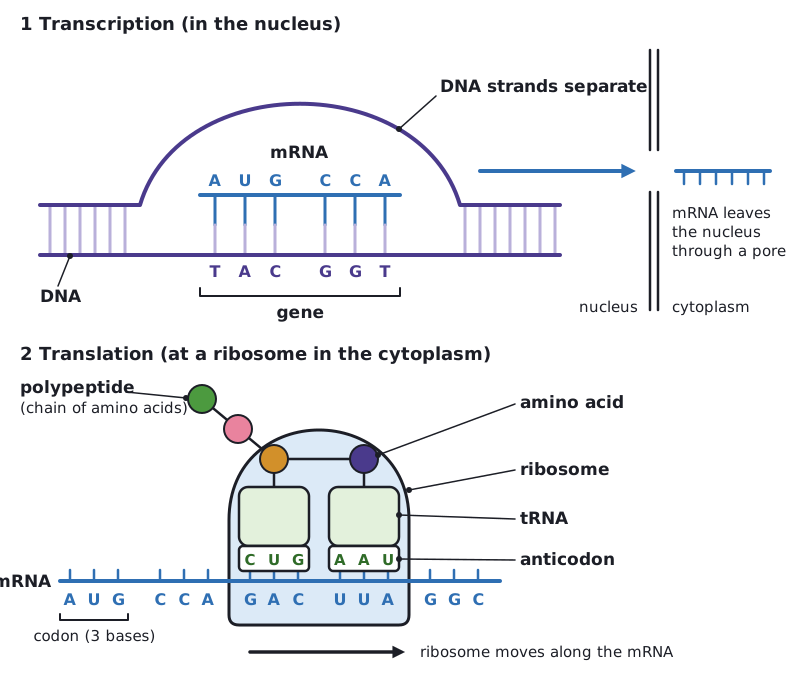
Transcription and translation are the two stages of protein synthesis. Transcription happens in the nucleus: a gene's DNA is copied into a single strand of mRNA. Translation happens at a ribosome in the cytoplasm: the mRNA is read in codons and tRNA brings the matching amino acids, which join to make a polypeptide.
Transcription copies a gene into mRNA in the nucleus. Translation uses that mRNA to build a chain of amino acids at a ribosome in the cytoplasm. Put simply: transcription makes mRNA from DNA, and translation makes a polypeptide (a protein) from mRNA. The two together are called protein synthesis.
How much detail you need depends on your course. Edexcel International GCSE Biology (4BI1) and Edexcel GCSE Biology (1BI0) both name transcription and translation. Cambridge IGCSE 0610 and AQA GCSE Biology want a simpler outline. Everything below comes from the official specifications, and a table further down shows exactly where each course stops.
Transcription vs translation: the difference at a glance
| Transcription | Translation | |
|---|---|---|
| Stage of protein synthesis | First | Second |
| Where it happens | In the nucleus | At a ribosome in the cytoplasm |
| Template (what is read) | DNA of the gene | mRNA, read in codons |
| Product | A single strand of mRNA | A polypeptide (chain of amino acids), which folds into a protein |
| Molecules involved | DNA, RNA polymerase (Edexcel GCSE), free RNA nucleotides with bases A, U, C and G | mRNA, ribosome, tRNA, amino acids |
| Base pairing | DNA base to RNA base: A–U, T–A, C–G, G–C | mRNA codon to tRNA anticodon: A–U, U–A, C–G, G–C |
The names make sense if you think of languages. When you transcribe something, you write it out again in the same language: DNA bases are copied as RNA bases. When you translate, you change it into a different language: a sequence of bases becomes a sequence of amino acids.
Why cells need two stages
A gene is a section of DNA that codes for a specific protein. DNA stays in the nucleus, but proteins are made on ribosomes in the cytoplasm. So the cell makes a copy of the gene, called messenger RNA (mRNA), which is small enough to leave the nucleus and carry the code to a ribosome. The DNA itself never leaves the nucleus.
| DNA | RNA | |
|---|---|---|
| Strands | Two, coiled into a double helix | One (single stranded) |
| Bases | A, T, C, G | A, U, C, G |
| Base that pairs with A | Thymine (T) | Uracil (U) |
| Where it is found | Nucleus | mRNA is made in the nucleus and moves to the cytoplasm |
Transcription step by step
- The two strands of DNA separate along the gene, so the bases are exposed.
- One strand acts as the template. Free RNA nucleotides pair with it by complementary base pairing: A on the DNA pairs with U, T pairs with A, C pairs with G and G pairs with C.
- The nucleotides are joined to make a single strand of mRNA, a copy of the gene. Edexcel GCSE adds that the enzyme RNA polymerase binds to non-coding DNA in front of the gene and then makes the complementary mRNA strand from the coding DNA of the gene.
- The mRNA leaves the nucleus through a pore in the nuclear envelope and goes to a ribosome.
Translation step by step
- The mRNA attaches to a ribosome in the cytoplasm.
- The ribosome reads the mRNA in codons, groups of three bases. Each codon codes for one specific amino acid.
- tRNA (transfer RNA) molecules bring amino acids to the ribosome. Each tRNA carries one specific amino acid and has an anticodon, three bases that are complementary to one codon.
- The anticodon of each tRNA pairs with the matching codon on the mRNA, so the amino acids arrive in the order set by the codons.
- The amino acids are joined to form a polypeptide. When it is complete, the chain folds into a protein with a specific shape, such as an enzyme.
 (opens full size in a new tab)
- mRNA (messenger RNA)
- A single-stranded copy of a gene that carries the code from the nucleus to a ribosome.
- tRNA (transfer RNA)
- A molecule that carries one specific amino acid to the ribosome and has an anticodon.
- Ribosome
- The structure in the cytoplasm where the mRNA is read and amino acids are joined into a polypeptide.
- Codon
- A sequence of three bases on mRNA that codes for one amino acid.
- Anticodon
- A sequence of three bases on tRNA that is complementary to a codon.
Worked example: DNA triplet to amino acid
Base-pairing questions are the most common calculation-style question on this topic. Work one step at a time and remember two rules: there is no T in RNA, and each step uses complementary pairs.
From a DNA template to amino acids
The template strand of a gene reads T A C G G T C T T. Give the mRNA codons, the tRNA anticodons and the amino acids coded for. (Codon table: AUG = methionine, CCA = proline, GAA = glutamic acid.)
- Transcription: pair each DNA base with its RNA partner. T gives A, A gives U, C gives G, G gives C.
- TAC gives AUG, GGT gives CCA, CTT gives GAA. mRNA codons = AUG CCA GAA.
- Translation: each anticodon is complementary to its codon. AUG pairs with UAC, CCA pairs with GGU, GAA pairs with CUU.
- Use the codon table: AUG codes for methionine, CCA for proline and GAA for glutamic acid.
Answer: mRNA AUG CCA GAA; anticodons UAC GGU CUU; amino acids methionine, proline, glutamic acid.
| DNA template triplet | mRNA codon | tRNA anticodon | Amino acid |
|---|---|---|---|
| TAC | AUG | UAC | methionine |
| GGT | CCA | GGU | proline |
| CTT | GAA | CUU | glutamic acid |
A quick check: the anticodon has the same bases as the DNA template triplet, with U in place of T (TAC and UAC, CTT and CUU). None of these courses asks you to learn which codon codes for which amino acid, so a question that needs amino acid names has to give them to you.
What each course requires, and where it stops
| Course | Spec reference | Who sits it | What you need | Where it stops |
|---|---|---|---|---|
| Edexcel International GCSE Biology (4BI1) | 3.16B, 3.17B, 3.18B | Biology only; tested on Paper 2. Not in the Double Award (4SD0) | RNA is single stranded with uracil instead of thymine; the stages of protein synthesis including transcription and translation, and the roles of mRNA, ribosomes, tRNA, codons and anticodons | No RNA polymerase or non-coding DNA in the statement |
| Cambridge IGCSE Biology (0610) | 17.1.8 (Supplement) | Extended candidates only. Not in Combined Science (0653) | Gene stays in the nucleus; mRNA is a copy of the gene, made in the nucleus, moves to the cytoplasm and passes through ribosomes; the ribosome assembles amino acids; the base sequence in the mRNA sets the amino acid sequence | The syllabus says knowledge of the details of transcription or translation is not required: no tRNA, codons or anticodons |
| Edexcel GCSE Biology (1BI0) | 3.8B (also 3.7B, 3.9B, 3.10B) | Biology only and Higher tier. Not in Combined Science (1SC0) | RNA polymerase binds to non-coding DNA in front of a gene and makes a complementary mRNA strand; mRNA attaches to a ribosome; codons code for specific amino acids; tRNA transfers amino acids; amino acids are linked into polypeptides | Anticodons are not named in the statement |
| AQA GCSE Biology (8461) | 4.6.1.5 | Biology only and Higher tier. Not in Combined Science: Trilogy (8464) | A simple description: proteins are made on ribosomes according to a template; carrier molecules bring specific amino acids in the correct order; the chain folds into a unique shape | The spec says students are not expected to know or understand the structure of mRNA or tRNA |
So if you take Edexcel IGCSE Biology, you need the full story with tRNA, codons and anticodons, which is why we built the worked example around it. Cambridge 0610 Extended candidates need the outline of mRNA and ribosomes but do not need to use the words transcription or translation at all. AQA students should describe tRNA as 'carrier molecules', which is the wording the spec uses.
Revise it for your course
- Edexcel IGCSE 4BI1: RNA and protein synthesis notes, DNA structure notes, exam questions and flashcards.
- Cambridge IGCSE 0610: How genes control proteins notes, exam questions and flashcards.
- Edexcel GCSE 1BI0: Protein synthesis: transcription and translation notes, exam questions and flashcards.
- AQA GCSE 8461: DNA structure and protein synthesis notes, exam questions and flashcards.
Exam questions and model answers
Questions on this topic are usually describe or explain questions, where each correct, relevant step earns a mark, plus short base-pairing questions like the worked example above. These model answers match questions in our own exam-style question banks.
Edexcel IGCSE: describe how a gene is used to make a protein (6 marks)
The question asks for the roles of mRNA, ribosomes, tRNA, codons and anticodons, and is marked on levels, so organise it in order. Model answer: "In transcription, in the nucleus, the two DNA strands separate along the gene. A single strand of mRNA is made as a copy of the gene by complementary base pairing, with uracil pairing with adenine. The mRNA leaves the nucleus and attaches to a ribosome in the cytoplasm. In translation, the ribosome reads the mRNA in codons of three bases, and each codon codes for one amino acid. tRNA molecules each carry a specific amino acid, and the anticodon on the tRNA pairs with the complementary codon on the mRNA. The amino acids are joined in the order of the codons to form a polypeptide, which folds into a protein." Try it yourself in the Edexcel IGCSE DNA and protein synthesis questions.
Cambridge IGCSE: explain how a protein is made in a cell (5 marks)
This follows the six bullet points of syllabus 17.1.8, and five correct points get full marks. Model answer: "The gene for the protein stays in the nucleus. A copy of the gene, called mRNA, is made in the nucleus. The mRNA moves out of the nucleus into the cytoplasm. The mRNA passes through a ribosome. The ribosome assembles amino acids into a protein, and the sequence of amino acids is determined by the sequence of bases in the mRNA."
Edexcel GCSE: describe how a gene is used to make a polypeptide (4 marks)
Model answer: "RNA polymerase binds to the non-coding DNA in front of the gene. It produces a complementary mRNA strand from the coding DNA of the gene. The mRNA attaches to a ribosome, where triplets of bases called codons code for specific amino acids. tRNA transfers the amino acids to the ribosome, and they are linked to form a polypeptide." Higher-tier questions may also ask how a variant in the non-coding DNA changes the quantity of protein made.
AQA GCSE: a simple description of protein synthesis
Model answer: "Proteins are made on ribosomes, using a template copied from the gene. Carrier molecules bring specific amino acids to the ribosome, and they are added to the growing protein chain in the correct order. When the chain is complete, it folds up into a unique shape that lets the protein do its job, for example as an enzyme."
Common mistakes
- Mixing up the stages. Transcription makes mRNA from DNA in the nucleus. Translation makes a polypeptide from mRNA at a ribosome.
- Writing T in an mRNA or tRNA sequence. RNA has uracil (U) instead of thymine, so A on DNA pairs with U on mRNA.
- Putting codons on tRNA or anticodons on mRNA. Codons are on mRNA; anticodons are on tRNA. Name the molecule each time.
- Saying the DNA or the gene leaves the nucleus. Only the mRNA copy leaves.
- Saying the ribosome makes mRNA, or that translation happens in the nucleus.
- Saying a codon codes for a protein. One codon codes for one amino acid; the whole gene codes for the protein.
- Saying 'the mRNA codes for amino acids' without saying how. Say that the mRNA is read in codons of three bases, and the order of the bases sets the order of the amino acids.
How to revise protein synthesis
- Learn the comparison table above until you can write it out from memory: where, template, product and molecules.
- Practise three or four base-pairing conversions from DNA to mRNA to anticodon. Our Edexcel IGCSE flashcards cover the key terms.
- Write a full-mark answer for your own course, then check it against the notes and the question bank.
- Use the Edexcel IGCSE mind map to link protein synthesis to DNA structure, mutations and inheritance.
- Tick off 3.16B to 3.18B on the Edexcel IGCSE specification checklist, or the matching points on your own board's checklist, and finish with real papers from the Edexcel IGCSE past papers page.
If you are not sure which board you are on, our guide to IGCSE vs GCSE Biology explains the courses, and how IGCSE Biology is marked shows how describe and explain answers earn marks. If you want help with genetics or protein synthesis, we offer 1-to-1 biology tutoring online and in Dubai.
Sources: Pearson Edexcel International GCSE Biology (4BI1) specification, Cambridge IGCSE Biology 0610 syllabus 2026 to 2028, Pearson Edexcel GCSE Biology (1BI0) specification and AQA GCSE Biology (8461) specification.