
In short
Osmosis practical exam questions test five things: defining osmosis, naming the variables, calculating percentage change in mass, reading the graph to find where there is no change in mass, and explaining errors such as uneven blotting. Below are worked example results and eight original exam-style questions with full mark schemes.
Exam questions on the osmosis practical nearly always ask you to do one of five things: define osmosis, name the variables, calculate the percentage change in mass, use a graph to find the concentration where the mass does not change, and explain an error or improvement, usually blotting, cylinder size or repeats. Master those five and you can answer almost anything set on it.
It is AQA required practical 3 in GCSE Biology (8461) and required practical 2 in Combined Science: Trilogy (8464). Edexcel GCSE calls it a core practical, and Cambridge and Edexcel International GCSE include it too. Below: the method in brief, a worked calculation, the graph, errors, eight exam-style questions with model answers and the commonest mistakes.
What the osmosis practical questions test
| Question type | Typical marks | What gets the marks |
|---|---|---|
| Define or explain osmosis | 2–3 | Water, from a dilute to a concentrated solution, through a partially permeable membrane |
| Name the variables | 1–3 | Independent: concentration. Dependent: percentage change in mass. Controls named specifically |
| Percentage change in mass | 2–3 | Divide by the initial mass, multiply by 100, keep the minus sign for a loss |
| Mean and anomalies | 2 | Leave out the anomalous result before you calculate the mean |
| Read the graph | 2 | Concentration where the line crosses 0% = concentration of the cell contents |
| Errors and improvements | 2–3 | Blot the same way, same-size cylinders from one potato, repeats, narrower range of concentrations |
| Describe the method | 4–6 | A logical sequence with measurements, controls and how to process the results |
The osmosis practical method in brief
- Make up a range of sucrose (or salt) solutions, such as 0.0 to 0.8 mol/dm³, with the same volume in each boiling tube. 0.0 mol/dm³ is distilled water.
- Cut potato cylinders from one potato with a cork borer, all trimmed to the same length on a white tile.
- Blot each cylinder gently with a paper towel and weigh it to 0.01 g. Record the initial mass.
- Leave one cylinder fully covered in each tube, all at the same temperature for the same time (overnight is best).
- Remove each cylinder, blot it in exactly the same way and weigh it again.
- Calculate the percentage change in mass, repeat, find a mean for each concentration and plot a graph.
The full method, risk assessment and a blank results table are on our sheets: AQA osmosis in potato cylinders and Edexcel osmosis in potatoes. Looking for an osmosis required practical PDF? Every sheet page has a free printable PDF, with answers in a separate teacher section.
Potato osmosis practical results: an example table
Here is a set of example results (practice data, not from a real class) showing the pattern you should expect: a gain in dilute solutions, a loss in concentrated ones.
| Concentration of sucrose solution (mol/dm³) | Initial mass (g) | Final mass (g) | Change in mass (g) | Percentage change in mass (%) |
|---|---|---|---|---|
| 0.0 | 2.50 | 2.95 | +0.45 | +18.0 |
| 0.2 | 2.55 | 2.69 | +0.14 | +5.5 |
| 0.4 | 2.48 | 2.34 | −0.14 | −5.6 |
| 0.6 | 2.52 | 2.18 | −0.34 | −13.5 |
| 0.8 | 2.45 | 2.02 | −0.43 | −17.6 |
In 0.0 and 0.2 mol/dm³ the solution was more dilute than the cell contents, so water moved into the cells by osmosis and they gained mass. From 0.4 mol/dm³ upwards the solution was more concentrated, so water moved out. The 0.2 and 0.4 cylinders changed by the same 0.14 g in opposite directions, so the point of no change lies between them.
Percentage change in mass in osmosis: worked calculation
Percentage change in mass
Use the example results. The cylinder in 0.4 mol/dm³ sucrose solution had an initial mass of 2.48 g and a final mass of 2.34 g. Calculate the percentage change in mass. Give your answer to 2 significant figures.
- change in mass = final mass − initial mass = 2.34 g − 2.48 g = −0.14 g
- divide by the initial mass: −0.14 ÷ 2.48 = −0.05645…
- multiply by 100: −0.05645 × 100 = −5.645…%
- round to 2 significant figures and keep the minus sign, because the cylinder lost mass
Answer: −5.6%
Why a percentage? The cylinders never start at exactly the same mass, so the percentage change is what lets you compare them fairly. This is a favourite 2-mark question. The Edexcel notes have a full section on percentage change in mass.
AQA also lists the rate of water uptake as a simple compound measure. Rate of change of mass = change in mass ÷ time. A cylinder that loses 0.30 g in 60 minutes has a rate of −0.005 g/min. Always give the unit.
How to plot and read the osmosis graph
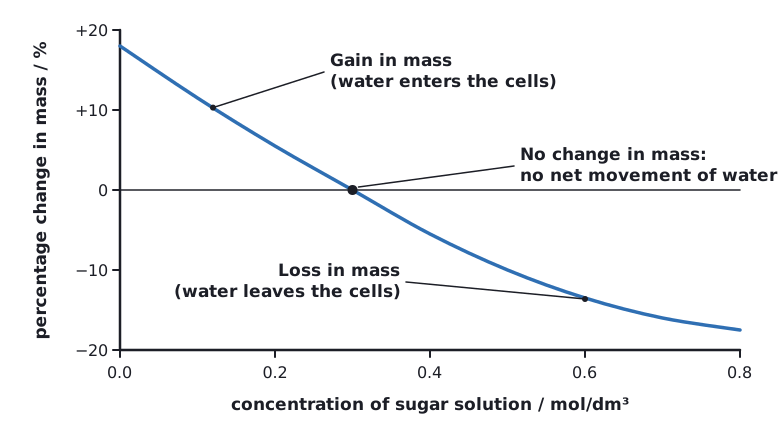
- Put concentration of sucrose solution (mol/dm³) on the x-axis and percentage change in mass (%) on the y-axis.
- The y-axis must go below zero, because some values are negative. The x-axis runs along the 0% line.
- Plot each mean with a small cross, then draw a smooth line or curve of best fit. Do not join the dots.
- Read off the concentration where the line crosses the x-axis. Here the percentage change is 0%, so there is no net movement of water.
 (opens full size in a new tab)
With the example results, the line crosses 0% at about 0.30 mol/dm³. Here the solution has the same concentration as the potato cell contents, so there is no net movement of water. Read the value from the x-axis and give the unit; mark schemes usually accept a small range.
Variables in the osmosis practical
Independent variable: the concentration of the sucrose (or salt) solution. Dependent variable: the percentage change in mass. Control variables: the same potato, the same cylinder length and diameter, the same volume of solution, temperature and time, and the same way of blotting.
Errors and improvements
| Error | Effect on the results | Improvement |
|---|---|---|
| Cylinders blotted differently, or not at all | Surface water adds to the mass, so the mass readings are wrong | Blot every cylinder the same way, for the same time, before both weighings |
| Cylinders of different size or from different potatoes | Different surface areas and cell contents change how much water moves | Use one potato, the same cork borer and cut every cylinder to the same length |
| Only one cylinder at each concentration | An anomalous result cannot be spotted | Use at least three cylinders per concentration and calculate a mean |
| Concentrations too far apart | The point of no change can only be estimated roughly | Add more concentrations close to where the line crosses 0%, such as 0.25, 0.30 and 0.35 mol/dm³ |
Osmosis practical GCSE questions and answers
These eight questions are original and written in the style of GCSE and IGCSE papers. Try each one before you read the mark scheme. Each mark point is worth 1 mark unless it says otherwise.
Question 1 (2 marks)
Define osmosis.
Mark scheme:
- the diffusion / net movement of water (1)
- from a dilute solution to a more concentrated solution through a partially permeable membrane (1)
- Cambridge Supplement: from a region of higher water potential to a region of lower water potential is also accepted
Question 2 (3 marks)
A student investigates how the concentration of salt solution affects the mass of carrot cylinders. Name the independent variable, the dependent variable and one control variable.
Mark scheme:
- independent: concentration of the salt solution (1)
- dependent: (percentage) change in mass of the carrot cylinders (1)
- control: any one of volume of solution / temperature / time in the solution / size or length of the cylinders / same carrot (1). Do not accept "amount of carrot" or "keep it fair"
Question 3 (3 marks)
A cylinder has an initial mass of 3.20 g and a final mass of 2.88 g. Calculate the percentage change in mass.
Mark scheme:
- change in mass = 2.88 − 3.20 = −0.32 g (1)
- (−0.32 ÷ 3.20) × 100 (1)
- = −10% (1). Allow "10% decrease"; do not accept +10%
Question 4 (2 marks)
Explain why the student calculated the percentage change in mass, not just the change in mass.
Mark scheme:
- the cylinders had different starting masses (1)
- so the percentage change allows a fair comparison between them (1)
Question 5 (2 marks)
Three cylinders in 0.6 mol/dm³ solution gave −12.8%, −13.9% and −4.1%. Calculate the mean percentage change.
Mark scheme:
- −4.1% is anomalous, so it is left out (1)
- mean = (−12.8 + −13.9) ÷ 2 = −13.4% (1). Allow −13.35%. An answer of −10.3% (including the anomaly) scores 0 for the second mark
Question 6 (3 marks)
Explain why a potato cylinder in 0.8 mol/dm³ sucrose solution loses mass.
Mark scheme:
- the solution is more concentrated than the cytoplasm / cell contents (1)
- so water moves out of the cells by osmosis (1)
- through the partially permeable cell membrane (1). No mark for "sugar moves out" or "water is absorbed by the sugar"
Question 7 (2 marks)
Use the results in the table to estimate the concentration of the potato cell contents. Explain your answer.
| Concentration of sucrose solution (mol/dm³) | Mean percentage change in mass (%) |
|---|---|
| 0.00 | +14.0 |
| 0.25 | +3.0 |
| 0.50 | −6.5 |
| 0.75 | −11.0 |
Mark scheme:
- 0.33 mol/dm³ (1). Allow 0.30 to 0.36 mol/dm³; the value must lie between 0.25 and 0.50
- this is where there is no change in mass / no net movement of water, so the solution has the same concentration as the cell contents (1)
Question 8 (3 marks)
Another student forgot to blot the cylinders before the final weighing. Explain how this would affect the estimated concentration of the cell contents.
Mark scheme:
- surface water makes every final mass too high (1)
- so the percentage changes are all too high / gains too big and losses too small (1)
- so the line crosses 0% at a higher concentration, and the concentration of the cell contents is overestimated (1)
Each practical sheet has more questions with mark schemes, including a 6-mark method question. For how to plan that answer, see GCSE Biology 6-mark questions.
Common mistakes on the osmosis practical
- Dividing by the final mass. The percentage change always uses the initial mass.
- Dropping the minus sign. A loss in mass is negative. "10%" for a cylinder that got lighter can lose the mark.
- Saying sugar moves. Sucrose molecules are too big to cross the membrane. It is water that moves.
- Leaving out "partially permeable". Without it, a definition of osmosis rarely gets full marks.
- Joining the dots instead of drawing a line of best fit, and starting the y-axis at zero so negative values do not fit.
- Vague control variables such as "same amount of potato". Say "same length and diameter" or "from the same potato".
The osmosis practical by exam board
| Course | What the spec calls it | Spec reference | Our practical sheet |
|---|---|---|---|
| AQA GCSE Biology (8461) | Required practical 3 | 4.1.3.2 | Osmosis in potato cylinders |
| AQA Combined Science: Trilogy (8464) | Required practical 2 | 4.1.3.2 | Osmosis in potato cylinders |
| Edexcel GCSE Biology (1BI0) | Core practical | 1.16 (calculation: 1.17) | Osmosis in potatoes |
| Edexcel GCSE Combined Science (1SC0) | Core practical | 1.16 (calculation: 1.17) | Osmosis in potatoes |
| Cambridge IGCSE Biology (0610) | Practical investigation in the syllabus content | 3.2.4 and 3.2.5 | Plant tissue in solutions and osmosis using dialysis tubing |
| Cambridge IGCSE Combined Science (0653) | Practical investigation in the syllabus content | B3.2.3 | Plant tissue in solutions |
| Edexcel International GCSE Biology (4BI1) | Practical (diffusion and osmosis) | 2.17 | Diffusion and osmosis |
| Edexcel International GCSE Double Award (4SD0) | Practical (diffusion and osmosis) | 2.17 | Diffusion and osmosis |
AQA asks you to calculate percentage gain and loss of mass and to plot and interpret the graph; see our AQA required practicals guide for all ten. Edexcel GCSE adds spec point 1.17 on percentage gain and loss, so expect the calculation on its own too; see the Edexcel core practicals guide. Cambridge IGCSE uses dialysis tubing as well as plant tissue, and Supplement candidates explain results with water potential, turgid, flaccid and plasmolysis (osmosis is a regular on the practical papers: see our Paper 6 guide). Edexcel International GCSE combines potato and Visking tubing in one practical, 2.17.
Revise the theory behind the practical
- AQA: transport in cells notes, the osmosis section, exam questions and flashcards. Combined Science: transport in cells.
- Edexcel GCSE: transport in cells notes, exam questions and flashcards.
- Cambridge IGCSE: osmosis notes, exam questions and flashcards.
- Edexcel International GCSE: movement into and out of cells notes, exam questions and flashcards.
To explain any result, give three ideas in order: which solution is more concentrated, which way water moves by osmosis, and that it crosses a partially permeable membrane.
If you want help with practical questions and data analysis, we offer 1-to-1 tutoring online and in Dubai.