
In short
Cambridge IGCSE Biology (0610) Paper 6, Alternative to Practical, is a 1-hour written paper worth 40 marks and 20% of the IGCSE. You do no experiments. Instead you answer questions about them: planning, drawing specimens, tables, graphs, variables, food tests, calculations, and errors and improvements. Core and Extended candidates sit the same paper.
Paper 6 is Cambridge's written alternative to a lab exam. It lasts 1 hour, is worth 40 marks and counts for 20% of your Cambridge IGCSE Biology (0610) grade. You do not do any experiments in the exam. You answer questions about experiments: reading apparatus, drawing specimens from photographs, completing tables, plotting graphs, planning investigations and suggesting improvements. A lot of it comes down to rules set out in the syllabus, which you can learn in advance.
Everything below comes from the official Cambridge IGCSE Biology 0610 syllabus for 2026 to 2028. Our free notes for the whole course are on the Cambridge IGCSE Biology course page, and the practical skills have their own topic, Experimental skills.
What is IGCSE Biology Paper 6?
Every 0610 candidate takes three components: a multiple-choice paper, a theory paper and one practical paper. The practical paper is either Paper 5 (Practical Test) or Paper 6 (Alternative to Practical), never both. The syllabus says the two papers "require the same experimental skills to be developed and learned", "require an understanding of the same experimental contexts" and test the same assessment objective, AO3 (experimental skills and investigations).
| Paper 5: Practical Test | Paper 6: Alternative to Practical | |
|---|---|---|
| Time | 1 hour 15 minutes | 1 hour |
| Marks | 40 | 40 |
| Weighting | 20% | 20% |
| Experiments in the exam? | Yes, in a laboratory | No, written answers only |
| Assessment objective | AO3 only | AO3 only |
| Who takes it | Core and Extended candidates | Core and Extended candidates |
There is no separate Core or Extended version. Core students sit Papers 1, 3 and 5 or 6, and Extended students sit Papers 2, 4 and 5 or 6. The syllabus says questions in the practical papers "are structured to assess performance across the full grade range", so the same paper has easy marks and harder ones. Your school or exam centre decides whether you are entered for Paper 5 or Paper 6. Exams run in the June and November series, and also in March in India.
What comes up: the experimental contexts
Cambridge does not publish a list of required practicals. Instead the syllabus lists experimental contexts that you "are expected to be familiar with and may be asked questions on". They include simple measurements of volume, mass, temperature, time and length, plus:
- diffusion and osmosis: see our sheets on factors affecting diffusion, osmosis using dialysis tubing and plant tissue in different solutions
- food tests, and rates of enzyme-catalysed reactions including judging end-points such as colour changes: temperature and pH on amylase and biological washing powders
- pH and the use of hydrogencarbonate indicator, litmus and universal indicator: gas exchange in an aquatic plant in light and dark
- photosynthesis (rate and limiting factors): what a plant needs for photosynthesis and factors affecting the rate
- transpiration: the potometer and the pathway of water through a plant
- heart rate and breathing rate, and respiration: heart rate and exercise, breathing and exercise, inspired and expired air and yeast respiration and temperature
- tropic responses, germination, and continuous and discontinuous variation: tropisms in seedlings, conditions for germination and continuous and discontinuous variation
- observation and dissection of seeds and flowers, sampling that is representative and avoids bias, and observing, measuring and drawing images of familiar and unfamiliar specimens
- using simple apparatus "in situations where the method may not be familiar to the candidate"
That last point matters: Paper 6 can describe an experiment you have never seen, and a good grasp of variables, controls and evaluation still earns the marks. All 17 of our Cambridge practical sheets are on the Cambridge IGCSE practicals page, and sheets for every course are on the main practicals page.
IGCSE Biology Paper 6 question types
| Question type | What you are asked to do | Revise it here |
|---|---|---|
| Planning an investigation | Name the independent and dependent variables, say how and why to keep variables constant, choose a range of values, describe a method with a control, and give safety precautions | Planning an investigation |
| Drawing and labelling | Draw a specimen from a photograph, label it, and calculate the magnification or actual size | Biological drawings |
| Tables | Read apparatus, record results with the right precision and units, and complete a results table | Recording results |
| Graphs and charts | Plot a line graph, bar chart or histogram, draw a best-fit line, and read values off it | Graphs and charts |
| Errors and improvements | Spot anomalous results, identify sources of error and suggest specific improvements | Evaluating experiments |
| Food tests and indicators | Describe a food test or indicator method and give the start and end colours | Food tests and indicators and tests |
| Calculations | Means, rates, percentages and percentage change, magnification, and gradients from graphs | Magnification |
Variables and controls
The independent variable is the one you change and the dependent variable is the one you measure. Controlled variables are kept the same in every test, and a control experiment is identical except that the factor being tested is missing or inactive, for example boiled enzyme. Say how you keep each variable constant, such as "keep the tubes in a water bath at 30 °C".
Food tests
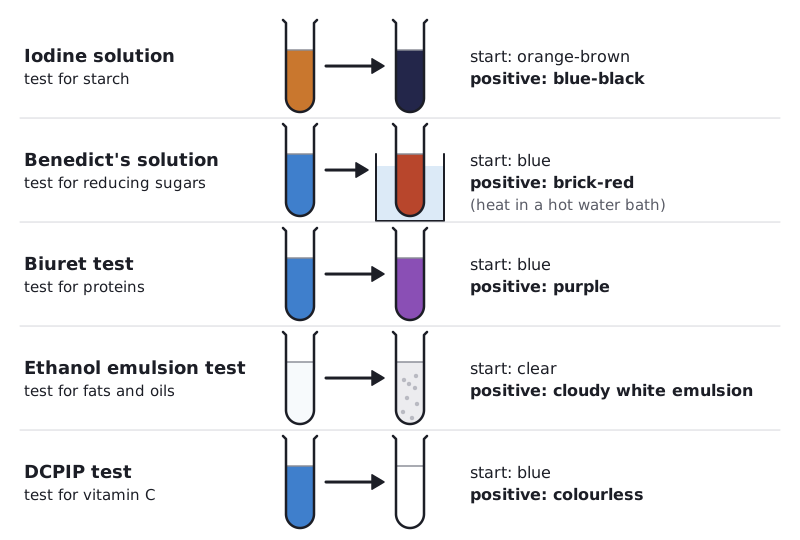
Food tests are one of the listed contexts. Learn the reagent, the method and the start and end colours for all five, and remember that DCPIP loses its blue colour when vitamin C is present.
 (opens full size in a new tab)
How to get full marks on biological drawings
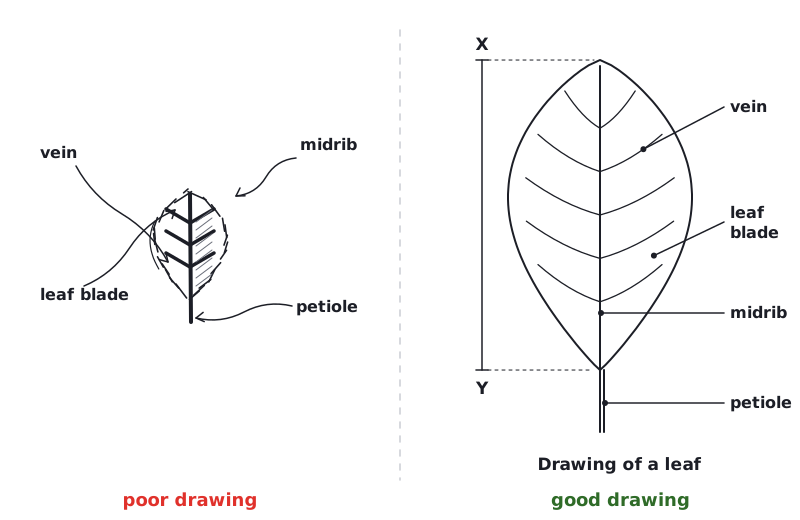
Drawing questions usually show a photograph of a specimen, such as a flower, seed or leaf, and ask you to draw it, label it and then calculate a magnification. Here is what a good drawing looks like, based on the syllabus conventions:
- Use a sharp pencil for fine lines that are "clear and unbroken".
- Use most of the available space and show all the features you can see.
- Use no shading and no colour.
- Draw label lines with a ruler, and make each one touch the feature it labels. Do not use arrowheads.
- Keep the proportions right. Draw only what you can see, not what a textbook diagram shows.
 (opens full size in a new tab)
Magnification of a drawing
A photograph shows a seed with a line X to Y across it. The actual length of the seed from X to Y is 12 mm. A student draws the seed and the same line on the drawing measures 84 mm. Calculate the magnification of the drawing.
- Measure both lengths in the same unit. Both are in mm.
- magnification = image size ÷ actual size
- = 84 mm ÷ 12 mm
- = 7
Answer: ×7
Giving a magnification with a unit, such as "7 mm". Magnification has no unit and is written with a × sign. If you measure your own drawing, measure carefully to the nearest mm and show the measurement in your working.
How to get full marks on tables and graphs
Results tables
- Head each column with the quantity and its unit, separated by a solidus: time / s, temperature / °C. Cambridge uses the solidus (/) in tables, graphs and charts.
- Do not write units in the body of the table, only in the heading.
- Record data to the precision of the instrument. If a stop-clock reads to 1 s, write 45, not 45.0.
Line graphs
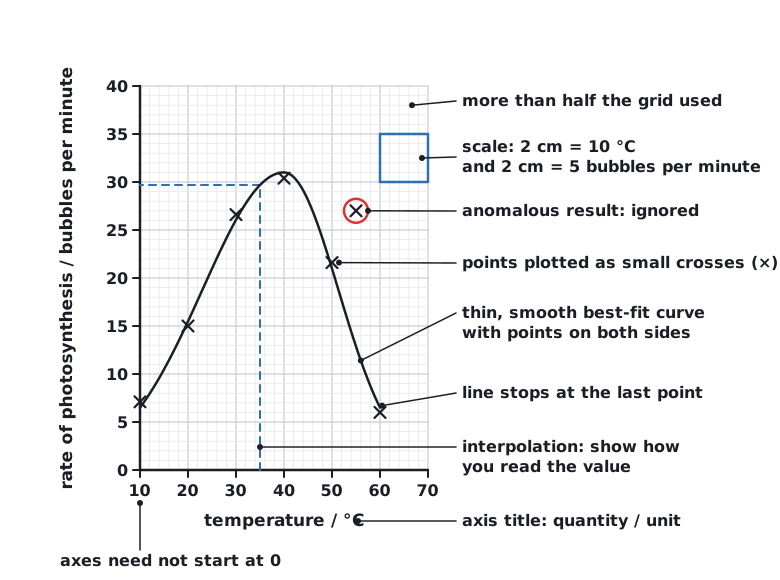
- Put the independent variable on the x-axis and the dependent variable on the y-axis, unless told otherwise.
- Label each axis with the quantity and unit, for example rate / bubbles per minute.
- Choose scales that use more than half the grid in both directions, with sensible ratios such as 2 cm for 1, 2 or 5 units. The axes do not have to start at 0.
- Plot points as small crosses (×) or encircled dots (⊙), accurate to half of the smallest square.
- Draw a single, thin, smooth best-fit line or curve. Ignore clearly anomalous points when drawing it.
 (opens full size in a new tab)
Choose the right chart for the data. The syllabus says bar charts are for categorical or discrete data, with bars of equal width that do not touch. Histograms are for continuous data, and their bars touch.
Worked example: osmosis and percentage change
Percentage change comes up often, because pieces of tissue rarely start at exactly the same mass. This example is based on our plant tissue osmosis sheet.
Percentage change in mass
A potato cylinder had a mass of 2.50 g. After 30 minutes in a concentrated sucrose solution its mass was 2.20 g. Calculate the percentage change in mass.
- change in mass = final mass − starting mass = 2.20 g − 2.50 g = −0.30 g
- percentage change = (change in mass ÷ starting mass) × 100
- = (−0.30 ÷ 2.50) × 100
- = −12
Answer: −12% (a loss of 12%)
The minus sign shows the tissue lost mass, because the solution was more concentrated than the cell contents and water left the cells by osmosis. A good conclusion states the pattern, quotes values from the data and links them to the biology.
Worked example: errors and improvements
Evaluation questions describe a method with weaknesses and ask you to find them. Suppose a student counts bubbles from pondweed with a lamp at different distances, doing one count at each distance.
| Source of error | Improvement |
|---|---|
| Only one count at each distance | Repeat each distance at least three times and calculate a mean, leaving out anomalous results |
| The lamp may warm the water, so temperature changes as well as light intensity | Put a beaker of water between the lamp and the plant as a heat shield, or use a water bath |
| Bubbles are different sizes, so counting them is not a fair measure of gas | Collect the gas in a gas syringe or measuring cylinder and measure its volume |
"Human error" and "be more accurate" score nothing. Name the exact problem and the exact fix, such as "use a 10 cm³ syringe instead of a beaker".
Common mistakes in Paper 6
- Units in the wrong place. Units go in the column heading as quantity / unit, not in each box of the table.
- Graph scales that are too small or that go up in awkward steps such as 3 or 7. Use more than half the grid and steps of 1, 2 or 5.
- Joining points dot to dot instead of drawing one smooth best-fit line.
- Bars touching on a bar chart of categories, or gaps between bars on a histogram.
- Shading or colouring a drawing, drawing it too small, or using freehand label lines with arrowheads.
- "It changes colour" without the start and end colours, for example blue to brick-red for Benedict's.
- Vague variables, such as "the amount" instead of "the volume of enzyme solution / cm³".
- Conclusions without data. Quote values from the table or graph to support what you say.
- Including an anomalous result in a mean or a best-fit line.
Paper 6 in Cambridge IGCSE Combined Science 0653
Cambridge IGCSE Combined Science (0653) has a Paper 6 too, with the same basic shape: 1 hour, 40 marks, 20% of the IGCSE, no experiments, and AO3 only. It is the alternative to the Paper 5 Practical Test, and both are taken by Core and Extended candidates. This is the same in the 0653 syllabus for 2025 to 2027 and the one for 2028 and 2029.
The big difference is that 0653 Paper 6 covers biology, chemistry and physics, so biology is only part of the paper. The biology contexts are the same as 0610's except that 0653 does not list tropic responses, continuous and discontinuous variation, or sampling methods. The 0653 skills list adds a few items shared across the sciences, such as identifying measurement, random and systematic error. The drawing, table and graph rules above apply in the same way. See our Cambridge IGCSE Combined Science course and its practicals page.
How to revise for Paper 6
- Learn the rules for drawings, tables and graphs first. They are worth marks in almost every paper and do not change.
- Work through the practical skills notes and the experimental skills flashcards.
- For each practical sheet, say out loud the independent variable, the dependent variable, two controlled variables and the control.
- Try the experimental skills exam questions, then more from the Cambridge IGCSE exam questions or all exam questions.
- Check words like "anomalous", "control" and "replicate" in the Cambridge IGCSE Biology glossary.
- Do real Paper 6s under timed conditions. Our Cambridge IGCSE past papers page links to Cambridge's official papers and mark schemes.
- Tick off the experimental skills on the specification checklist.
If you are still choosing a board, our guide to Cambridge vs Edexcel IGCSE Biology compares how each one tests practical skills. If you want help with Paper 6, we offer 1-to-1 biology tutoring online and in Dubai.
Sources: Cambridge IGCSE Biology 0610 syllabus 2026 to 2028, Cambridge IGCSE Combined Science 0653 syllabus 2025 to 2027 and Cambridge IGCSE Combined Science 0653 syllabus 2028 and 2029.