
In short
To answer a 6-mark GCSE Biology question, find the command word, plan four to six linked points, and write them in a logical order where each point is explained, not just listed. These questions are marked by levels: examiners judge the whole answer, so a clear, connected argument beats a long list of facts.
To answer a 6-mark question in GCSE Biology, read the command word, plan four to six linked points, and write them in a logical order, explaining each one. These questions are not marked one point per mark. They are marked by levels: the examiner reads your whole answer and decides how complete, accurate and well connected it is. A short answer with a clear chain of reasoning will usually score more than a long list of disconnected facts.
This works for AQA GCSE Biology and Combined Science (extended response questions) and Edexcel GCSE Biology and Combined Science (extended open-response questions). Below: how they are marked, the command words, a step-by-step method, three model answers and the most costly mistakes.
What is a 6-mark question in GCSE Biology?
A 6-mark question asks for a longer answer, usually a paragraph or two, on one idea: a process, an adaptation, a method or a judgement. The AQA GCSE Biology specification says extended responses should be coherent, relevant, substantiated and logically structured, and the Edexcel GCSE Biology specification includes extended open-response questions in every paper.
They can come up on any topic, but are most common on processes, adaptations, required or core practicals, and "evaluate" questions about treatments or human impacts. If the question gives information or data, use it.
How 6-mark questions are marked: levels of response
Instead of a list of marking points, a 6-mark question has a levels-based mark scheme. There are usually three levels, plus zero for nothing worthy of credit:
| Level | Marks | What the answer usually looks like |
|---|---|---|
| Level 3 | 5–6 | Detailed and accurate. Points are linked into a clear, logical sequence or argument, and the answer covers what the question asks. On evaluate questions this usually includes a supported conclusion. |
| Level 2 | 3–4 | Several relevant points, some of them linked or explained, but with gaps, a weaker structure or a missing part of the question. |
| Level 1 | 1–2 | A few simple, relevant statements with little or no linking or explanation. |
| 0 | 0 | Nothing relevant or correct. |
The examiner first decides which level your answer fits as a whole, then whether it sits at the top or bottom of that level. The mark scheme also gives indicative content: the relevant biology a good answer might include. It is guidance, not a checklist. You do not need every point for the top level, and ten unlinked facts can still be stuck in Level 1 or 2.
Think "quality of argument", not "number of facts". Every point you make should lead to the next one or be followed by so, because or which means.
Command words in 6-mark biology questions
The command word tells you what kind of answer is wanted. An excellent description when the question says "explain" is one of the quickest ways to lose a level. Edexcel defines its command words in an appendix of the specification, and AQA publishes its own list. The ones you will see most are:
| Command word | What it wants | How to structure your answer |
|---|---|---|
| Describe | An account of what happens or what something is like. No reasons needed. | Steps or features in a logical order, with specific detail (names, numbers, colours). |
| Explain | Reasons: why or how something happens. | Point + reason for every point: "feature… so… which means…". |
| Compare | Similarities and/or differences between two or more things. | Talk about both things in every sentence: "X has…, whereas Y has…". |
| Evaluate | A judgement, using strengths, weaknesses and evidence. | Advantages, disadvantages, then a conclusion that says which is better and why. |
| Plan / describe a method (Edexcel also uses "devise") | A method someone else could follow to get valid results. | Equipment, numbered steps, what you change, measure and keep the same, repeats, and how you process the results. |
If a word in the question is unfamiliar, check it in our AQA GCSE Biology glossary or Edexcel GCSE Biology glossary. Using the exact key term, such as "partially permeable membrane" or "concentration gradient", is often what lifts an answer into the next level.
How to answer a 6-mark question: step-by-step method
- Underline the command word and the topic. Are you describing, explaining, comparing, evaluating or planning?
- Use any information given. If there is a table, graph or passage, the mark scheme expects you to use it. Quote numbers.
- Plan in the margin (30 seconds). Jot down four to six key points so you do not repeat yourself or run dry.
- Put the points in a logical order. A process from start to finish, a method as numbered steps, an evaluation as advantages, disadvantages, conclusion.
- Develop every point. "Thin walls, so a short diffusion distance, so faster diffusion."
- Answer every part. "Describe and explain" or "advantages and disadvantages" means both.
- Finish properly. For evaluate questions, write a justified conclusion. Otherwise, reread the question and check you answered it.
Worked example 1: explain how alveoli are adapted (explain)
This is a classic "explain an adaptation" question. It comes from AQA's content on exchange surfaces and the lungs, and from Edexcel spec point 8.3 ("Explain how alveoli are adapted for gas exchange by diffusion between air in the lungs and blood in capillaries").
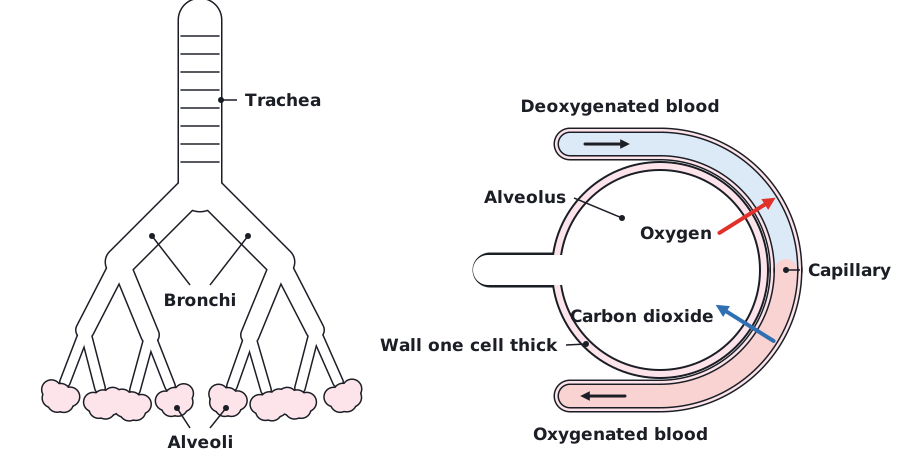 (opens full size in a new tab)
Explain the adaptations of alveoli (6 marks)
Explain how the structure of the alveoli is adapted for efficient gas exchange. [6 marks]
- Command word: explain, so every feature needs a reason linked to diffusion.
- Plan: surface area, diffusion distance, blood supply, ventilation, each linked to rate of diffusion or the concentration gradient.
Answer: The lungs contain millions of alveoli, which gives a very large surface area, so a lot of oxygen can diffuse into the blood at the same time. The walls of the alveoli are only one cell thick and the capillary walls are also very thin, so there is a short diffusion distance between the air and the blood, which makes diffusion faster. Each alveolus is surrounded by a dense network of capillaries. The blood flowing through them constantly carries oxygen away and brings carbon dioxide, which keeps a steep concentration gradient: oxygen concentration stays higher in the alveoli than in the blood, and carbon dioxide concentration stays higher in the blood. Breathing (ventilation) also replaces the air in the alveoli, bringing in fresh oxygen and removing carbon dioxide, which keeps the gradient steep. All of these features increase the rate of diffusion of oxygen into the blood and carbon dioxide out.
Why it reaches the top level: every feature is linked to diffusion, the gradients go the right way for both gases, and the last sentence ties it back to the question. Revise it in our notes on AQA lungs and the circulatory system, AQA exchange surfaces and Edexcel transport and exchange surfaces (also in Edexcel Combined).
Worked example 2: describe a method for the osmosis practical (plan)
Method questions on required or core practicals are among the most common 6-mark questions. Osmosis in potato tissue is a required practical for AQA and a core practical for Edexcel, in both the Biology and Combined Science courses.
Describe a method for the osmosis practical (6 marks)
Describe a method to investigate the effect of sugar solution concentration on the mass of potato tissue. [6 marks]
- Command word: describe a method, so give steps in order that someone else could follow.
- Include the independent variable (concentration), dependent variable (change in mass), named controls, repeats and the calculation.
Answer: Make up a range of sugar solutions, for example 0.0, 0.2, 0.4, 0.6, 0.8 and 1.0 mol/dm³, by diluting a 1.0 mol/dm³ solution with distilled water. Put the same volume, for example 20 cm³, of each solution into a labelled boiling tube. Use a cork borer to cut potato cylinders of the same diameter, and cut them all to the same length, for example 3 cm, with a scalpel on a tile. Blot each cylinder dry with a paper towel and measure its starting mass on a balance. Place one cylinder in each tube and leave them all for the same time, for example 24 hours, at the same temperature. Remove each cylinder, blot it dry in the same way and measure its final mass. Calculate the percentage change in mass for each one using (final mass − starting mass) ÷ starting mass × 100. Repeat the investigation three times at each concentration and calculate a mean. Plot percentage change in mass against concentration; the concentration where the line crosses zero is an estimate of the concentration inside the potato cells.
A method answer reaches the top level when someone could actually follow it: give a range of values, name the equipment, state what you keep the same, and say how you would process the results. "Keep it a fair test" earns nothing on its own.
Full method, results table and exam questions are on our practical sheets: AQA osmosis in potato cylinders (Combined version) and Edexcel osmosis in potatoes (Combined version). The theory is in our notes on AQA transport in cells and Edexcel transport in cells. For all the other method questions, see our guide to the AQA required practicals.
Worked example 3: evaluate a treatment for CVD (evaluate)
AQA asks you to evaluate the advantages and disadvantages of treating cardiovascular disease by drugs, mechanical devices or transplant (spec 4.2.2.4). Edexcel asks you to evaluate treatments including life-long medication, surgical procedures and lifestyle changes (spec point 5.25). The skill is the same: weigh up both sides, then judge.
Evaluate stents and statins (6 marks)
A patient has coronary heart disease. Evaluate the use of stents and statins to treat coronary heart disease. [6 marks]
- Command word: evaluate, so give advantages and disadvantages of both, then a conclusion.
- Keep the disease background to one sentence. The marks are for the evaluation.
Answer: In coronary heart disease, fatty material builds up inside the coronary arteries, narrowing them and reducing the supply of oxygen to the heart muscle. A stent is a mesh tube put into the narrowed artery to hold it open. An advantage is that it restores blood flow quickly, so it can relieve symptoms or treat a heart attack straight away, and the patient usually recovers faster than after major surgery. A disadvantage is that inserting it is an operation, with risks such as infection or a blood clot forming, and the artery can narrow again. Statins are drugs that lower blood cholesterol, which slows down the rate at which fatty material is deposited in the arteries. Their advantages are that no surgery is needed and they help prevent the disease getting worse. Their disadvantages are that they must be taken every day for life, they can have side effects, and they do not remove the fatty material that is already there, so they work slowly. Overall, a stent is better for an artery that is already badly narrowed because it works immediately, but statins are better for long-term prevention, so the best treatment is often a stent followed by statins.
Leaving out the conclusion. On evaluate questions the top level usually needs a judgement, and it must be justified with a reason, not just "stents are better".
Revise CVD treatments in our notes on AQA coronary heart disease (also in AQA Combined) and Edexcel non-communicable diseases (also in Edexcel Combined).
A note on compare questions
Compare questions trip students up when they write one paragraph about each thing and leave the examiner to find the differences. Use comparative sentences instead: "Mitosis produces two daughter cells, whereas meiosis produces four, which are genetically different." Practise with AQA cell division and AQA reproduction, or Edexcel mitosis and Edexcel meiosis.
Common mistakes in 6-mark biology questions
- Describing when asked to explain. "Alveoli have thin walls" is a description. "Thin walls give a short diffusion distance, so diffusion is faster" is an explanation.
- Listing instead of linking. Six facts in bullet points rarely reach Level 3. Join them with because, so and which means.
- Ignoring the data or context. If the question gives a graph, a table or a named patient, use it. Answers that ignore it are often capped.
- Vague words. "Fair test", "it gets bigger", "the enzyme is killed". Use precise terms: "same volume of solution", "concentration gradient", "denatured".
- Only doing half the question. "Advantages and disadvantages" means both. "Describe and explain" means both.
- No conclusion on evaluate questions. Finish with a judgement and a reason.
How to practise 6-mark questions
- Pick one topic from our AQA GCSE Biology, AQA Combined Science, Edexcel GCSE Biology or Edexcel Combined Science course and read the AQA revision notes or Edexcel revision notes.
- Answer 6-mark exam questions in about 6 to 7 minutes each: try the AQA organisation questions, or all AQA and Edexcel questions.
- Mark it: decide which level it fits, then check which indicative points you missed.
- Rewrite it once with better links and structure. This is where most of the improvement happens.
- Learn key terms with flashcards, and practise method questions from the AQA practicals and Edexcel core practicals.
If you want help turning your 6-mark answers into Level 3 answers, we offer 1-to-1 tutoring online and in Dubai.