How to investigate the effect of different salt concentrations on the mass of potato tissue, as required for GCSE Biology.
Aim and equipment
To find out how the concentration of a salt solution affects the mass of potato cylinders, and estimate the concentration inside the potato cells.
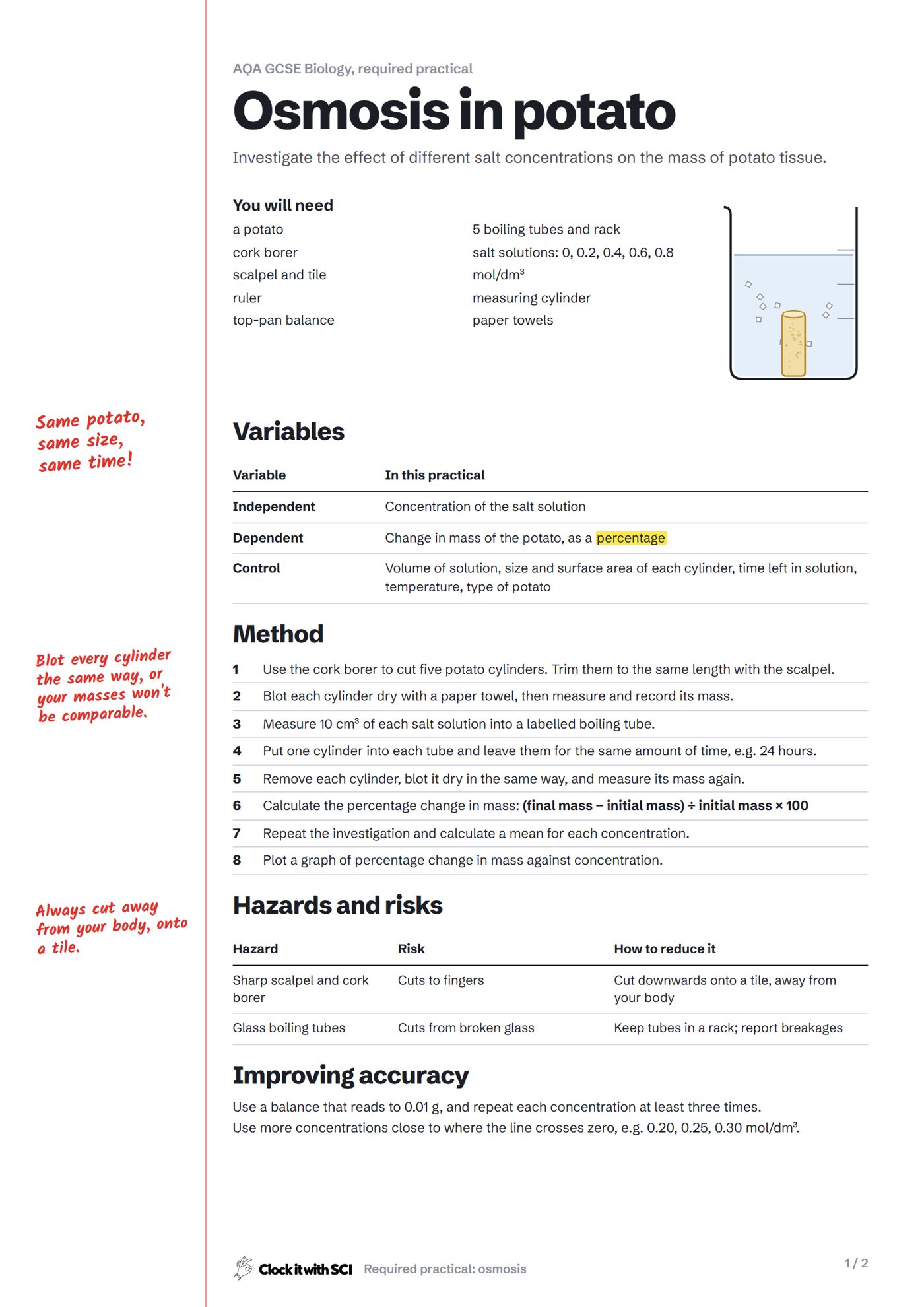
- A potato
- Cork borer
- Scalpel and tile
- Ruler
- Top-pan balance
- 5 boiling tubes and a rack
- Salt solutions: 0, 0.2, 0.4, 0.6, 0.8 mol/dm³
- Measuring cylinder
- Paper towels
Variables
| Variable | In this practical |
|---|---|
| Independent | Concentration of the salt solution |
| Dependent | Change in mass of the potato, as a percentage |
| Control | Volume of solution, size and surface area of each cylinder, time in solution, temperature, type of potato |
Method
- Use the cork borer to cut five potato cylinders. Trim them to the same length with the scalpel.
- Blot each cylinder dry with a paper towel, then measure and record its mass.
- Measure 10 cm³ of each salt solution into a labelled boiling tube.
- Put one cylinder into each tube and leave them for the same amount of time, for example 24 hours.
- Remove each cylinder, blot it dry in the same way, and measure its mass again.
- Calculate the percentage change in mass: (final mass − initial mass) ÷ initial mass × 100.
- Repeat the investigation and calculate a mean for each concentration.
- Plot a graph of percentage change in mass against concentration.
Hazards and risks
| Hazard | Risk | How to reduce it |
|---|---|---|
| Sharp scalpel and cork borer | Cuts to fingers | Cut downwards onto a tile, away from your body |
| Glass boiling tubes | Cuts from broken glass | Keep tubes in a rack and report breakages |
Results and analysis
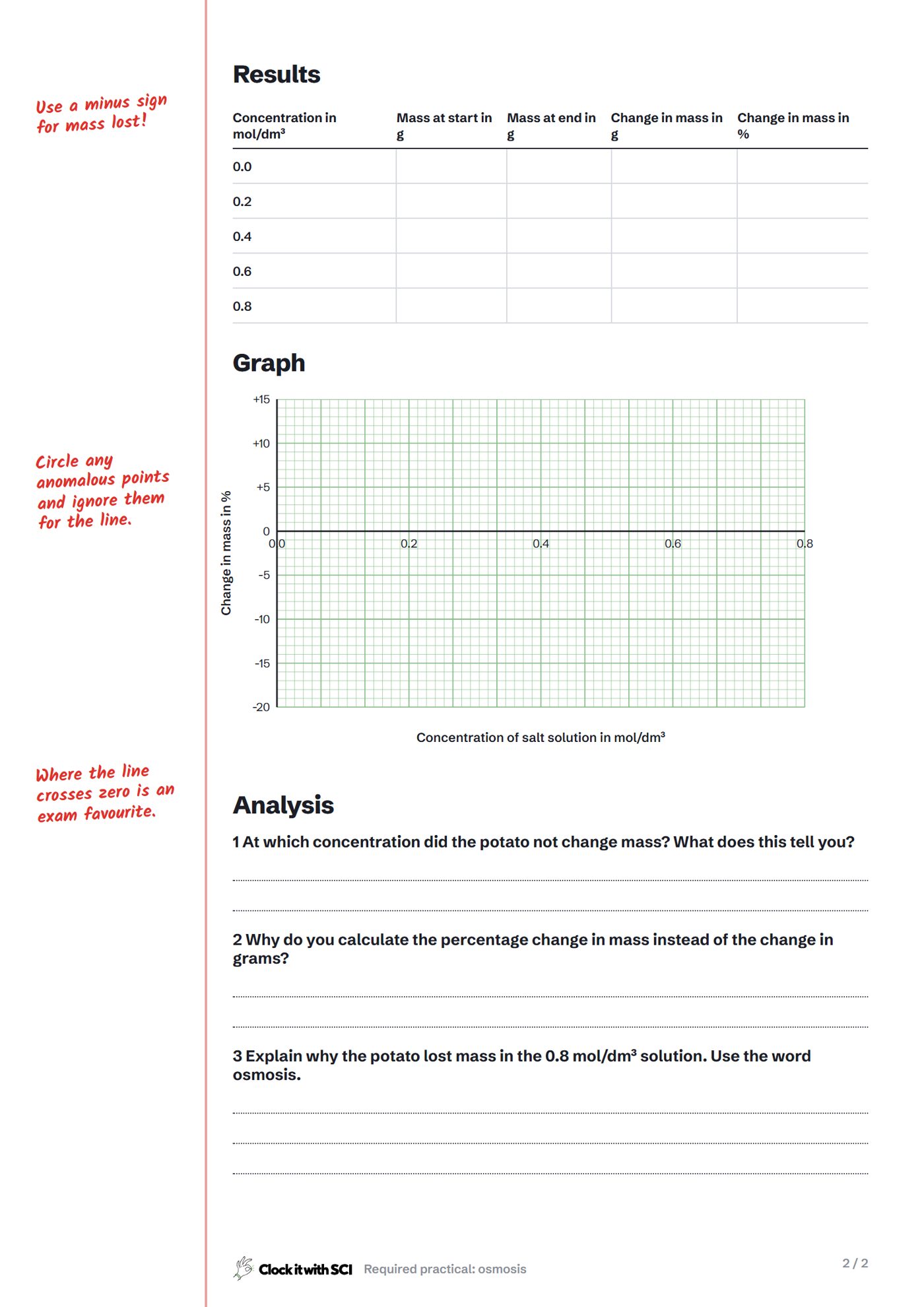
In pure water the potato gains mass, because water moves into the cells by osmosis. In strong salt solutions it loses mass, because water moves out of the cells. Where the line of best fit crosses 0 %, there is no net movement of water: the solution has the same concentration as the inside of the potato cells.
Improving accuracy
- Use a balance that reads to 0.01 g, and repeat each concentration at least three times.
- Use more concentrations close to where the line crosses zero, for example 0.20, 0.25 and 0.30 mol/dm³.
Quick check
Why do you calculate the percentage change in mass instead of the change in grams?
Show answer
The cylinders had different starting masses, so percentage change lets you compare them fairly.
Explain why the potato lost mass in the 0.8 mol/dm³ solution.
Show answer
The solution was more concentrated than the potato cells, so water left the cells by osmosis.