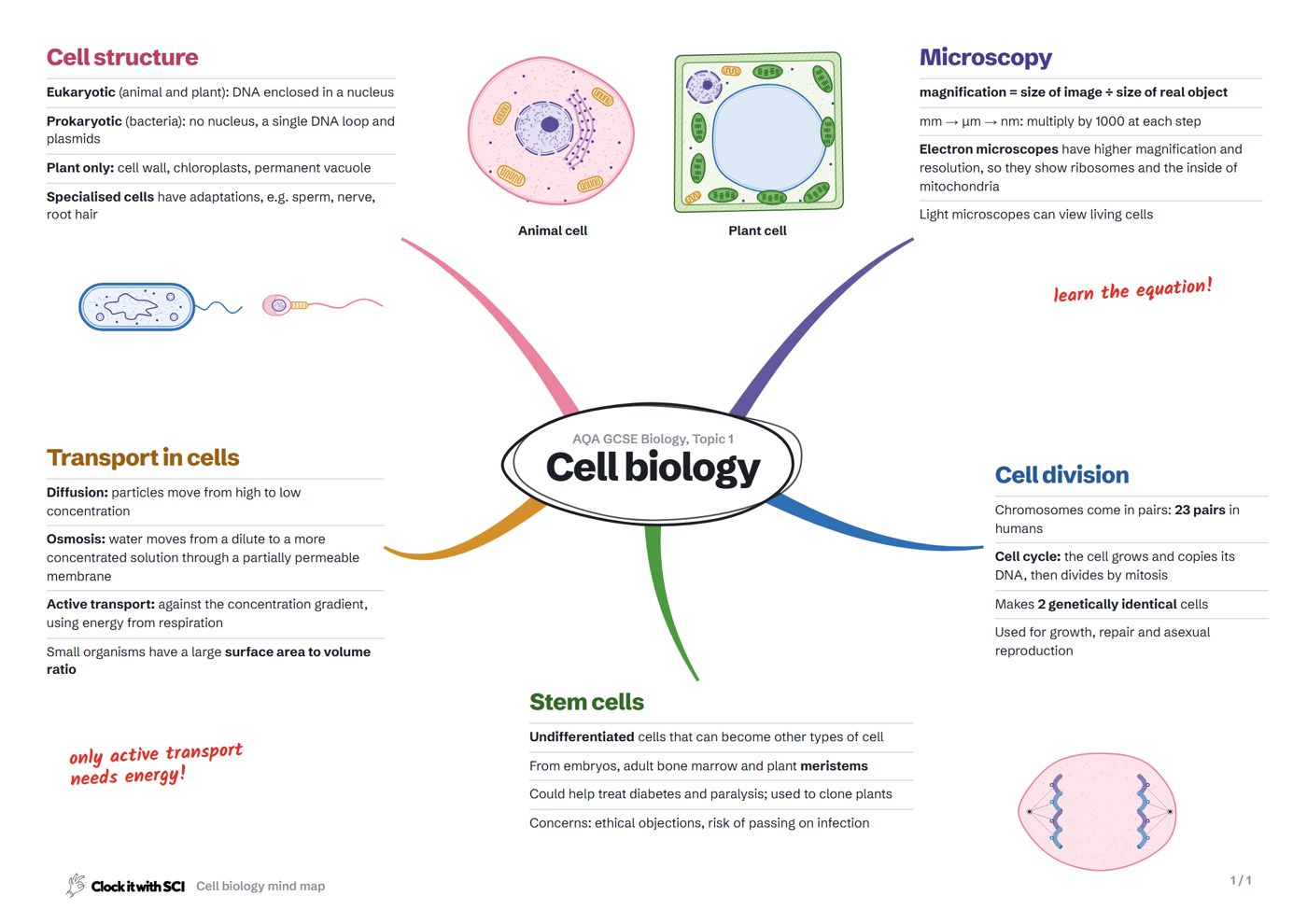
The whole cell biology topic on one page. Here it is as an outline; download the PDF for the full-colour landscape mind map.
Cell structure
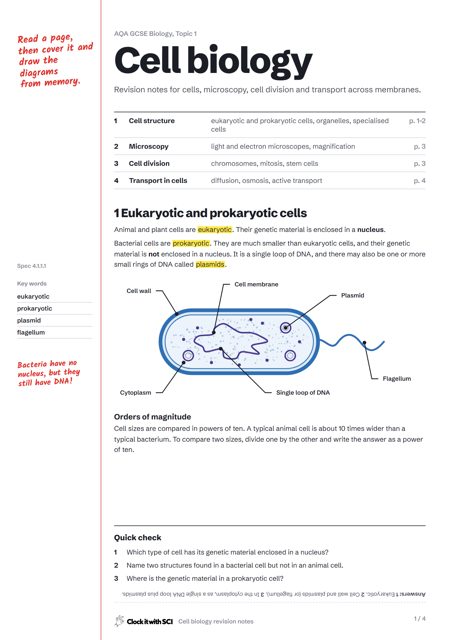
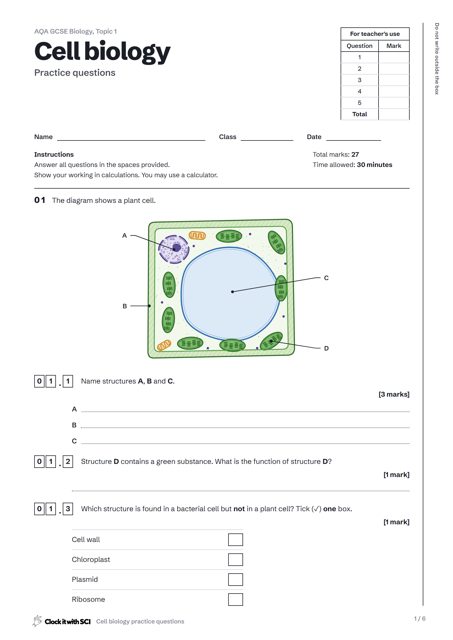
- Eukaryotic (animal and plant): DNA enclosed in a nucleus.
- Prokaryotic (bacteria): no nucleus, a single DNA loop and plasmids.
- Plant only: cell wall, chloroplasts, permanent vacuole.
- Specialised cells have adaptations, for example sperm, nerve and root hair cells.
Microscopy
- magnification = size of image ÷ size of real object
- mm → µm → nm: multiply by 1000 at each step.
- Electron microscopes have higher magnification and resolution, so they show ribosomes and the inside of mitochondria.
- Light microscopes can view living cells.
Cell division
- Chromosomes come in pairs: 23 pairs in humans.
- Cell cycle: the cell grows and copies its DNA, then divides by mitosis.
- Mitosis makes two genetically identical cells.
- Used for growth, repair and asexual reproduction.
Stem cells
- Undifferentiated cells that can become other types of cell.
- From embryos, adult bone marrow and plant meristems.
- Could help treat diabetes and paralysis; meristems are used to clone plants.
- Concerns: ethical objections and the risk of passing on infection.
Transport in cells
- Diffusion: particles move from high to low concentration.
- Osmosis: water moves from a dilute to a more concentrated solution through a partially permeable membrane.
- Active transport: against the concentration gradient, using energy from respiration.
- Small organisms have a large surface area to volume ratio.