These notes cover the whole of AQA GCSE Biology Topic 1: cell structure, microscopy, cell division and how substances move in and out of cells. Words in highlighter are the ones examiners look for in mark schemes.
Eukaryotic and prokaryotic cellsSpec 4.1.1.1
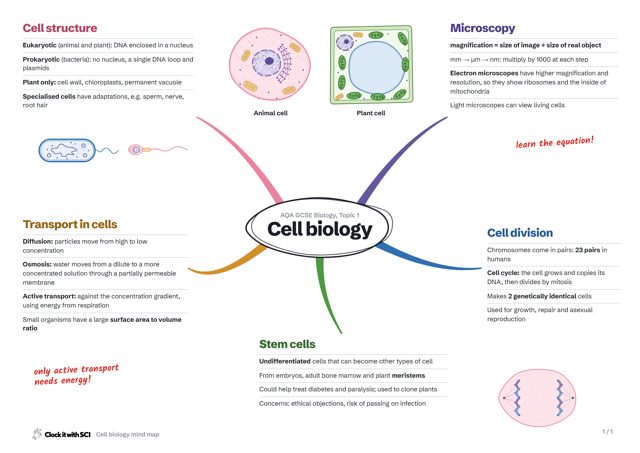
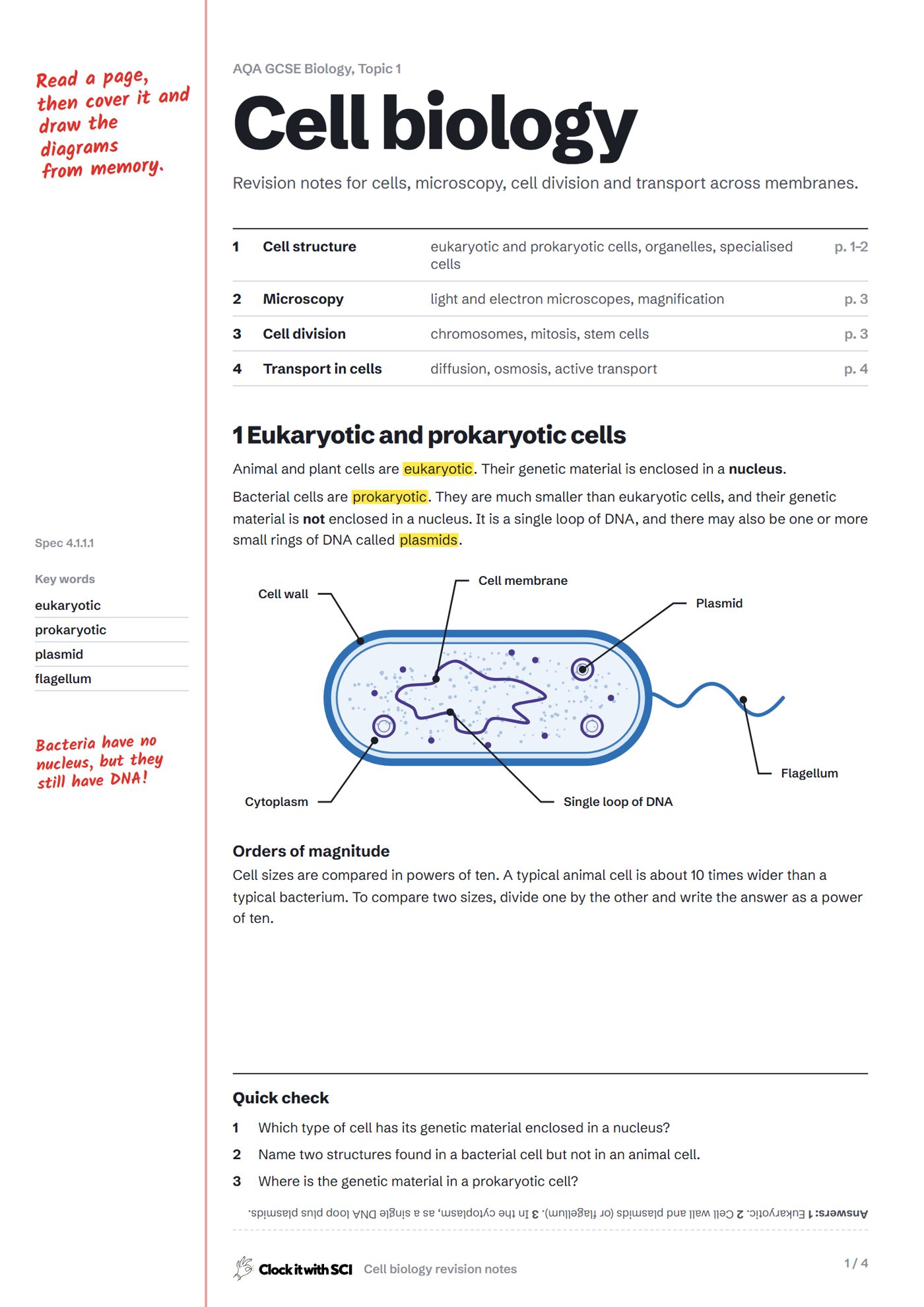
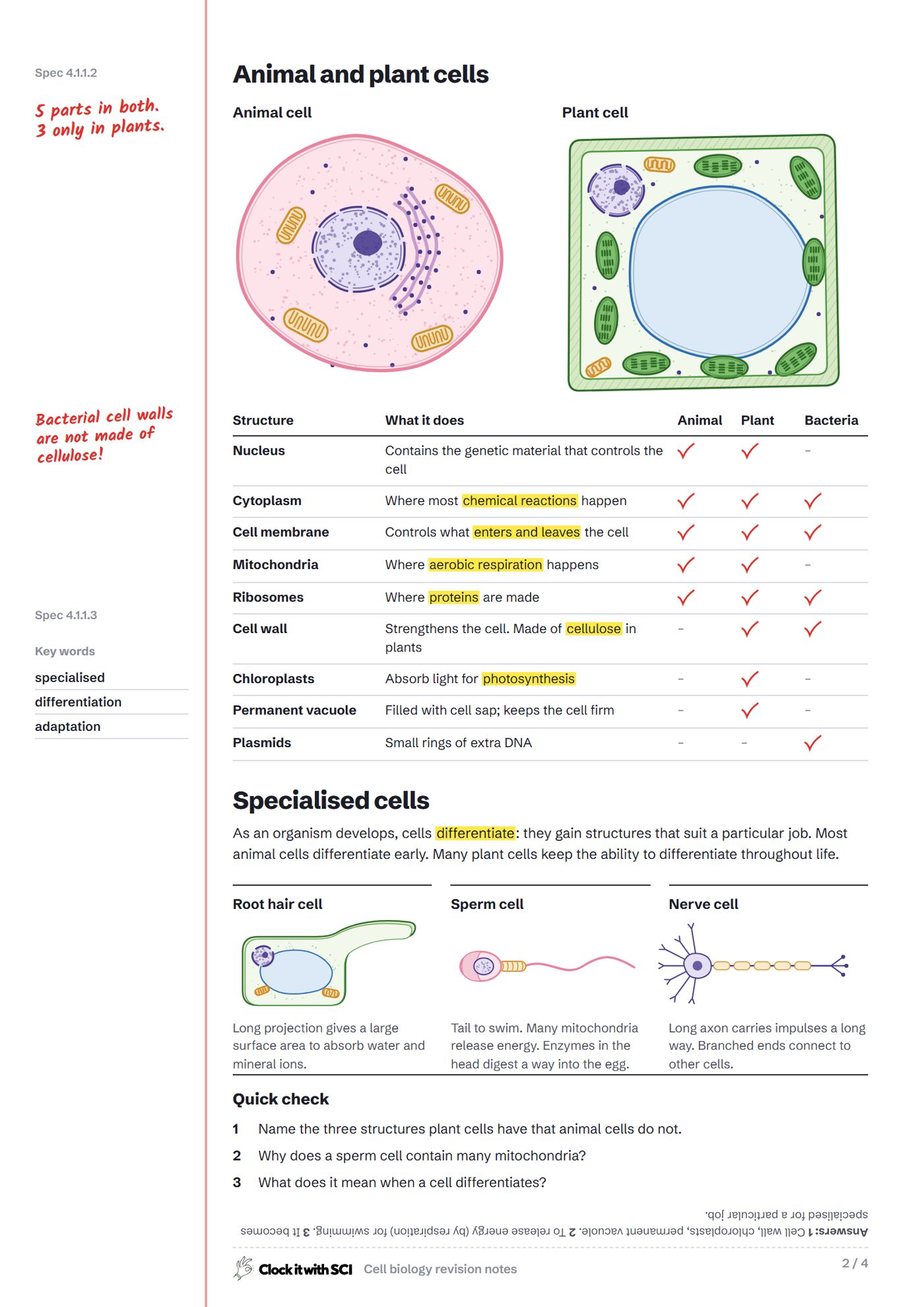
Animal and plant cells are eukaryotic. Their genetic material is enclosed in a nucleus.
Bacterial cells are prokaryotic. They are much smaller than eukaryotic cells, and their genetic material is not enclosed in a nucleus. It is a single loop of DNA in the cytoplasm, and there may also be one or more small rings of DNA called plasmids.
Orders of magnitude
Cell sizes are compared in powers of ten. A typical animal cell is about 10 times wider than a typical bacterium. To compare two sizes, divide one by the other and write the answer as a power of ten.
Animal and plant cellsSpec 4.1.1.2
| Structure | What it does | Animal | Plant | Bacteria |
|---|---|---|---|---|
| Nucleus | Contains the genetic material that controls the cell | ✓ | ✓ | – |
| Cytoplasm | Where most chemical reactions happen | ✓ | ✓ | ✓ |
| Cell membrane | Controls what enters and leaves the cell | ✓ | ✓ | ✓ |
| Mitochondria | Where aerobic respiration happens | ✓ | ✓ | – |
| Ribosomes | Where proteins are made | ✓ | ✓ | ✓ |
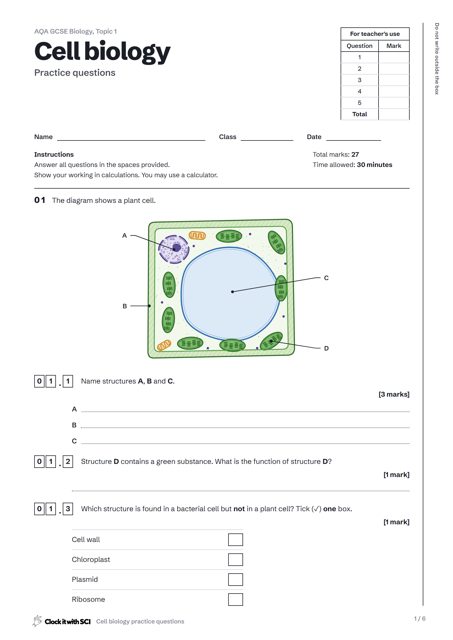
| Cell wall | Strengthens the cell. Made of cellulose in plants | – | ✓ | ✓ |
| Chloroplasts | Absorb light for photosynthesis | – | ✓ | – |
| Permanent vacuole | Filled with cell sap; keeps the cell firm | – | ✓ | – |
| Plasmids | Small rings of extra DNA | – | – | ✓ |
Specialised cellsSpec 4.1.1.3
As an organism develops, cells differentiate: they gain structures that suit a particular job. Most animal cells differentiate early in life. Many plant cells keep the ability to differentiate throughout their life.
- Root hair cell: a long projection gives a large surface area to absorb water and mineral ions.
- Sperm cell: a tail to swim, many mitochondria to release energy, and enzymes in the head to digest a way into the egg.
- Nerve cell: a long axon carries impulses a long way, and branched ends connect to other cells.
Quick check
Name the three structures plant cells have that animal cells do not.
Show answer
Cell wall, chloroplasts and a permanent vacuole.
Why does a sperm cell contain many mitochondria?
Show answer
To release energy by respiration for swimming.
What does it mean when a cell differentiates?
Show answer
It becomes specialised for a particular job.
MicroscopySpec 4.1.1.5
| Light microscope | Electron microscope | |
|---|---|---|
| Magnification | Up to about ×2000 | Up to about ×2 000 000 |
| Resolution | About 200 nm | About 0.2 nm, so it shows much more detail |
| Specimens | Can be living | Must be dead (viewed in a vacuum) |
| What you can see | Cells, nucleus, chloroplasts | Ribosomes, and the inside of mitochondria and chloroplasts |
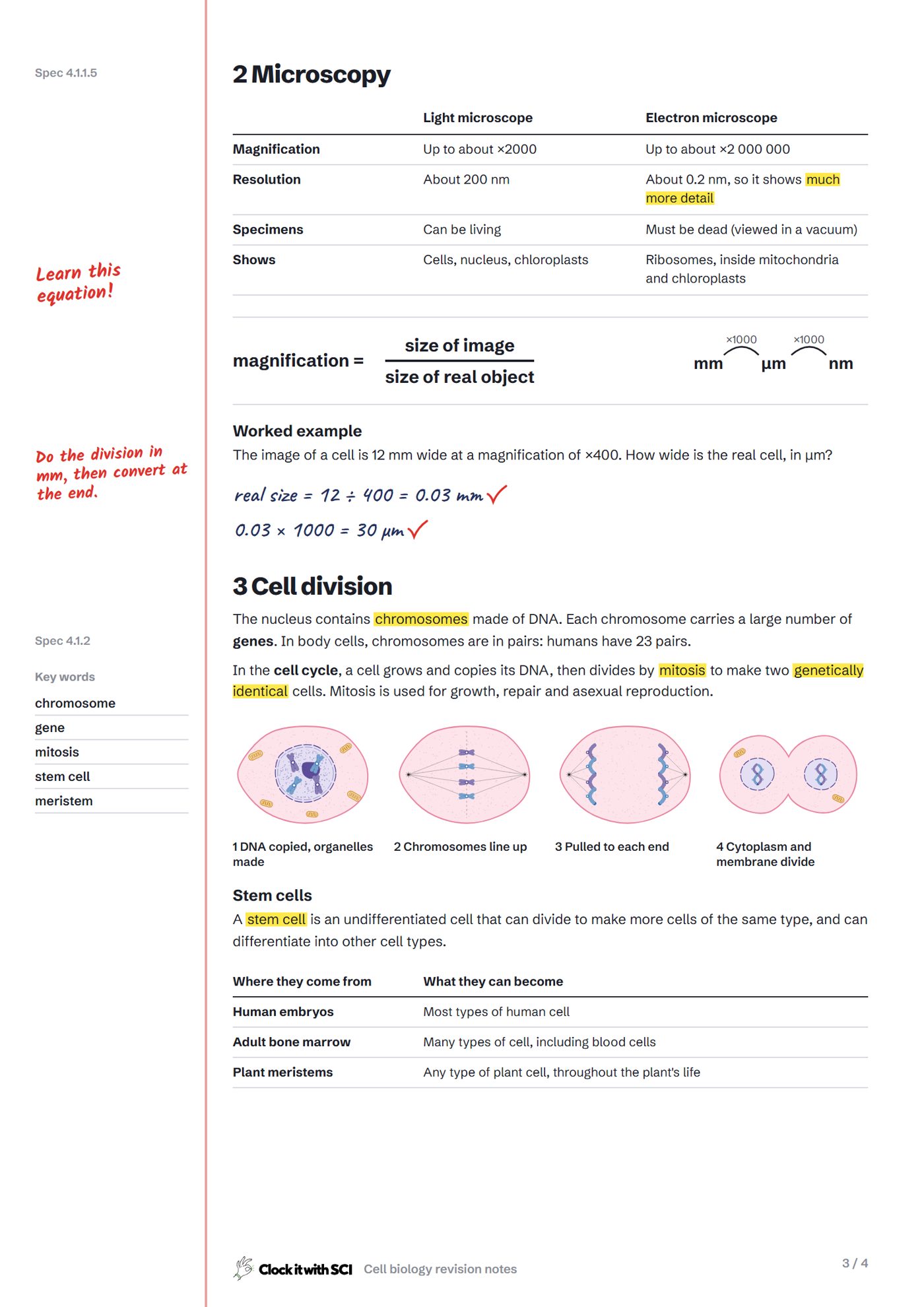
To convert units: 1 mm = 1000 µm, and 1 µm = 1000 nm. Multiply by 1000 to go from mm to µm, or from µm to nm.
Worked example
The image of a cell is 12 mm wide at a magnification of ×400. How wide is the real cell in µm?
- real size = image size ÷ magnification = 12 ÷ 400 = 0.03 mm
- 0.03 mm × 1000 = 30 µm
Cell divisionSpec 4.1.2
The nucleus contains chromosomes made of DNA. Each chromosome carries a large number of genes. In body cells, chromosomes are in pairs: humans have 23 pairs.
In the cell cycle, a cell grows and copies its DNA, then divides by mitosis to make two genetically identical cells. Mitosis is used for growth, repair and asexual reproduction.
Stem cellsSpec 4.1.2.3
A stem cell is an undifferentiated cell that can divide to make more cells of the same type, and can differentiate into other types of cell.
| Where they come from | What they can become |
|---|---|
| Human embryos | Most types of human cell |
| Adult bone marrow | Many types of cell, including blood cells |
| Plant meristems | Any type of plant cell, throughout the plant's life |
Stem cells could help treat conditions such as diabetes and paralysis, and meristems are used to clone plants quickly. Some people object to using embryos for ethical or religious reasons, and there is a risk of passing on viral infections.
Transport in cellsSpec 4.1.3
Diffusion
Diffusion is the spreading out of particles, resulting in a net movement from an area of higher concentration to an area of lower concentration. Oxygen and carbon dioxide move in and out of cells this way. The rate of diffusion increases with a bigger difference in concentration, a higher temperature and a larger membrane surface area.
| Cube side | Surface area | Volume | SA : V |
|---|---|---|---|
| 1 cm | 6 cm² | 1 cm³ | 6 : 1 |
| 2 cm | 24 cm² | 8 cm³ | 3 : 1 |
| 3 cm | 54 cm² | 27 cm³ | 2 : 1 |
Small organisms have a large surface area to volume ratio, so diffusion across their surface is enough. Larger organisms need exchange surfaces like the lungs and the small intestine.
Osmosis
Osmosis is the diffusion of water from a dilute solution to a more concentrated solution through a partially permeable membrane.
Active transport
Active transport moves substances from a more dilute solution to a more concentrated solution, against a concentration gradient. It needs energy from respiration. Root hair cells use it to absorb mineral ions from dilute soil water, and the small intestine uses it to absorb sugar.
| What moves | Direction | Energy needed? | |
|---|---|---|---|
| Diffusion | Particles of a gas or a solute | High to low concentration | No |
| Osmosis | Water only | Dilute to concentrated solution | No |
| Active transport | For example mineral ions and sugar | Low to high concentration | Yes, from respiration |
Quick check
Give two factors that increase the rate of diffusion.
Show answer
Any two of: a bigger concentration difference, a higher temperature, a larger surface area.
Which has the larger surface area to volume ratio: a 1 cm cube or a 3 cm cube?
Show answer
The 1 cm cube (6 : 1).
What does active transport need that osmosis does not?
Show answer
Energy from respiration.