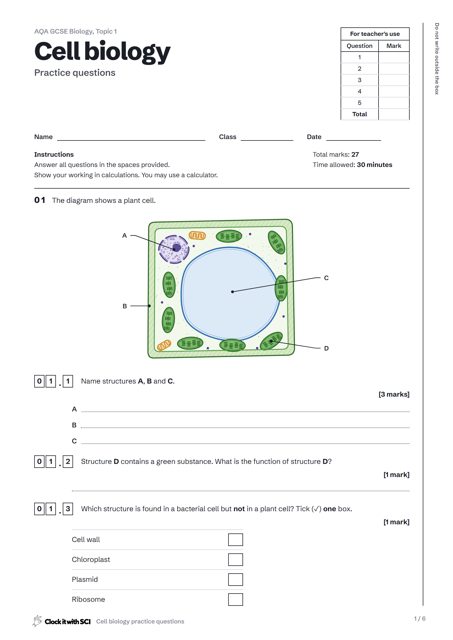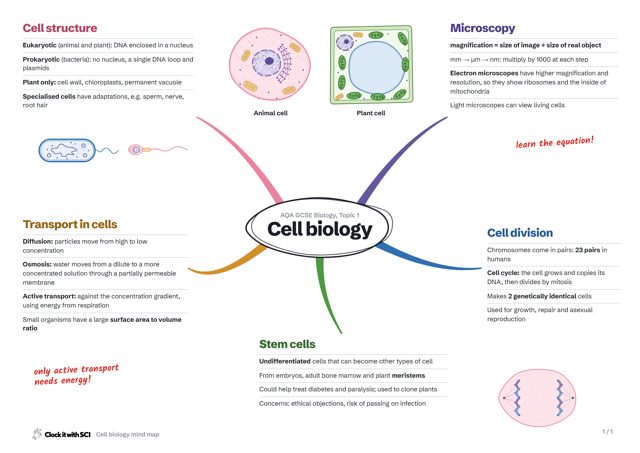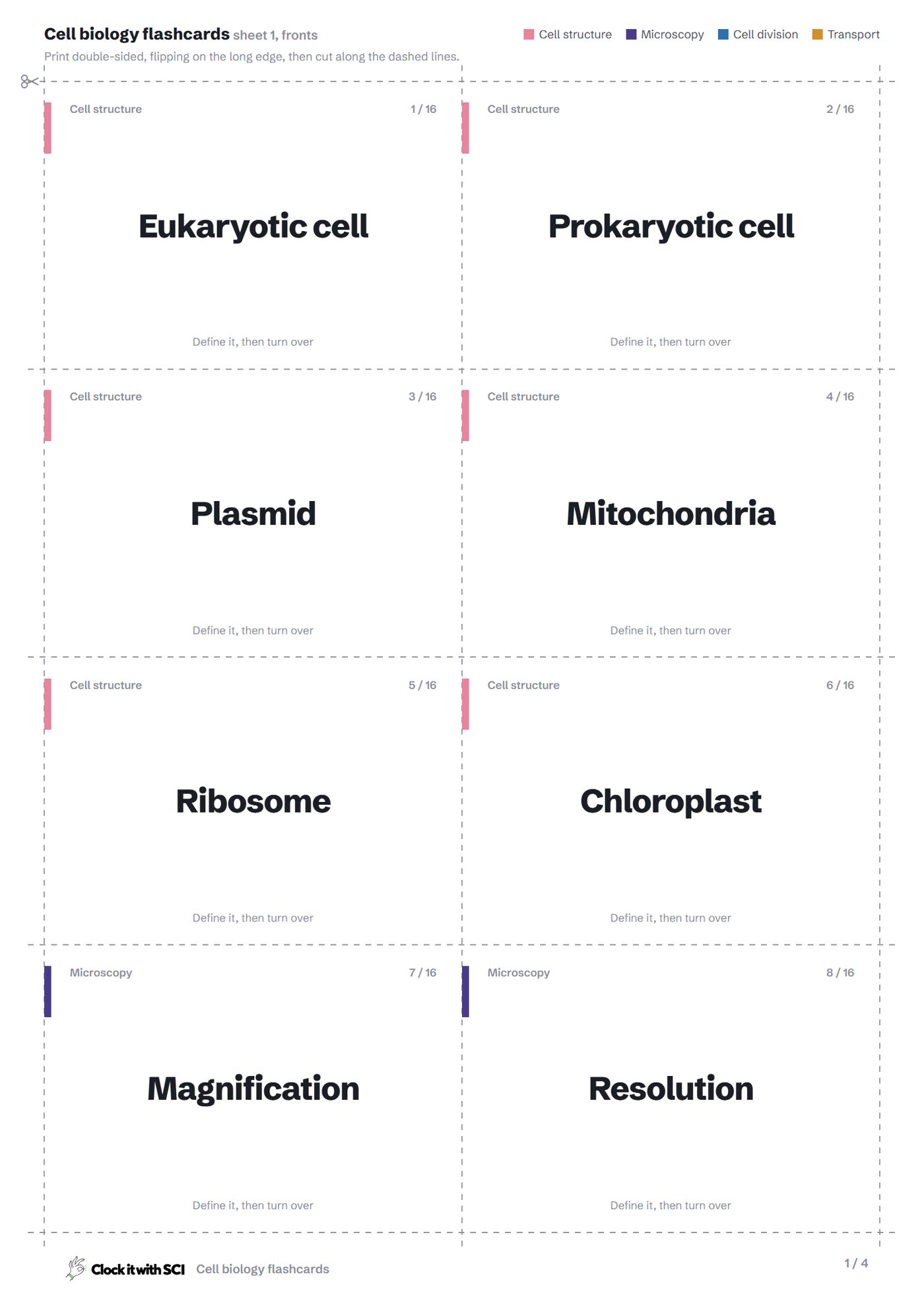
The 16 key terms for GCSE cell biology. Cover the definitions and test yourself, or download the PDF to print double-sided and cut out as flashcards.
Key terms
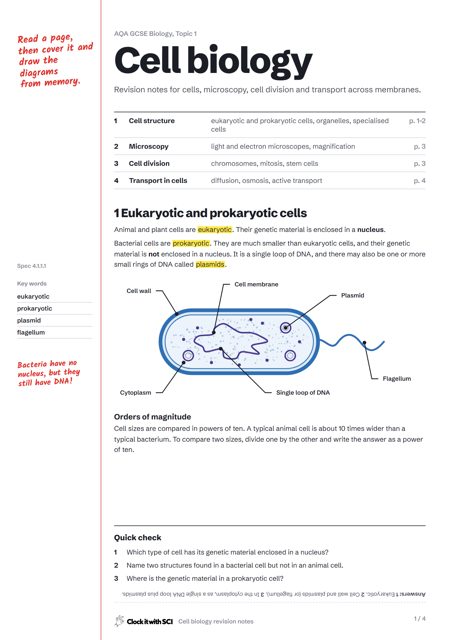
- Eukaryotic cell
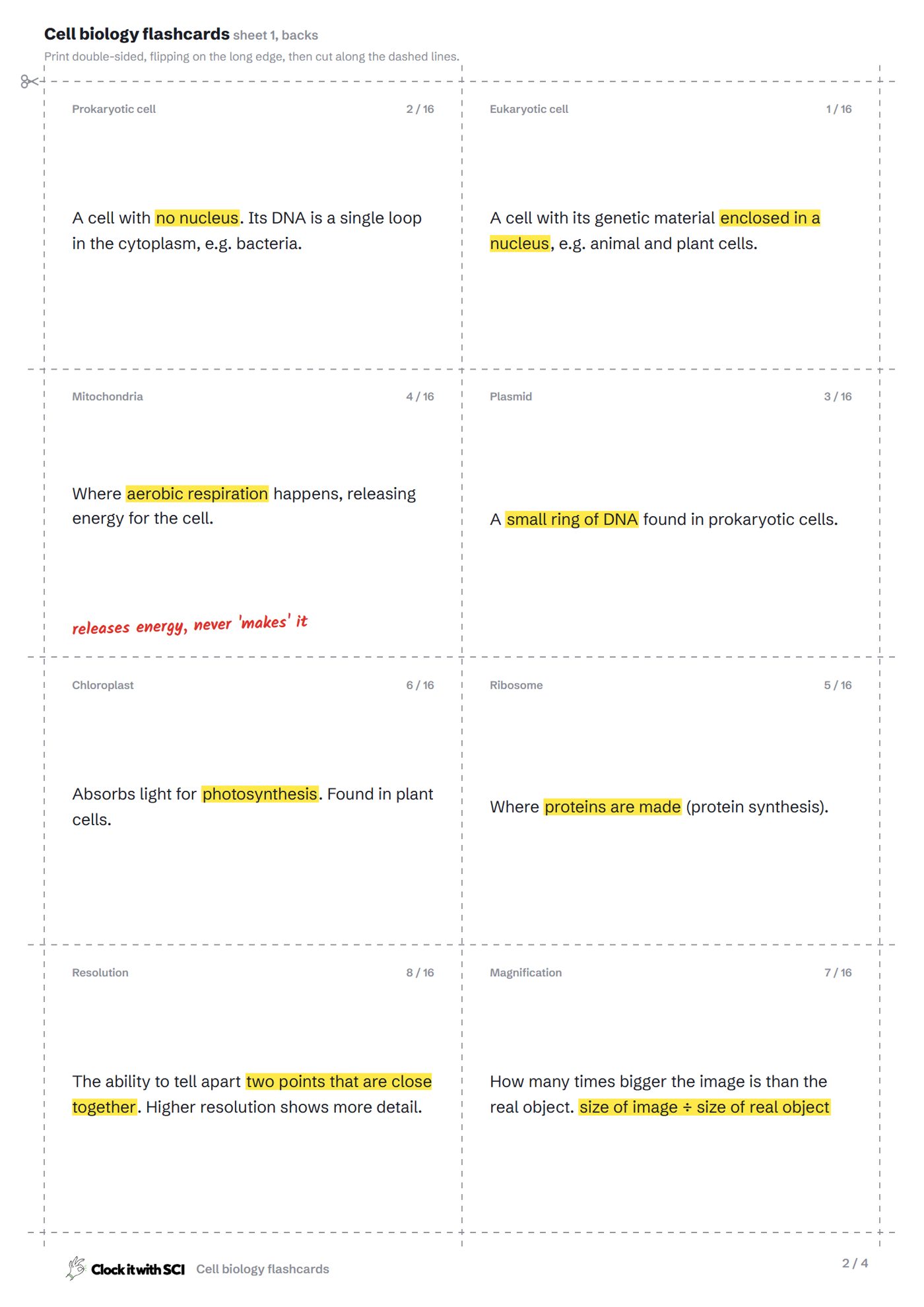
- A cell with its genetic material enclosed in a nucleus, for example animal and plant cells.
- Prokaryotic cell
- A cell with no nucleus. Its DNA is a single loop in the cytoplasm, for example bacteria.
- Plasmid
- A small ring of DNA found in prokaryotic cells.
- Mitochondria
- Where aerobic respiration happens, releasing energy for the cell.
- Ribosome
- Where proteins are made (protein synthesis).
- Chloroplast
- Absorbs light for photosynthesis. Found in plant cells.
- Magnification
- How many times bigger the image is than the real object: size of image ÷ size of real object.
- Resolution
- The ability to tell apart two points that are close together. Higher resolution shows more detail.
- Chromosome
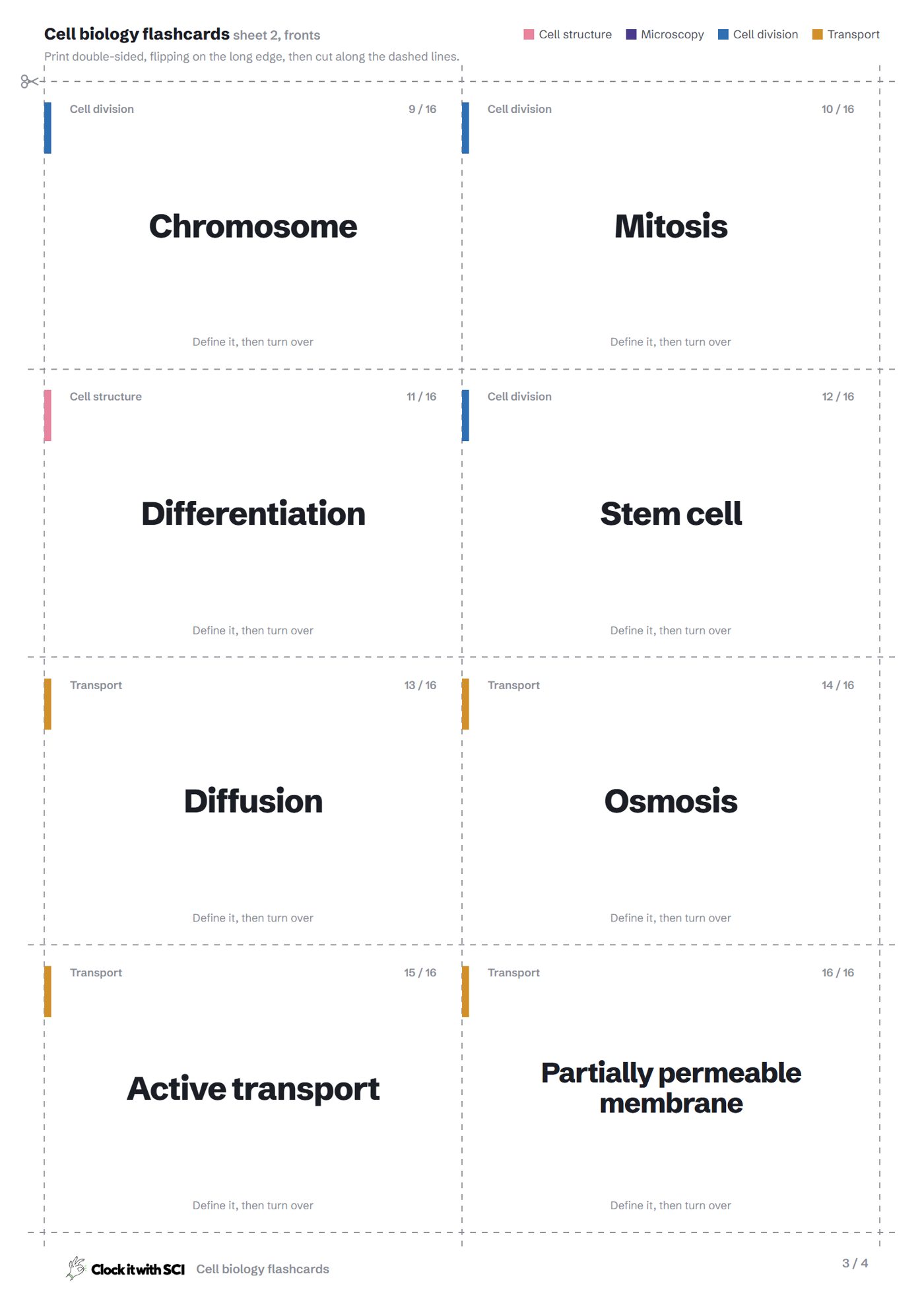
- A long molecule of DNA carrying many genes, found in the nucleus.
- Mitosis
- Cell division that makes two genetically identical cells.
- Differentiation
- When a cell becomes specialised for a particular job.
- Stem cell
- An undifferentiated cell that can divide and become other types of cell.
- Diffusion
- The net movement of particles from higher to lower concentration.
- Osmosis
- The diffusion of water from a dilute to a more concentrated solution through a partially permeable membrane.
- Active transport
- Moving substances against a concentration gradient, using energy from respiration.
- Partially permeable membrane
- A membrane that lets some molecules through but not others, for example water but not larger solute particles.