27 marks of exam-style questions on GCSE cell biology. Try each question first, then open the mark scheme to check your answer. Download the PDF for a printable version with answer lines and graph paper.
Question 1: Plant cells
Show mark scheme
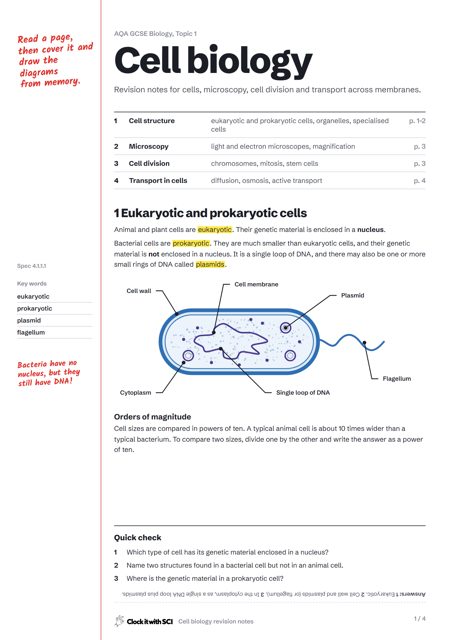
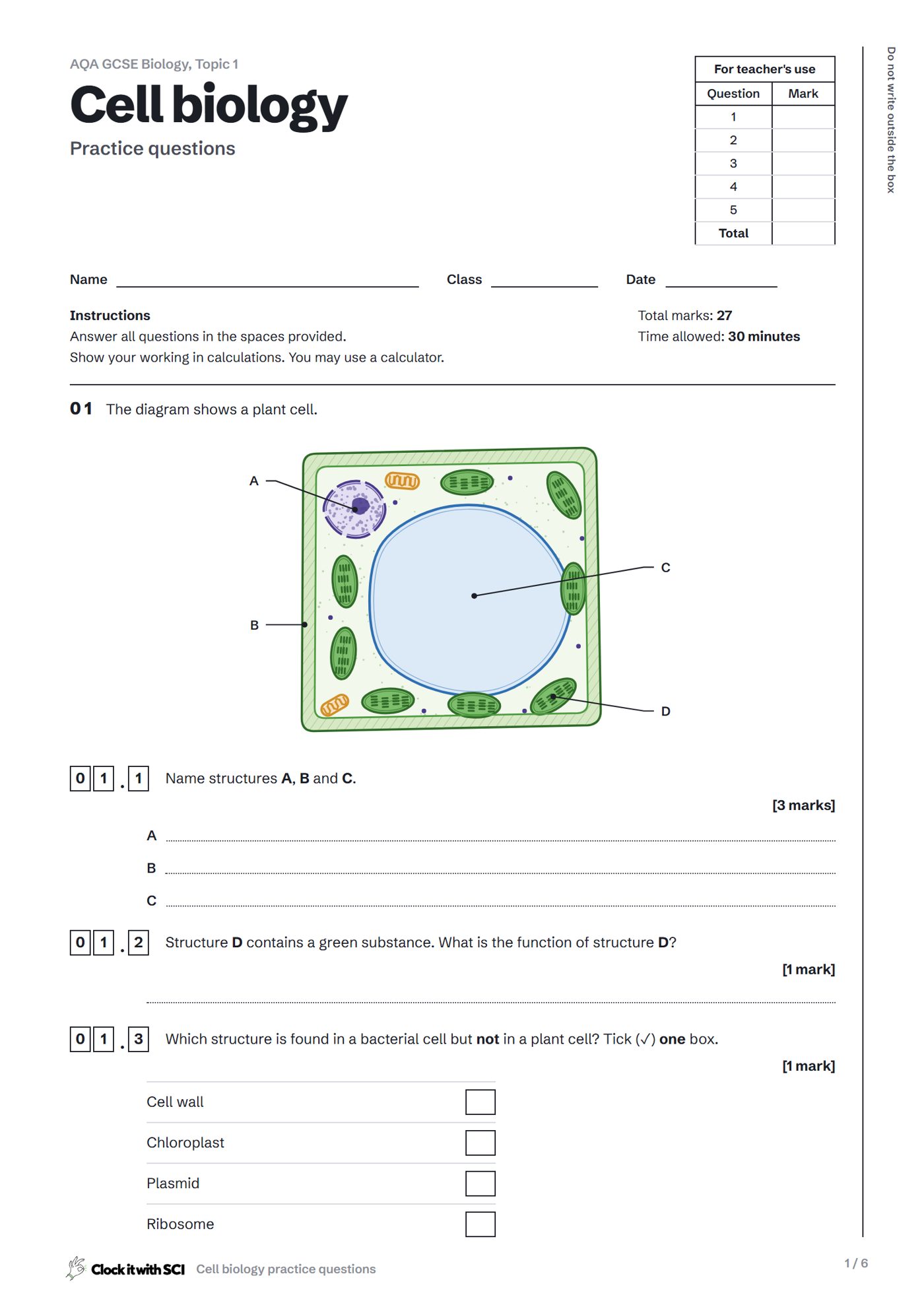
A: nucleus. B: cell wall. C: (permanent) vacuole.
Show mark scheme
It absorbs light for photosynthesis. Allow "where photosynthesis happens".
Show mark scheme
Plasmid.
Question 2: Microscopy
A student uses a light microscope to look at cells from the inside of their cheek.
Show mark scheme
Ribosomes are too small to see, because the resolution of a light microscope is too low.
Show mark scheme
6 ÷ 400 (1 mark) = 0.015 mm (1 mark) = 15 µm (1 mark). A correct answer of 15 µm with no working gets all 3 marks.
Show mark scheme
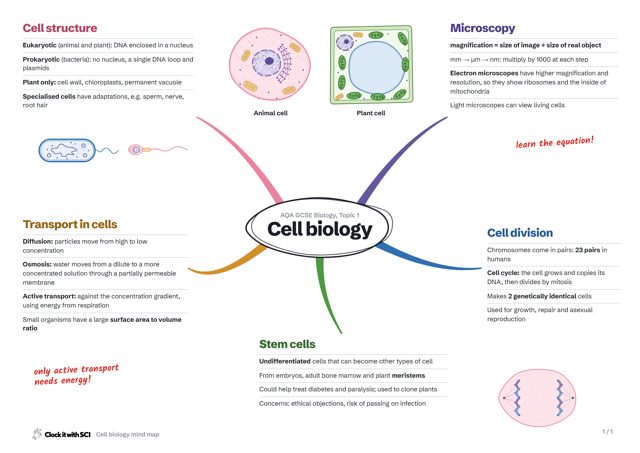
Higher resolution or higher magnification, so it shows more detail.
Question 3: Cell division
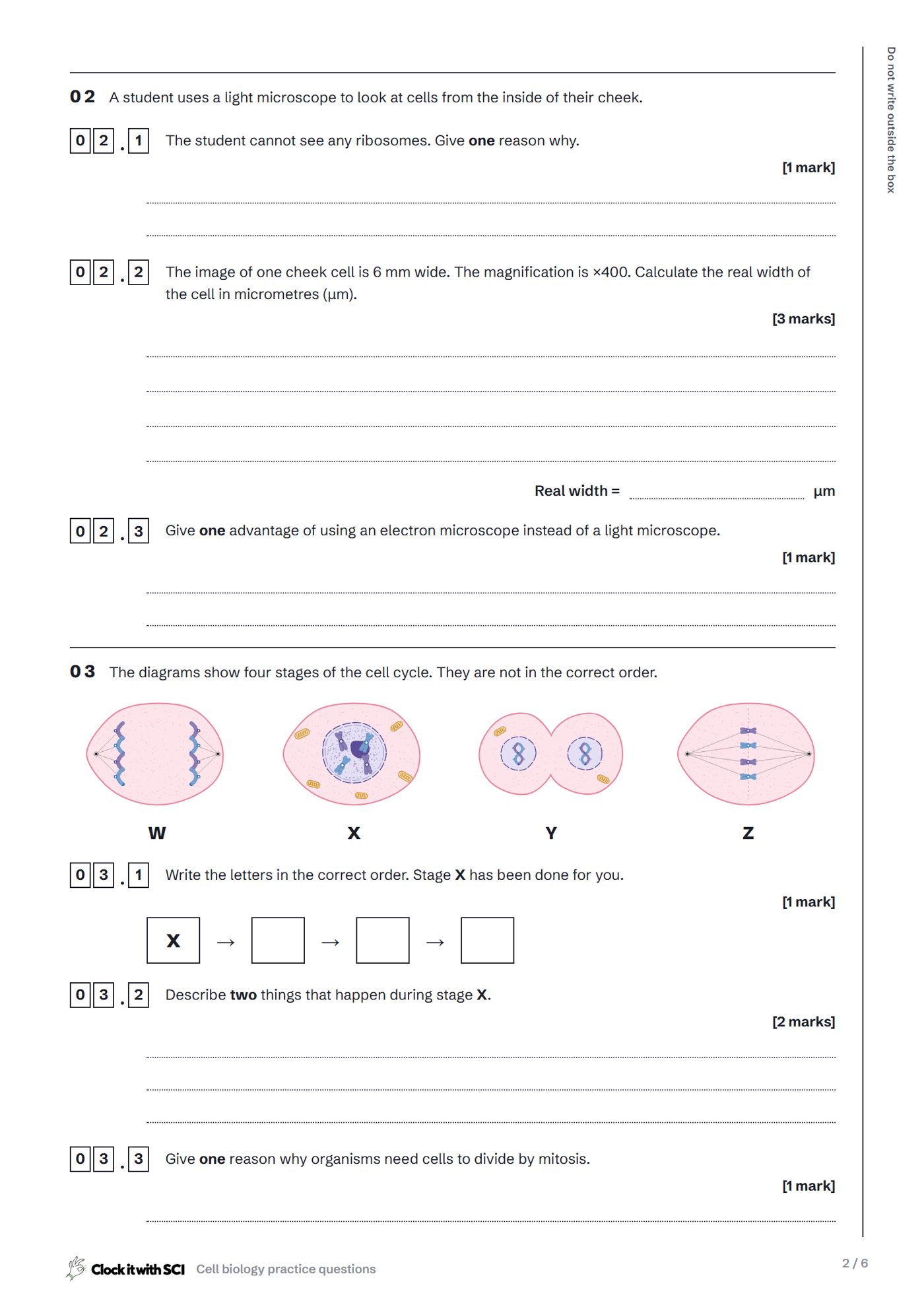
The diagrams show four stages of the cell cycle. They are not in the correct order.
Show mark scheme
X, Z, W, Y.
Show mark scheme
Any two from: the cell grows; the DNA is copied (replicated); more organelles are made, such as ribosomes or mitochondria.
Show mark scheme
Growth, repair, or asexual reproduction.
Question 4: Osmosis practical
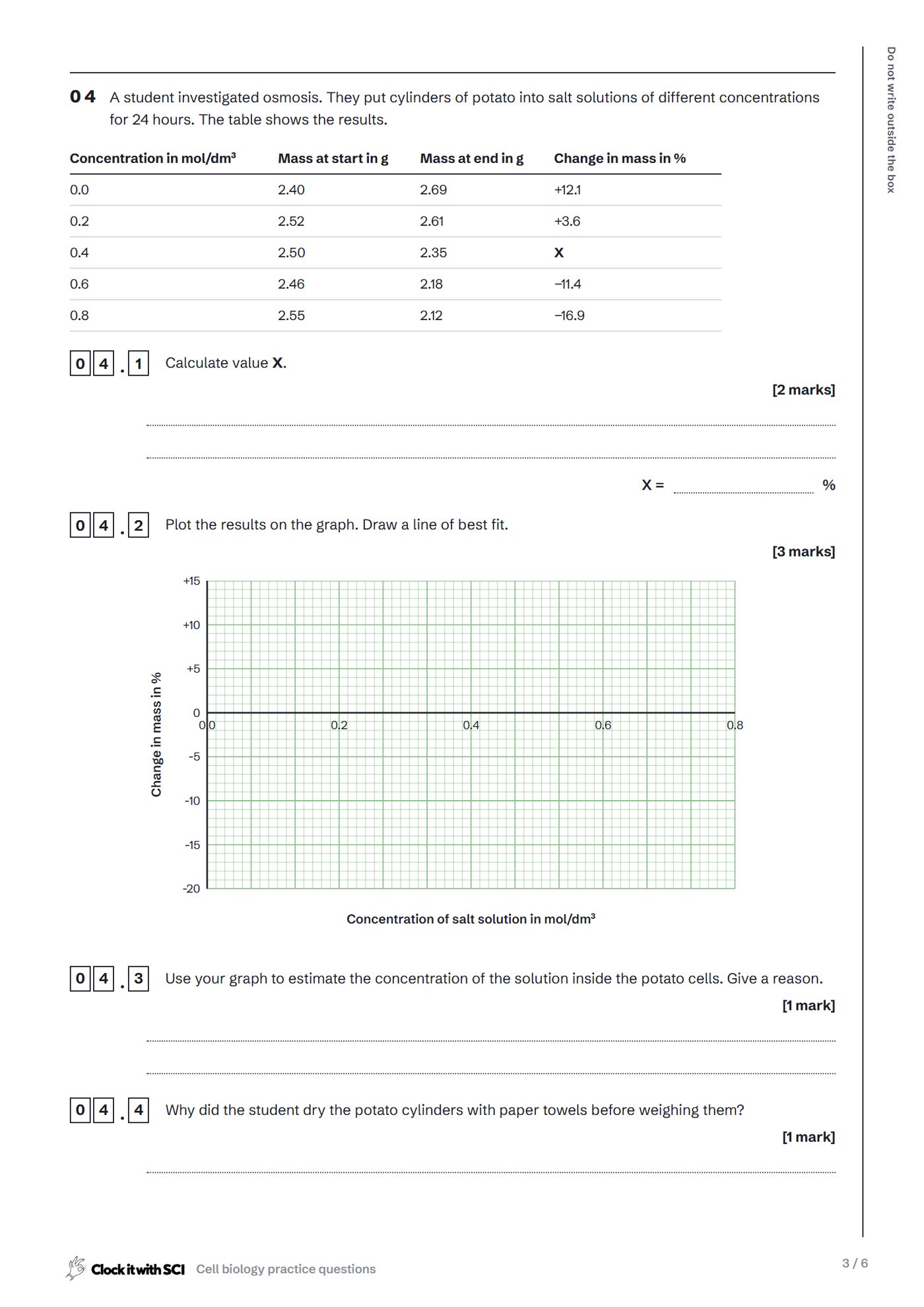
A student put potato cylinders into salt solutions of different concentrations for 24 hours.
| Concentration in mol/dm³ | Mass at start in g | Mass at end in g | Change in mass in % |
|---|---|---|---|
| 0.0 | 2.40 | 2.69 | +12.1 |
| 0.2 | 2.52 | 2.61 | +3.6 |
| 0.4 | 2.50 | 2.35 | X |
| 0.6 | 2.46 | 2.18 | −11.4 |
| 0.8 | 2.55 | 2.12 | −16.9 |
Show mark scheme
(2.35 − 2.50) ÷ 2.50 × 100 (1 mark) = −6.0 % (1 mark). The minus sign is needed for the second mark.
Show mark scheme
All points plotted correctly (2 marks; 1 mark for three or four correct), and a smooth line of best fit (1 mark).
Show mark scheme
About 0.27 mol/dm³, where the line crosses 0 %: there is no net movement of water at this concentration. Accept 0.25 to 0.30.
Show mark scheme
To remove excess solution, so only the mass of the potato is measured.
Question 5: Transport
Show mark scheme
Level 3 (5 to 6 marks): a detailed comparison of all three processes, covering what moves, the direction of movement and whether energy is needed. Level 2 (3 to 4 marks): some comparison of at least two processes. Level 1 (1 to 2 marks): simple statements with little comparison.
Indicative content:
- Diffusion and osmosis are passive and do not need energy; active transport needs energy from respiration.
- Diffusion is the net movement of particles from high to low concentration.
- Osmosis is the movement of water only, from a dilute to a more concentrated solution, through a partially permeable membrane.
- Active transport moves substances against a concentration gradient, from low to high concentration.
- Examples: oxygen diffusing into cells; mineral ions entering root hair cells by active transport.