

Fish farmingSpec 9.9
Human interactions with ecosystems can have both positive and negative impacts on biodiversity, which is the variety of living organisms in an ecosystem. Fish farming is one example.
| Positive | Negative |
|---|---|
| Provides a reliable supply of food for a growing population | Waste and uneaten food pollute water and can cause eutrophication |
| Reduces overfishing, which protects wild fish stocks and biodiversity | Disease and parasites can spread from farmed fish to wild fish |
| Conditions can be controlled, so fish grow quickly | Escaped farmed fish may compete or interbreed with wild fish, reducing their genetic variety |
| Fish may be fed on wild fish, and chemicals used to control disease can harm other organisms |
Non-indigenous speciesSpec 9.9
A non-indigenous species (also called an introduced or invasive species) is one that has been brought, deliberately or accidentally, into an area where it does not naturally live.
- It may have no natural predators in the new area, so its population can grow quickly.
- It can compete with native species for food and space, so native species decline.
- It may eat native species or carry diseases that native species cannot resist.
- The result is that biodiversity falls, as native species decline or die out.
Positive effects are possible. Some non-indigenous species are introduced to provide food or other products, or to control pests. But the risk to native species means that introductions need careful control.
EutrophicationSpec 9.9
Eutrophication happens when too many nutrients, such as nitrates from fertilisers or sewage, run off into lakes and rivers.
- Nitrates from fertilisers or sewage are washed into the water.
- Algae in the water grow very quickly because of the extra nutrients, forming a layer on the surface (an algal bloom).
- The layer blocks light, so plants and algae lower down cannot photosynthesise and die.
- Bacteria (decomposers) feed on the dead material and their numbers increase.
- The bacteria use up oxygen in the water for aerobic respiration.
- Fish and other aquatic animals die from lack of oxygen, so biodiversity falls.
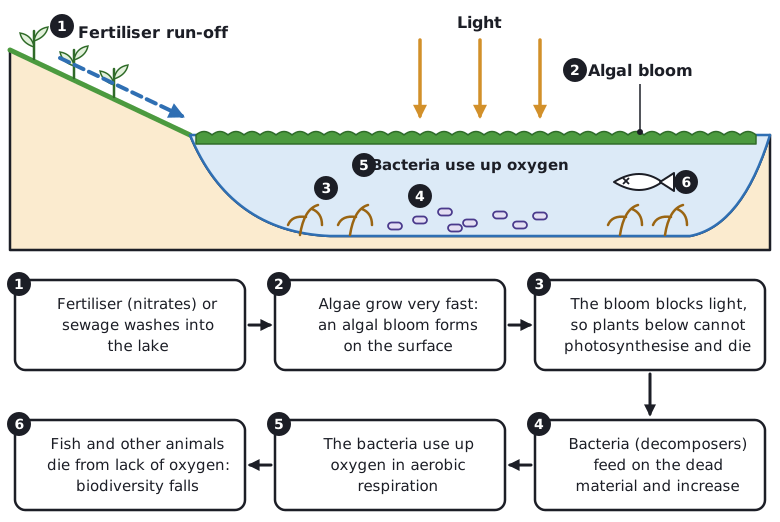 Tap to enlarge
Benefits of maintaining biodiversitySpec 9.10
It is important to maintain biodiversity both locally and globally.
- Ecosystems with high biodiversity are more stable, because species depend on each other (interdependence) and the loss of one is less likely to cause others to fail.
- Biodiversity gives humans food, materials and medicines, and may supply useful resources not yet discovered.
- Species help to maintain the conditions we depend on, such as pollination of crops and cycling of materials.
- Local biodiversity benefits the local people and wildlife. Global biodiversity protects species from extinction.
Conservation of animal species
Endangered animal species can be protected by conservation programmes, such as protecting their habitats, captive breeding programmes, and laws to prevent hunting. This helps to maintain biodiversity.
Reforestation
Reforestation means replanting trees in areas where forest has been cut down. It has benefits for biodiversity and the environment:
- It restores habitats, so the variety of species can increase.
- Trees absorb carbon dioxide by photosynthesis, which helps to reduce the amount of carbon dioxide in the atmosphere.
- Tree roots help to hold soil, which reduces soil erosion and flooding.
Reforestation takes a long time, and the land may be needed for farming, so there can be conflict between the needs of people and the needs of wildlife.
Food securitySpec 9.11BTriple only
Food security means having enough food to feed a population. Several biological factors make it harder to achieve.
- Increasing human population: more people need more food, which puts pressure on land and resources.
- Increasing animal farming and increased meat and fish consumption: energy is lost at each trophic level, so producing meat and fish needs much more land and crops than eating plants directly. Wild fish stocks can be overfished.
- New pests and pathogens: these can spread quickly and destroy crops and farm animals, reducing the amount of food produced.
- Environmental change caused by human activity: for example climate change, pollution and loss of habitats can reduce crop yields or the area of land that can be farmed.
- Sustainability issues: for example using land to grow crops for biofuels instead of food, and the cost of agricultural inputs such as fertilisers, pesticides, fuel and animal feed, which can make farming unaffordable.
Quick check
Name the three human interactions you must be able to explain for this topic.
Show answer
Fish farming, introduction of non-indigenous species, eutrophication.
Why do fish die in eutrophication?
Show answer
Bacteria feeding on dead plants and algae use up the oxygen in the water.
Give two benefits of reforestation.
Show answer
Any two of: restores habitats, absorbs carbon dioxide, reduces soil erosion.
What is meant by a non-indigenous species?
Show answer
A species introduced to an area where it does not naturally live.