

Energy loss and pyramids of biomassSpec 9.7B
Producers absorb only a small part of the light energy that reaches them. The energy stored in their biomass is passed to the next trophic level when they are eaten, and so on along the food chain.
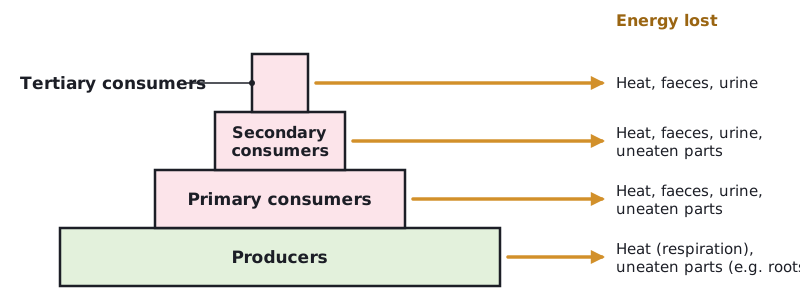
At each trophic level some energy is transferred to less useful forms, so less is available to the next level. Energy is lost because:
- not all of the organism is eaten (for example bones, roots or hair), and some of what is eaten is not digested and is lost in faeces;
- energy is released by respiration and transferred to the surroundings as heat;
- energy is used for movement and for keeping warm in mammals and birds;
- energy is lost in waste such as urine.
This has three effects:
- There are fewer organisms at each successive trophic level, because less energy and less biomass is available to support them.
- Food chains are limited in length, because there is too little energy left to support more trophic levels.
- A pyramid of biomass is wide at the bottom and gets narrower at each level. Each bar shows the dry mass of living material at that trophic level, and the producers are at the base.
 Tap to enlarge
Efficiency and biomass calculationsSpec 9.8B
You may be asked to work out how efficiently energy or biomass is transferred from one trophic level to the next.
Energy transfer efficiency
The grass in a field contains 40 000 kJ of energy. The cattle that eat the grass gain 4 000 kJ in their biomass. Calculate the efficiency of energy transfer from grass to cattle.
- Efficiency = energy transferred ÷ energy available × 100
- = 4 000 ÷ 40 000 × 100
- = 10 %
Answer: 10 %
Percentage of biomass
A caterpillar eats 40 g of leaf (dry mass) and its own dry mass increases by 6 g. Calculate the percentage of the leaf biomass that became caterpillar biomass.
- Percentage = mass gained ÷ mass eaten × 100
- = 6 ÷ 40 × 100
- = 15 %
Answer: 15 %
The numbers are always less than 100 %, because energy and biomass are lost at every stage. The remainder is the part lost as heat, waste or uneaten material.
Quick check
Give two ways energy is lost between trophic levels.
Show answer
Any two of: respiration (heat), movement, waste (faeces, urine), parts not eaten.
Why are food chains short?
Show answer
Energy is lost at each level, so too little remains to support more trophic levels.
What shape is a pyramid of biomass?
Show answer
Wide at the bottom, narrower at each higher trophic level.
State the equation for efficiency of transfer.
Show answer
Energy transferred to next level ÷ energy available at previous level × 100.