

DiffusionSpec 4.1.3.1
Substances may move into and out of cells across the cell membranes via diffusion.
- Diffusion
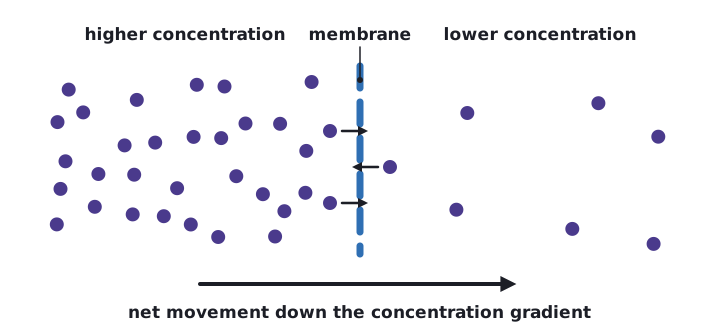
- The spreading out of the particles of any substance in solution, or particles of a gas, resulting in a net movement from an area of higher concentration to an area of lower concentration.
Some of the substances transported in and out of cells by diffusion are oxygen and carbon dioxide in gas exchange, and the waste product urea from cells into the blood plasma for excretion in the kidney.
Factors affecting the rate of diffusion
| Factor | Effect on the rate of diffusion |
|---|---|
| Difference in concentrations (concentration gradient) | A bigger difference means a faster rate, because more particles move down the gradient in the same time |
| Temperature | A higher temperature means a faster rate, because the particles have more energy and move faster |
| Surface area of the membrane | A larger surface area means a faster rate, because more particles can cross at once |
 Tap to enlarge
Surface area to volume ratioSpec 4.1.3.1
A single-celled organism has a relatively large surface area to volume ratio. This allows sufficient transport of molecules into and out of the cell to meet the needs of the organism.
As an organism gets bigger, its volume increases faster than its surface area, so its surface area to volume ratio becomes smaller. A multicellular organism cannot get enough molecules in and out of every cell by diffusion across its outer surface alone.
| Side length | Surface area (6 × side²) | Volume (side³) | Surface area : volume |
|---|---|---|---|
| 1 cm | 6 cm² | 1 cm³ | 6 : 1 |
| 2 cm | 24 cm² | 8 cm³ | 3 : 1 |
| 3 cm | 54 cm² | 27 cm³ | 2 : 1 |
Comparing surface area to volume ratios
Calculate the surface area to volume ratio of a cube with sides of 4 cm. Is it larger or smaller than for a 2 cm cube?
- Surface area = 6 × 4 × 4 = 96 cm².
- Volume = 4 × 4 × 4 = 64 cm³.
- Ratio = 96 : 64 = 1.5 : 1. The 2 cm cube has 3 : 1.
Answer: 1.5 : 1, which is smaller than the ratio of 3 : 1 for the 2 cm cube.
You should be able to explain the need for exchange surfaces and a transport system in multicellular organisms in terms of surface area to volume ratio. Their surface area to volume ratio is small, so they cannot rely on diffusion across the outside of the body to supply all of their cells. They need specialised exchange surfaces and a transport system to move substances to and from cells deep inside the body.
Exchange surfacesSpec 4.1.3.1
In multicellular organisms, surfaces and organ systems are specialised for exchanging materials. This is to allow sufficient molecules to be transported into and out of cells for the organism's needs. The effectiveness of an exchange surface is increased by:
- having a large surface area
- a membrane that is thin, to provide a short diffusion path
- (in animals) having an efficient blood supply
- (in animals, for gaseous exchange) being ventilated.
| Exchange surface | Substances exchanged | Adaptations |
|---|---|---|
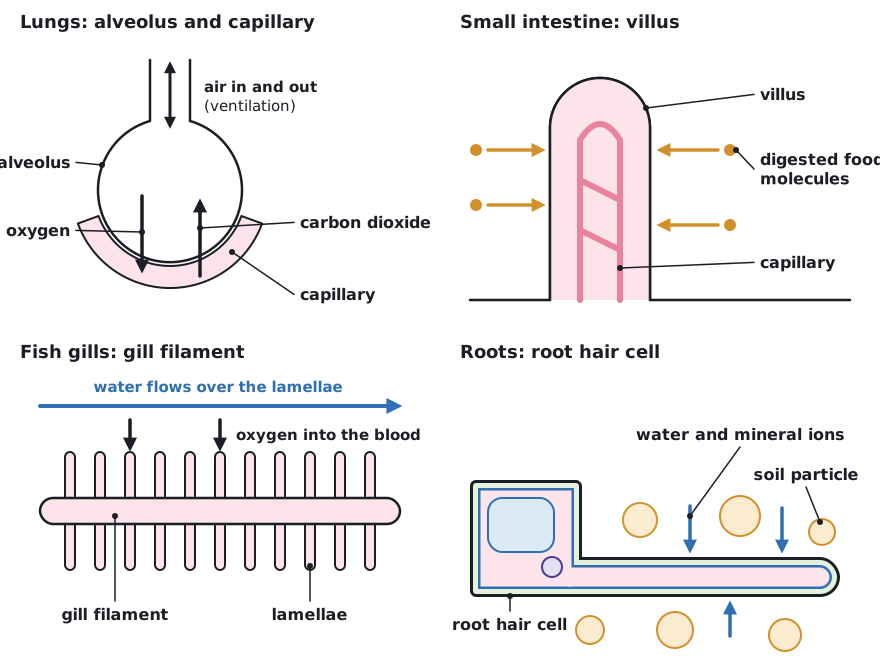
| Small intestine (mammals) | Digested food molecules into the blood | Villi give a large surface area; thin lining gives a short diffusion path; good blood supply carries absorbed molecules away |
| Lungs (mammals) | Oxygen into the blood, carbon dioxide out | Many alveoli give a large surface area; thin walls; good blood supply; ventilated by breathing |
| Gills (fish) | Oxygen from the water into the blood, carbon dioxide out | Many gill filaments covered in folds called lamellae give a large surface area; thin; good blood supply; ventilated as water flows over them |
| Roots (plants) | Water and mineral ions into the plant | Root hair cells give a large surface area; thin cell walls give a short diffusion path |
| Leaves (plants) | Carbon dioxide into the leaf, oxygen and water vapour out | Flat shape and air spaces inside give a large surface area; thin leaf gives a short diffusion path; stomata let gases in and out |
 Tap to enlarge
OsmosisSpec 4.1.3.2
Water may move across cell membranes via osmosis.
- Osmosis
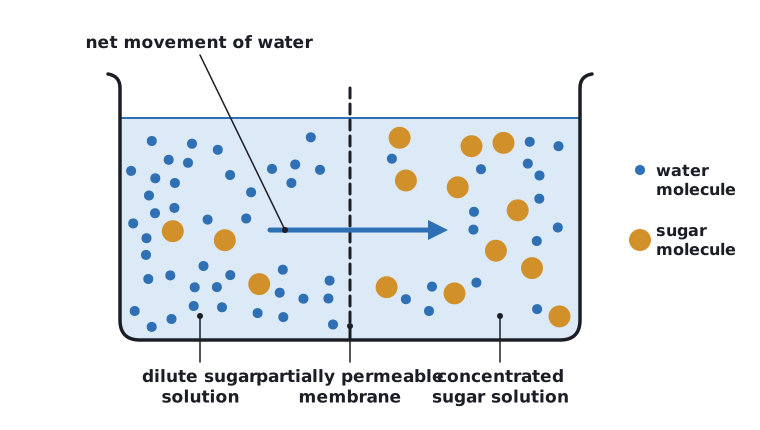
- The diffusion of water from a dilute solution to a concentrated solution through a partially permeable membrane.
 Tap to enlarge
- Cut identical cylinders of plant tissue, for example potato, using a cork borer, and trim them to the same length.
- Blot each cylinder dry and measure its mass using a balance.
- Place each cylinder in a different concentration of sugar or salt solution, including one in pure water. Use the same volume of solution in each tube.
- Leave for the same length of time at the same temperature.
- Remove the cylinders, blot them dry in the same way and measure their mass again.
- Calculate the percentage change in mass for each cylinder.
- Independent variable: the concentration of the solution.
- Dependent variable: the change in mass (as a percentage).
- Control variables: type and size of plant tissue, volume of solution, temperature, time left in the solution, how the tissue is dried.
In dilute solutions, water moves into the plant cells by osmosis and the mass increases. In concentrated solutions, water moves out of the cells and the mass decreases. Where the mass does not change, there is no net movement of water, so the solution is the same concentration as the inside of the cells.
Safety: take care when using the cork borer and scalpel, cutting on a tile and away from your hand.
Calculations and graphs
A positive answer is a gain in mass and a negative answer is a loss in mass. You should be able to use simple compound measures of rate of water uptake, for example the change in mass or volume per minute (g/min or cm³/min).
Percentage change in mass
A potato cylinder has a mass of 4.0 g at the start and 3.4 g after 30 minutes in a salt solution. Calculate the percentage change in mass and the rate of mass change in g per minute.
- Change in mass = 3.4 − 4.0 = −0.6 g.
- Percentage change = −0.6 ÷ 4.0 × 100 = −15%.
- Rate = −0.6 ÷ 30 = −0.02 g per minute.
Answer: −15% (a 15% loss in mass), a rate of −0.02 g/min.
Plot the concentration of solution on the x-axis (the independent variable) and the percentage change in mass on the y-axis. Draw a smooth line or a line of best fit through the points. The point where the line crosses the x-axis shows the concentration with no change in mass.
Active transportSpec 4.1.3.3
- Active transport
- Moves substances from a more dilute solution to a more concentrated solution (against a concentration gradient). This requires energy from respiration.
- Active transport allows mineral ions to be absorbed into plant root hairs from very dilute solutions in the soil. Plants require ions for healthy growth.
- It also allows sugar molecules to be absorbed from lower concentrations in the gut into the blood, which has a higher sugar concentration. Sugar molecules are used for cell respiration.
Because active transport needs energy from respiration, cells that carry it out (such as root hair cells) have many mitochondria.
Comparing the three processes
You should be able to describe how substances are transported into and out of cells by diffusion, osmosis and active transport, and explain the differences between the three processes.
| Diffusion | Osmosis | Active transport | |
|---|---|---|---|
| What moves | Particles of a gas or of a substance in solution | Water only | Substances such as mineral ions and sugar |
| Direction | From higher to lower concentration (down the gradient) | From a dilute solution to a concentrated solution | From a more dilute to a more concentrated solution (against the gradient) |
| Membrane | Across a membrane or not | Through a partially permeable membrane | Across the cell membrane |
| Energy from respiration needed? | No | No | Yes |
Quick check
Name three factors that affect the rate of diffusion.
Show answer
The concentration gradient, the temperature and the surface area of the membrane.
Why do multicellular organisms need exchange surfaces and a transport system?
Show answer
They have a small surface area to volume ratio, so diffusion across the outside alone cannot supply all of their cells.
Define osmosis.
Show answer
The diffusion of water from a dilute solution to a concentrated solution through a partially permeable membrane.
How is active transport different from diffusion?
Show answer
It moves substances against a concentration gradient and needs energy from respiration.
Give an example of active transport in plants.
Show answer
Absorption of mineral ions into root hairs from very dilute solutions in the soil.