

Keyboard: space to flip, 1 for not yet, 2 for got it, arrow keys to move.
See all 70 cards as a list
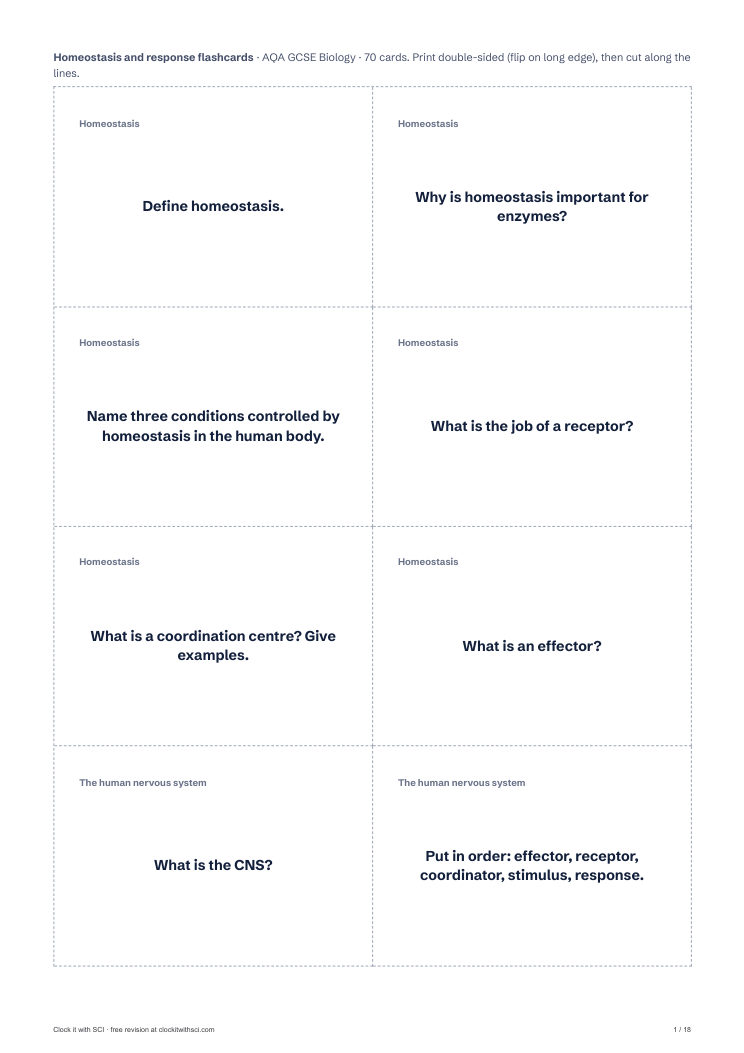
Homeostasis
- Define homeostasis.
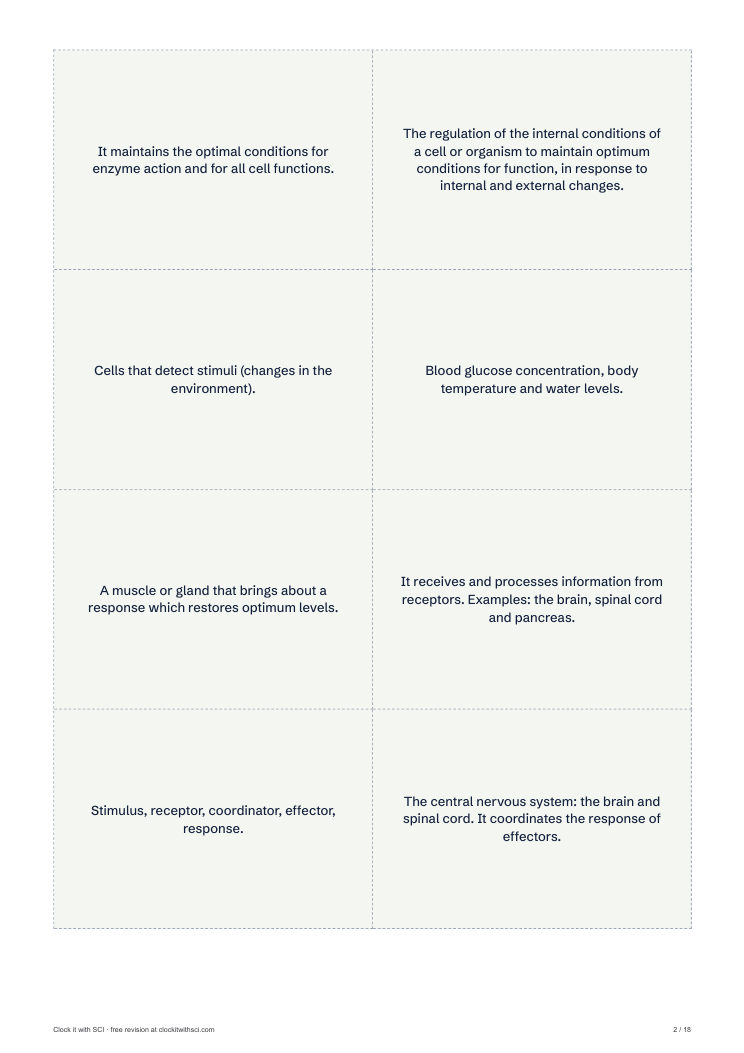
- The regulation of the internal conditions of a cell or organism to maintain optimum conditions for function, in response to internal and external changes.
- Why is homeostasis important for enzymes?
- It maintains the optimal conditions for enzyme action and for all cell functions.
- Name three conditions controlled by homeostasis in the human body.
- Blood glucose concentration, body temperature and water levels.
- What is the job of a receptor?
- Cells that detect stimuli (changes in the environment).
- What is a coordination centre? Give examples.
- It receives and processes information from receptors. Examples: the brain, spinal cord and pancreas.
- What is an effector?
- A muscle or gland that brings about a response which restores optimum levels.
The human nervous system
- What is the CNS?
- The central nervous system: the brain and spinal cord. It coordinates the response of effectors.
- Put in order: effector, receptor, coordinator, stimulus, response.
- Stimulus, receptor, coordinator, effector, response.
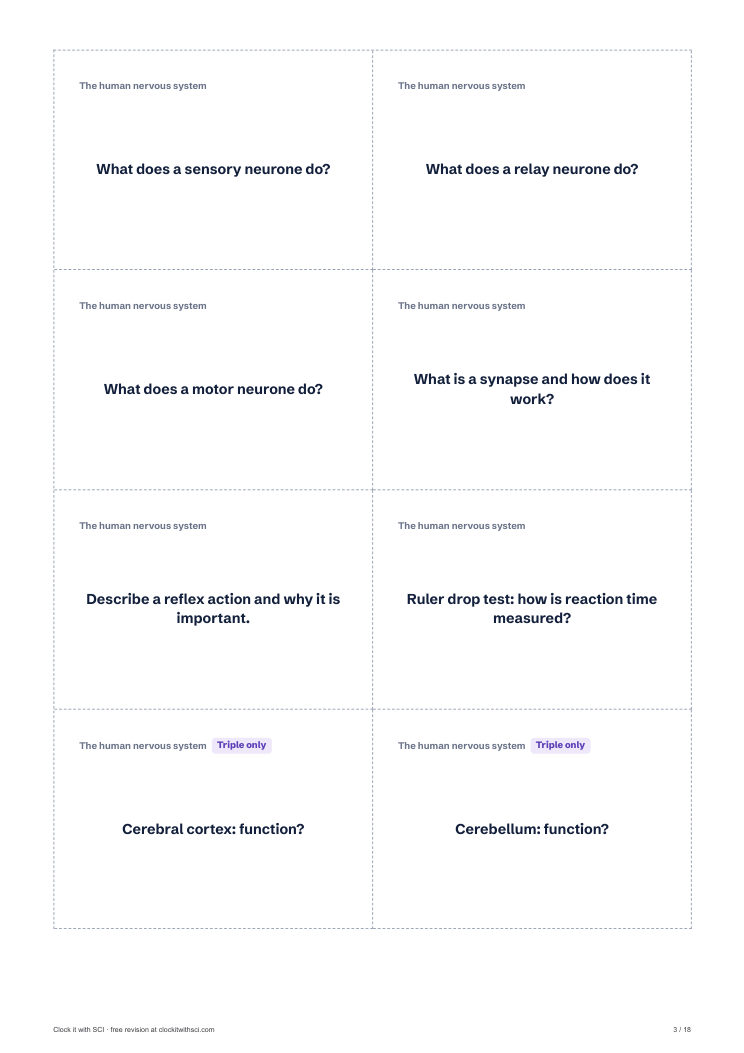
- What does a sensory neurone do?
- Carries electrical impulses from a receptor to the CNS.
- What does a relay neurone do?
- Carries impulses within the CNS, from the sensory neurone to the motor neurone.
- What does a motor neurone do?
- Carries impulses from the CNS to an effector (a muscle or a gland).
- What is a synapse and how does it work?
- A gap between two neurones. A chemical diffuses across the gap and starts an impulse in the next neurone.
- Describe a reflex action and why it is important.
- Automatic and rapid, not involving the conscious part of the brain. It protects the body from harm.
- Ruler drop test: how is reaction time measured?
- Partner drops a ruler without warning; the person catches it. The distance it falls shows reaction time. Repeat and take a mean.
- Cerebral cortex: function? Triple only
- Consciousness, intelligence, memory and language.
- Cerebellum: function? Triple only
- Coordinates muscular activity and balance.
- Medulla: function? Triple only
- Controls unconscious activities such as heart rate and breathing.
- Name three ways neuroscientists have mapped brain function. Triple onlyHigher tier
- Studying patients with brain damage, electrically stimulating parts of the brain, and MRI scanning.
- Why is it difficult to investigate and treat brain disorders? Triple onlyHigher tier
- The brain is very complex and delicate.
- Retina: function? Triple only
- Contains the light receptors, which are sensitive to light intensity and colour. The image is focused here.
- Optic nerve: function? Triple only
- Carries impulses from the retina to the brain.
- Sclera and cornea: functions? Triple only
- Sclera: tough outer layer that protects the eye. Cornea: transparent front surface that refracts light into the eye.
- Iris: function? What happens in dim light? Triple only
- Controls how much light enters the pupil. In dim light the pupil widens so more light enters.
- What are the ciliary muscles and suspensory ligaments for? Triple only
- They change the shape of the lens: the ciliary muscles contract or relax, and the ligaments loosen or tighten.
- What is accommodation? Triple only
- The process of changing the shape of the lens to focus on near or distant objects.
- Focusing on a near object: what happens? Triple only
- Ciliary muscles contract, suspensory ligaments loosen, the lens is thicker and refracts light strongly.
- Focusing on a distant object: what happens? Triple only
- Ciliary muscles relax, suspensory ligaments are pulled tight, the lens is pulled thin and only slightly refracts light.
- Myopia and hyperopia: what are they and how are they corrected? Triple only
- Myopia (short sight): focus in front of retina, concave lens. Hyperopia (long sight): focus behind retina, convex lens.
- Name newer treatments for eye defects. Triple only
- Hard and soft contact lenses, laser surgery to change the shape of the cornea, and a replacement lens.
- What monitors and controls body temperature? Triple only
- The thermoregulatory centre in the brain, which has receptors sensitive to blood temperature. Skin receptors send it impulses.
- Body temperature too high: responses? Triple only
- Blood vessels dilate (vasodilation) and sweat is produced. Both transfer energy from the skin to the environment.
- Body temperature too low: responses? Triple only
- Blood vessels constrict (vasoconstriction), sweating stops and skeletal muscles contract (shiver).
Hormonal coordination in humans
- What is the endocrine system?
- Glands that secrete hormones directly into the bloodstream. The blood carries them to a target organ.
- Nervous system vs hormones: speed and duration?
- Hormone effects are slower but act for longer than nervous responses.
- Why is the pituitary called the master gland?
- It secretes several hormones that act on other glands to stimulate other hormones to be released.
- Where are the pituitary, thyroid, adrenal glands and pancreas?
- Pituitary: base of the brain. Thyroid: neck. Adrenal glands: on top of each kidney. Pancreas: abdomen, just below the stomach.
- What does insulin do?
- Released by the pancreas when blood glucose is too high. Causes glucose to move from the blood into cells; in liver and muscle cells excess glucose becomes glycogen.
- Type 1 diabetes: cause and treatment?
- The pancreas fails to produce sufficient insulin. Normally treated with insulin injections.
- Type 2 diabetes: cause and treatment?
- Body cells no longer respond to insulin. Carbohydrate controlled diet and exercise. Obesity is a risk factor.
- What does glucagon do? Higher tier
- When blood glucose is too low, it causes glycogen to be converted into glucose and released into the blood.
- How do insulin and glucagon form negative feedback? Higher tier
- Each reverses a change in blood glucose, bringing the level back to normal, so the level stays near constant.
- How is water lost from the body, and what controls it? Triple only
- Via lungs (exhaling), skin (sweat) and kidneys (urine). Lungs and skin loss is not controlled; the kidneys adjust.
- What happens if cells gain or lose too much water by osmosis? Triple only
- They do not function efficiently.
- How do the kidneys make urine? Triple only
- Filtration of the blood, then selective reabsorption of useful substances such as glucose, some ions and water.
- Excess amino acids: what happens in the liver? Triple onlyHigher tier
- Deaminated to form ammonia, which is toxic, so it is immediately converted to urea.
- What is ADH and what does it do? Triple onlyHigher tier
- Hormone from the pituitary when blood is too concentrated. Makes kidney tubules more permeable, so more water is reabsorbed.
- Treatments for kidney failure, and basic principle of dialysis? Triple only
- Transplant or dialysis. Urea and excess ions diffuse from blood across a partially permeable membrane into dialysis fluid.
- What do reproductive hormones do at puberty?
- They cause secondary sex characteristics to develop.
- Oestrogen: where made and what does it do?
- The main female reproductive hormone, made in the ovary. With progesterone, it is involved in maintaining the uterus lining.
- Testosterone: where made and what does it do?
- Main male reproductive hormone, made by the testes. Stimulates sperm production.
- FSH, LH, and oestrogen with progesterone: roles in the menstrual cycle?
- FSH: egg maturation. LH: release of the egg. Oestrogen and progesterone: maintaining the uterus lining.
- How do FSH, oestrogen, LH and progesterone interact? Higher tier
- FSH causes an egg to mature and oestrogen release; oestrogen inhibits FSH and stimulates LH; progesterone maintains the lining and inhibits FSH and LH.
- How do oral contraceptives work?
- They contain hormones which inhibit FSH production, so no eggs mature.
- Hormonal contraception: injection, implant, skin patch?
- Slow release of progesterone, inhibiting maturation and release of eggs for months or years.
- Name four non-hormonal contraception methods.
- Barrier methods (condoms, diaphragms), spermicides, abstaining when an egg may be in the oviduct, surgical sterilisation.
- How do intrauterine devices work?
- They prevent the implantation of an embryo, or release a hormone.
- What is a fertility drug? Higher tier
- It contains FSH and LH, given to a woman. She may then become pregnant in the normal way.
- Describe IVF. Higher tier
- FSH and LH mature several eggs; eggs collected and fertilised in the lab; embryos develop; one or two are inserted into the uterus.
- Give disadvantages of fertility treatment. Higher tier
- Stressful emotionally and physically, success rates not high, and multiple births risk babies and mother.
- Adrenaline: where made and what does it do? Higher tier
- Made by the adrenal glands in fear or stress. Increases heart rate and boosts oxygen and glucose delivery to brain and muscles.
- Thyroxine: where made and what does it do? Higher tier
- From the thyroid gland. Stimulates the basal metabolic rate and is important in growth and development.
- What is negative feedback? Higher tier
- A change is reversed to bring the level back to normal. Thyroxine levels are controlled this way.
Plant hormones
- What is auxin and what does it do? Triple only
- A plant hormone. Unequal distribution of auxin causes unequal growth rates in roots and shoots.
- Phototropism and gravitropism? Triple only
- Phototropism: growth response to light. Gravitropism (geotropism): growth response to gravity.
- Why does a shoot bend towards light? Triple only
- Auxin builds up on the shaded side, cells there grow faster, so the shoot bends towards the light.
- Seedling practical: what to record? Triple only
- Length measurements and careful, labelled biological drawings to show the effects of light or gravity.
- Gibberellins and ethene: functions? Triple onlyHigher tier
- Gibberellins initiate seed germination. Ethene controls cell division and ripening of fruits.
- Uses of auxins? Triple onlyHigher tier
- As weed killers, as rooting powders, and for promoting growth in tissue culture.
- Use of ethene? Triple onlyHigher tier
- In the food industry to control ripening of fruit during storage and transport.
- Uses of gibberellins? Triple onlyHigher tier
- To end seed dormancy, promote flowering and increase fruit size.