

The menstrual cycleSpec 7.4
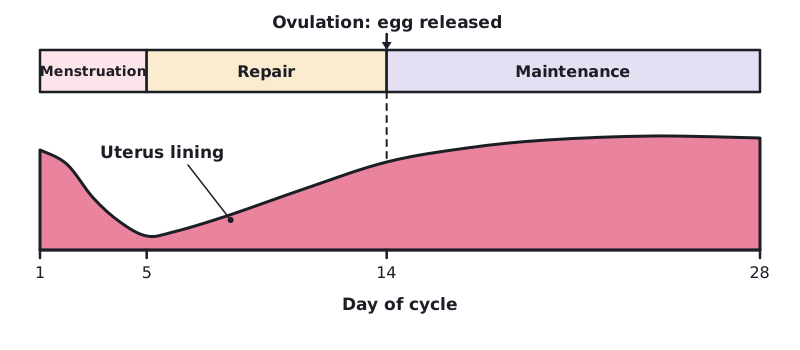
The menstrual cycle is a series of changes in a woman that repeats about every 28 days. Each cycle, an egg is released from an ovary and the lining of the uterus is prepared in case the egg is fertilised.
| Stage | Days | What happens |
|---|---|---|
| Menstruation | 1 to 5 | The lining of the uterus breaks down and is lost through the vagina with blood |
| Repair | 5 to 14 | The uterus lining is repaired and thickens again |
| Ovulation | Around 14 | An egg is released from an ovary |
| Maintenance | 14 to 28 | The lining stays thick, ready for a fertilised egg. If there is no pregnancy it breaks down and the cycle starts again |
The roles of two hormones
- Oestrogen is made in the ovaries. It causes the repair and growth of the uterus lining.
- Progesterone is made in the ovaries. It maintains the uterus lining.
 Tap to enlarge
How four hormones control the cycleSpec 7.5Higher tier
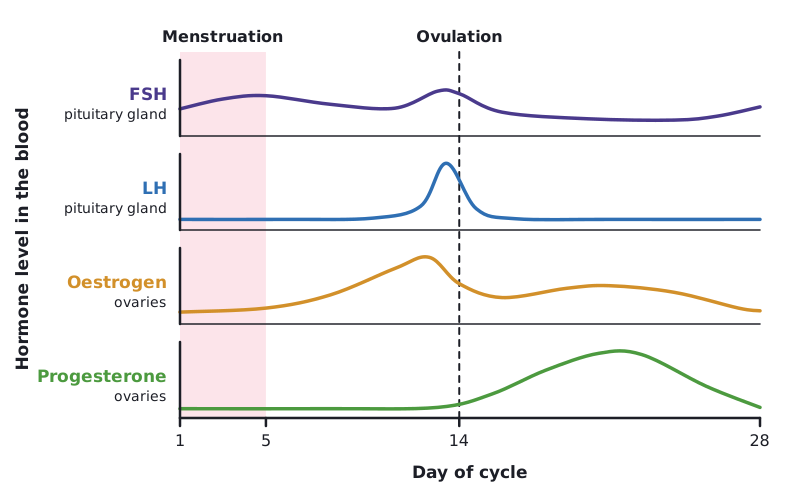
Four hormones interact to control the cycle. FSH and LH are released by the pituitary gland. Oestrogen and progesterone are made by the ovaries.
| Hormone | Made in | What it does |
|---|---|---|
| FSH | Pituitary gland | Causes an egg to mature in an ovary. Stimulates the ovaries to produce oestrogen |
| Oestrogen | Ovaries | Repairs and builds up the uterus lining. Inhibits FSH. Stimulates the release of LH |
| LH | Pituitary gland | Causes ovulation |
| Progesterone | Ovaries | Maintains the uterus lining. Inhibits FSH and LH |
- FSH makes an egg mature and stimulates the ovaries to make oestrogen.
- Oestrogen repairs the uterus lining. When oestrogen is high it inhibits FSH and stimulates the release of LH.
- LH causes ovulation, around day 14.
- After ovulation the ovary produces progesterone, which maintains the lining and inhibits FSH and LH, so no more eggs mature.
- If there is no pregnancy, progesterone falls. The lining is no longer maintained and breaks down. This is menstruation.
 Tap to enlarge
Hormonal contraceptionSpec 7.6
Hormonal contraceptives contain oestrogen, progesterone or both. They can be taken as a pill, or given as a patch, an injection or an implant under the skin.
The hormones keep levels in the body high. This stops the normal changes in hormone levels that cause eggs to mature and be released. The effects on the cycle and on pregnancy are:
- Eggs do not mature, so ovulation does not happen. There is no egg to be fertilised.
- Progesterone makes the mucus at the cervix thicker, so sperm cannot get through to reach an egg.
The oestrogen in the pill inhibits the release of FSH from the pituitary gland. With FSH kept low, eggs do not mature in the ovaries.
Evaluating hormonal and barrier methodsSpec 7.7
Barrier methods such as condoms and diaphragms stop sperm reaching an egg. Hormonal methods change the menstrual cycle. To evaluate them, give advantages and disadvantages of each.
| Method | Advantages | Disadvantages |
|---|---|---|
| Hormonal (pill, patch, injection, implant) | Very effective when used correctly. Implants and injections last a long time, so there is nothing to remember each day | Do not protect against sexually transmitted infections. Can cause side effects. The pill must be taken at the right time every day |
| Barrier (condom, diaphragm) | Condoms also protect against sexually transmitted infections. No hormone side effects. Only used when needed | Less effective if not used correctly, for example a condom can split or slip. A diaphragm has to be fitted correctly |
Assisted reproductive technologySpec 7.8Higher tier
Assisted Reproductive Technology (ART) helps people who find it hard to have a baby. Hormones are used in two types of treatment.
IVF (in vitro fertilisation)
- The woman is given FSH and LH. These make several eggs mature in her ovaries.
- The eggs are collected from the ovaries.
- The eggs are mixed with sperm in a dish in the laboratory, where they are fertilised.
- The fertilised eggs develop into embryos.
- One or two embryos are placed into the woman's uterus.
Clomifene therapy
Clomifene is a drug taken by women who do not ovulate. It stimulates the release of FSH and LH, so eggs mature and ovulation happens.
Quick check
Which hormone repairs the uterus lining and which maintains it?
Show answer
Oestrogen repairs it. Progesterone maintains it.
Around which day does ovulation happen in a 28-day cycle?
Show answer
Around day 14.
State one way the contraceptive pill prevents pregnancy.
Show answer
It stops ovulation, or thickens the mucus at the cervix so sperm cannot get through.
Give one advantage of condoms over the pill.
Show answer
They protect against sexually transmitted infections.
What does clomifene do? (Higher)
Show answer
It stimulates the release of FSH and LH so that ovulation happens.