

Keyboard: space to flip, 1 for not yet, 2 for got it, arrow keys to move.
See all 56 cards as a list
Photosynthesis and limiting factors
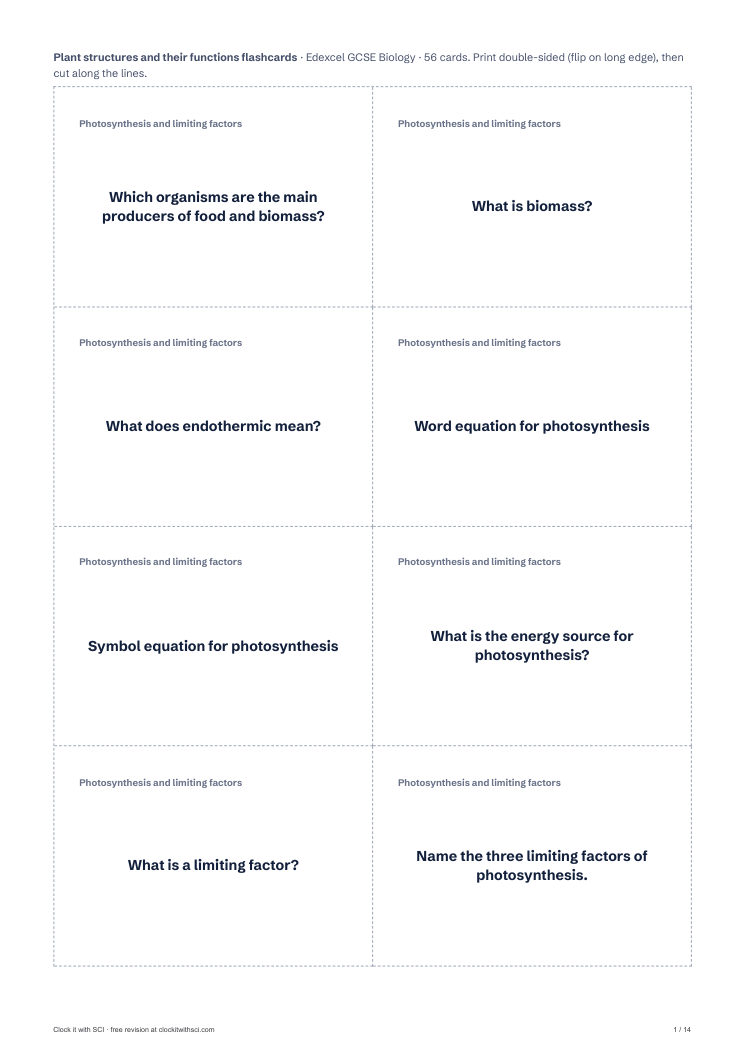
- Which organisms are the main producers of food and biomass?
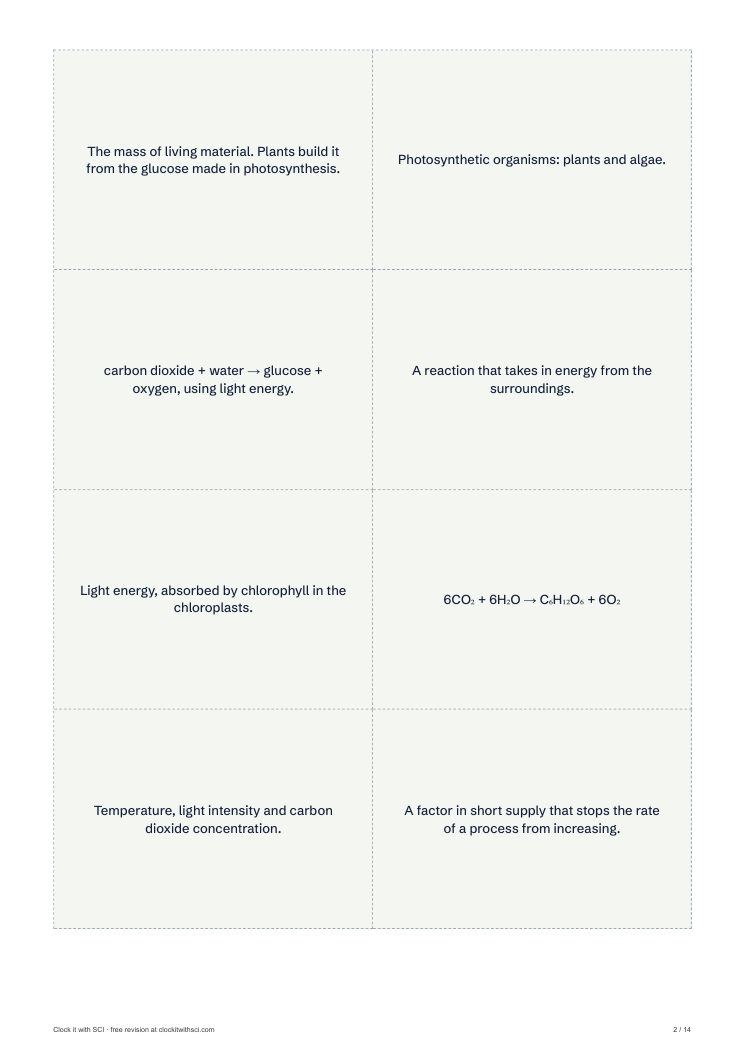
- Photosynthetic organisms: plants and algae.
- What is biomass?
- The mass of living material. Plants build it from the glucose made in photosynthesis.
- What does endothermic mean?
- A reaction that takes in energy from the surroundings.
- Word equation for photosynthesis
- carbon dioxide + water → glucose + oxygen, using light energy.
- Symbol equation for photosynthesis
- 6CO₂ + 6H₂O → C₆H₁₂O₆ + 6O₂
- What is the energy source for photosynthesis?
- Light energy, absorbed by chlorophyll in the chloroplasts.
- What is a limiting factor?
- A factor in short supply that stops the rate of a process from increasing.
- Name the three limiting factors of photosynthesis.
- Temperature, light intensity and carbon dioxide concentration.
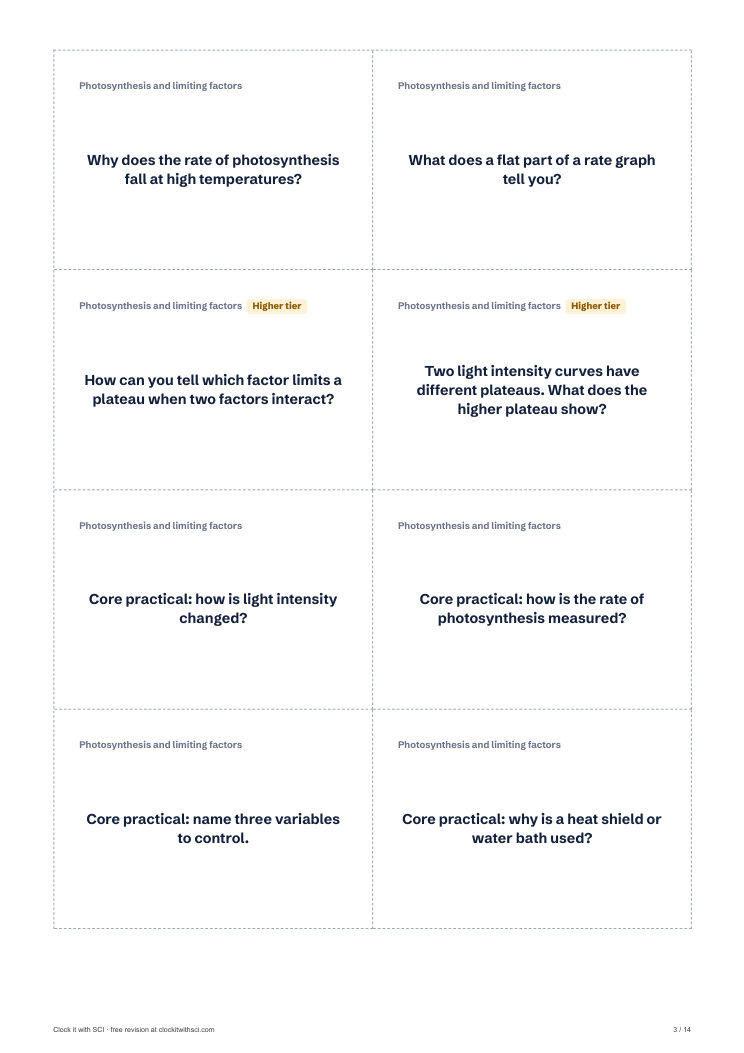
- Why does the rate of photosynthesis fall at high temperatures?
- The enzymes are denatured, because their active site changes shape, so substrates cannot bind.
- What does a flat part of a rate graph tell you?
- The factor being changed is no longer limiting. Another factor is.
- How can you tell which factor limits a plateau when two factors interact? Higher tier
- It is the factor that is in shortest supply. Increasing it raises the plateau.
- Two light intensity curves have different plateaus. What does the higher plateau show? Higher tier
- The other factor, such as carbon dioxide concentration or temperature, was higher and was limiting the lower curve.
- Core practical: how is light intensity changed?
- By changing the distance between the lamp and the pondweed.
- Core practical: how is the rate of photosynthesis measured?
- Count the bubbles of oxygen released per minute, or measure the volume of gas collected.
- Core practical: name three variables to control.
- Temperature, carbon dioxide concentration (sodium hydrogencarbonate) and the plant used.
- Core practical: why is a heat shield or water bath used?
- To keep the temperature constant, because the lamp warms the water.
- How is the rate of photosynthesis related to light intensity when light is limiting? Higher tier
- Directly proportional.
- State the inverse square law for light intensity. Higher tier
- Light intensity is proportional to 1 ÷ distance² from the light source.
- A lamp is moved to three times the distance. What happens to light intensity? Higher tier
- It falls to one ninth (1 ÷ 3²).
Transport in plants
- Give three adaptations of a root hair cell.
- Long thin projection for a large surface area, thin wall, and many mitochondria for active transport.
- How do root hair cells take in mineral ions?
- By active transport, using energy from respiration.
- How does water enter a root hair cell?
- By osmosis, because the cell sap is more concentrated than the soil water.
- What does xylem carry?
- Water and mineral ions, from the roots to the rest of the plant.
- Why are xylem cells lignified and dead?
- Dead cells with no end walls form a hollow tube for water, and lignin strengthens the walls.
- What does phloem carry?
- Sucrose, dissolved in water, around the plant.
- Why are phloem cells living?
- They use energy from respiration to transport sucrose.
- What is the role of companion cells?
- They have many mitochondria and release the energy needed for the transport of sucrose in the phloem.
- What is transpiration?
- The loss of water vapour from the leaves, which pulls water and mineral ions up through the plant.
- Put the path of water in order.
- Root hair cell → xylem → leaf cells (evaporation) → air spaces → out through the stomata.
- What are stomata?
- Pores in the leaf surface, each surrounded by two guard cells, which let gases in and out.
- How do guard cells close a stoma?
- They lose water and become limp, which reduces water loss.
- What is translocation?
- The transport of sucrose around the plant in the phloem.
- Where does sucrose move to and from in translocation?
- From the leaves to the parts of the plant that use or store it, such as roots, shoots and fruits.
- Does translocation need energy?
- Yes. It is carried out by the living cells of the phloem, using energy from respiration.
Leaves, water uptake and extreme environments
- Why is the palisade mesophyll near the top of the leaf? Triple only
- It has many chloroplasts and most photosynthesis happens here, close to the light.
- What is the function of the air spaces in the spongy mesophyll? Triple only
- They allow carbon dioxide to diffuse through the leaf to the cells, and oxygen to diffuse out.
- What does the waxy cuticle do? Triple only
- It is waterproof, so it reduces water loss by evaporation from the leaf surface.
- Why is a leaf broad, flat and thin? Triple only
- A large surface area absorbs light, and a thin leaf gives a short diffusion distance for gases.
- Why is the upper epidermis transparent? Triple only
- To let light pass through to the palisade cells below.
- How does increasing light intensity affect water uptake?
- It increases it, because the stomata open and more water vapour diffuses out.
- How does increasing air movement affect water uptake?
- It increases it, because water vapour is carried away, keeping a steep concentration gradient.
- How does increasing temperature affect water uptake?
- It increases it, because water evaporates faster and water vapour diffuses out faster.
- What does a potometer measure?
- The rate of water uptake of a leafy shoot, from the movement of an air bubble in a capillary tube.
- How do you calculate a rate of water uptake?
- Rate = change in quantity (such as distance moved or volume) ÷ time.
- How do you calculate percentage change in mass?
- (change in mass ÷ original mass) × 100.
- How does leaf size and shape help plants in dry places? Triple only
- Small, narrow or rolled leaves, or spines, have a small surface area so less water evaporates.
- How does a thick cuticle help plants in extreme environments? Triple only
- It is waterproof, so less water evaporates from the leaf surface.
- How can stomata be adapted to reduce water loss? Triple only
- Fewer stomata, stomata in pits, or stomata that are closed during the day.
Plant hormones
- What is a tropism? Triple only
- A growth response of a plant to a stimulus.
- Where is auxin made in a shoot? Triple only
- In the tip of the shoot.
- How does auxin cause phototropism in a shoot? Triple only
- Auxin moves to the shaded side and makes cells elongate there, so the shoot bends towards light.
- How does a root respond to gravity? Triple only
- It grows downwards (positive gravitropism). Auxin on the lower side slows the growth of the cells there.
- How does a shoot respond to gravity? Triple only
- It grows upwards (negative gravitropism).
- Two commercial uses of auxins Triple onlyHigher tier
- Weedkillers and rooting powders.
- Three commercial uses of gibberellins Triple onlyHigher tier
- Germination of seeds, fruit and flower formation, and production of seedless fruit.
- Commercial use of ethene Triple onlyHigher tier
- Ripening fruit.