

Keyboard: space to flip, 1 for not yet, 2 for got it, arrow keys to move.
See all 51 cards as a list
Darwin, natural selection and antibiotic resistance
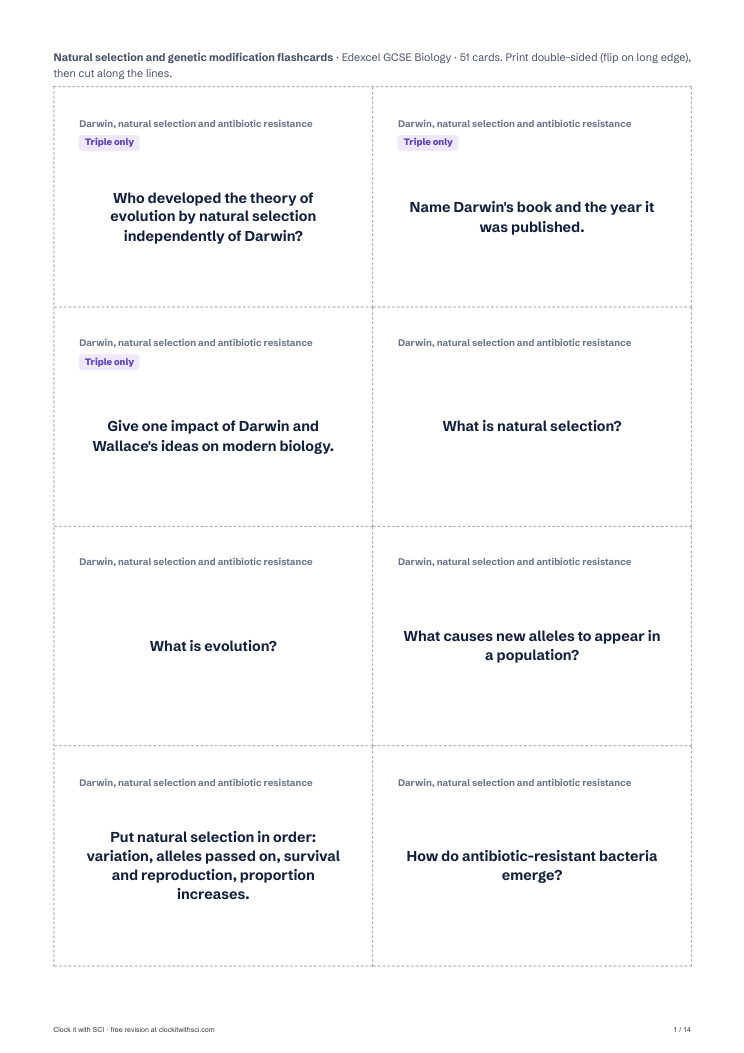
- Who developed the theory of evolution by natural selection independently of Darwin? Triple only
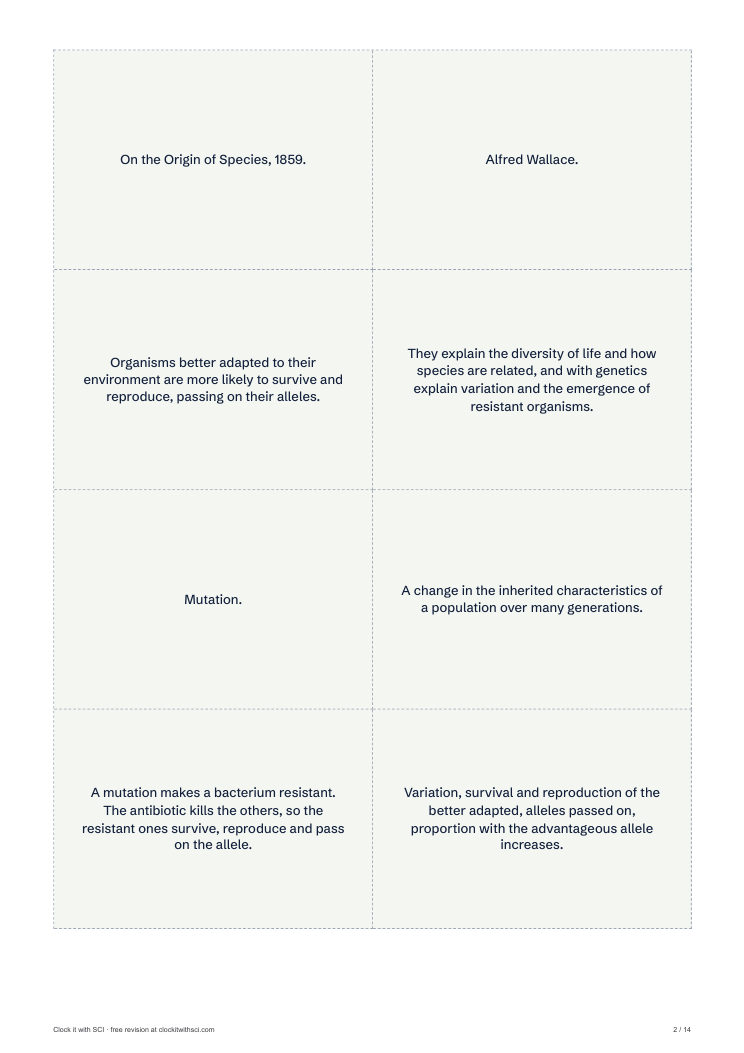
- Alfred Wallace.
- Name Darwin's book and the year it was published. Triple only
- On the Origin of Species, 1859.
- Give one impact of Darwin and Wallace's ideas on modern biology. Triple only
- They explain the diversity of life and how species are related, and with genetics explain variation and the emergence of resistant organisms.
- What is natural selection?
- Organisms better adapted to their environment are more likely to survive and reproduce, passing on their alleles.
- What is evolution?
- A change in the inherited characteristics of a population over many generations.
- What causes new alleles to appear in a population?
- Mutation.
- Put natural selection in order: variation, alleles passed on, survival and reproduction, proportion increases.
- Variation, survival and reproduction of the better adapted, alleles passed on, proportion with the advantageous allele increases.
- How do antibiotic-resistant bacteria emerge?
- A mutation makes a bacterium resistant. The antibiotic kills the others, so the resistant ones survive, reproduce and pass on the allele.
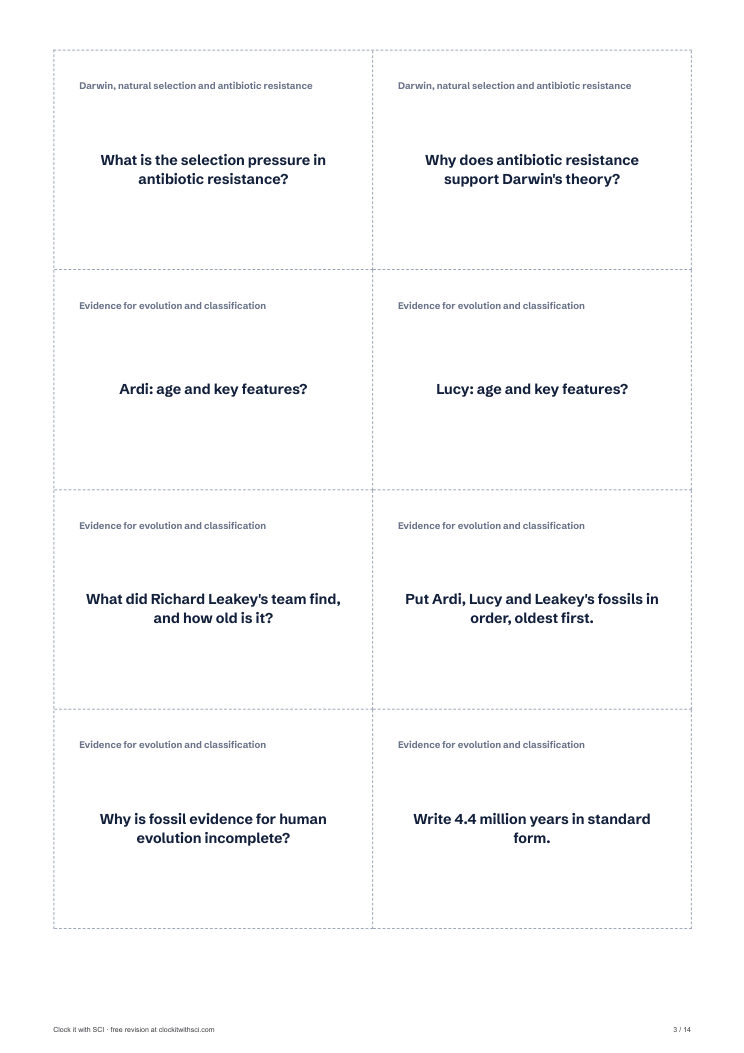
- What is the selection pressure in antibiotic resistance?
- The antibiotic.
- Why does antibiotic resistance support Darwin's theory?
- It shows natural selection happening: variation, a selection pressure, survival of the resistant, and inheritance of resistance.
Evidence for evolution and classification
- Ardi: age and key features?
- 4.4 million years ago. Walked upright but had a grasping big toe, so could still climb trees.
- Lucy: age and key features?
- 3.2 million years ago. Walked upright on two legs, with a small brain.
- What did Richard Leakey's team find, and how old is it?
- Fossils from 1.6 million years ago, including a nearly complete skeleton with a larger brain and longer legs, much more like a modern human.
- Put Ardi, Lucy and Leakey's fossils in order, oldest first.
- Ardi (4.4 million), Lucy (3.2 million), Leakey's (1.6 million years ago).
- Why is fossil evidence for human evolution incomplete?
- Fossils are rare and often incomplete, because most remains decay before they fossilise.
- Write 4.4 million years in standard form.
- 4.4 × 10⁶ years.
- How do stone tools change over time?
- They become more complex and better made, showing greater skill and intelligence.
- How can stone tools be dated from their environment?
- By the age of the rock layer or materials found with them.
- What is a pentadactyl limb? Triple only
- A limb with five digits, found in many vertebrates.
- What does the pentadactyl limb suggest about evolution? Triple only
- Similar bone structure suggests a common ancestor, with limbs adapted by natural selection for different functions.
- Name the five kingdoms.
- Animals, plants, fungi, protists and prokaryotes.
- Name the three domains.
- Archaea, Bacteria and Eukarya.
- What led to the suggestion of three domains?
- Genetic analysis showed that the prokaryotes are not one closely related group.
Selective breeding and tissue culture
- What is selective breeding?
- Humans choosing parents with desired characteristics to breed together, repeated over many generations.
- Give two characteristics selected for in food plants.
- Any two of: disease resistance, larger fruit or grains, better taste, higher yield.
- Give two characteristics selected for in domesticated animals.
- Any two of: more milk, more meat, more eggs, a gentle nature.
- What is a disadvantage of selective breeding?
- It reduces genetic variation, so the population is at greater risk from disease; inbreeding can cause health problems.
- Two Rr plants are crossed (R dominant). What is the probability of an rr offspring?
- 1/4 or 25%.
- What is tissue culture? Triple only
- Growing new cells or plants from small pieces of tissue on a sterile nutrient medium.
- What conditions does tissue culture need? Triple only
- Aseptic technique to prevent contamination, and a nutrient medium (agar) with nutrients and growth hormones.
- Advantage of tissue culture in plant breeding programmes? Triple only
- Many genetically identical plants can be produced quickly from a small amount of tissue.
- Advantage of tissue culture in medical research? Triple only
- Large numbers of identical cells can be grown to test drugs and study diseases.
Genetic engineering
- What is genetic engineering?
- A process which involves modifying the genome of an organism to introduce desirable characteristics.
- Give an example of genetic engineering in medicine.
- Bacteria given the human gene for insulin, so they make human insulin.
- What does a restriction enzyme do? Higher tier
- Cuts DNA at a specific base sequence.
- What are sticky ends? Higher tier
- Short, unpaired strands of DNA left at the ends of a cut, which join with complementary sticky ends.
- What does ligase do? Higher tier
- Joins pieces of DNA together, for example the gene and the vector.
- What is a vector in genetic engineering? Higher tier
- A carrier, such as a plasmid or virus, used to insert a gene into another organism's cells.
- Give the main stages of genetic engineering in order. Higher tier
- Cut out the gene (restriction enzyme), cut the vector (same enzyme), join with ligase, insert the vector into the target cells.
- What does the Bt gene from Bacillus thuringiensis do in a crop plant? Triple only
- Codes for a toxin that kills insect pests, giving the plant insect resistance.
- Give two advantages of GM crops. Triple only
- Higher yield because less is lost to pests, and less insecticide is needed. They can also have extra characteristics such as greater nutritional value.
- Give two disadvantages of GM crops. Triple only
- Possible risk to human health; genes may spread to wild plants; expensive seeds; ethical concerns.
Agriculture and evaluating biotechnology
- How do fertilisers increase crop yield? Triple only
- They add mineral ions, such as nitrates, that plants need for growth.
- Give a disadvantage of using fertilisers. Triple only
- They can be washed into rivers and lakes, causing pollution, and they cost money.
- What is biological control? Triple only
- Using living organisms to control pests, for example ladybirds eating aphids.
- Advantage and disadvantage of biological control? Triple only
- Advantage: no chemical residues. Disadvantage: slow, may not remove all pests, or the control organism may become a pest.
- Give a benefit of selective breeding in agriculture.
- Higher yields and better quality food, with no special technology needed.
- Give a risk of genetic engineering in agriculture.
- Unknown effects on the environment or health, or genes spreading to wild species.
- Give an ethical implication of genetic engineering.
- Some people think it is wrong to alter the genes of organisms, especially animals.
- Give a practical implication of genetic engineering or selective breeding.
- Cost, time (selective breeding takes many generations), skill, and the method may not work.
- A yield rises from 4.0 to 5.0 tonnes per hectare. What is the percentage increase?
- (5.0 − 4.0) ÷ 4.0 × 100 = 25%.