

Keyboard: space to flip, 1 for not yet, 2 for got it, arrow keys to move.
See all 56 cards as a list
Cell structure and specialised cells
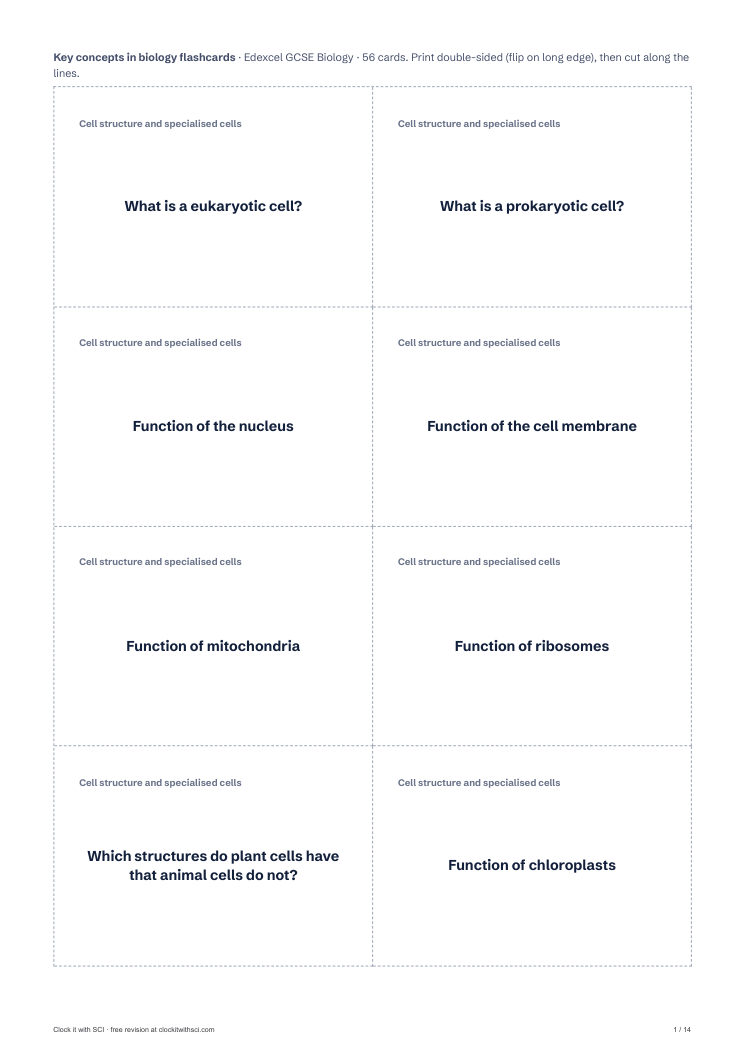
- What is a eukaryotic cell?
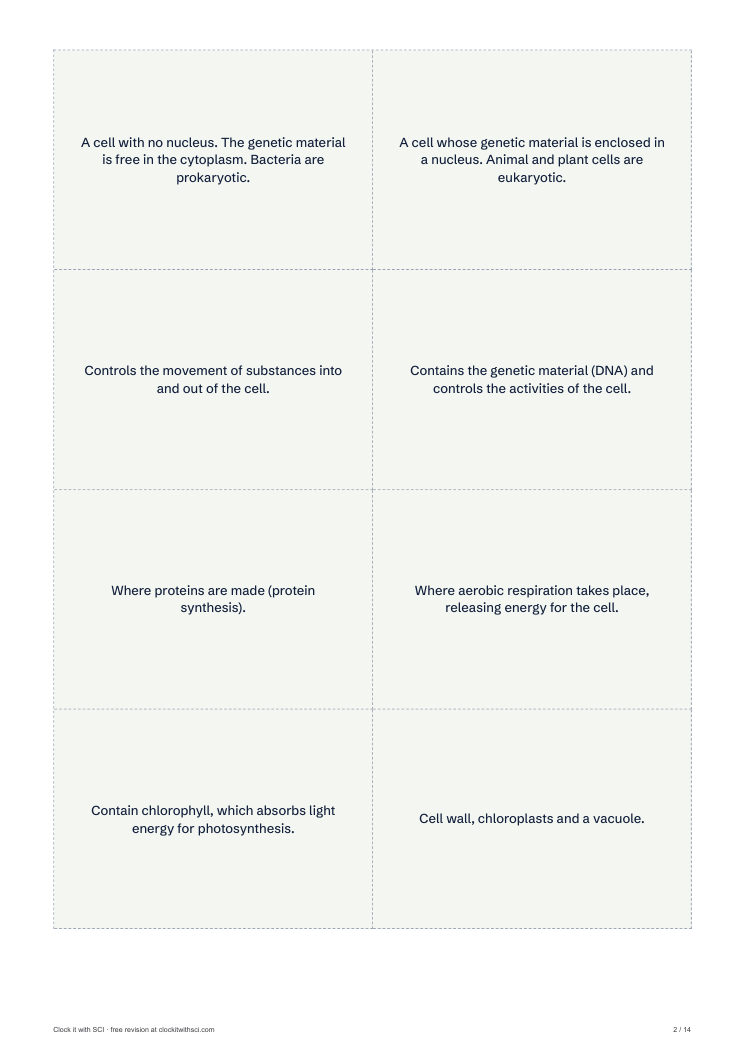
- A cell whose genetic material is enclosed in a nucleus. Animal and plant cells are eukaryotic.
- What is a prokaryotic cell?
- A cell with no nucleus. The genetic material is free in the cytoplasm. Bacteria are prokaryotic.
- Function of the nucleus
- Contains the genetic material (DNA) and controls the activities of the cell.
- Function of the cell membrane
- Controls the movement of substances into and out of the cell.
- Function of mitochondria
- Where aerobic respiration takes place, releasing energy for the cell.
- Function of ribosomes
- Where proteins are made (protein synthesis).
- Which structures do plant cells have that animal cells do not?
- Cell wall, chloroplasts and a vacuole.
- Function of chloroplasts
- Contain chlorophyll, which absorbs light energy for photosynthesis.
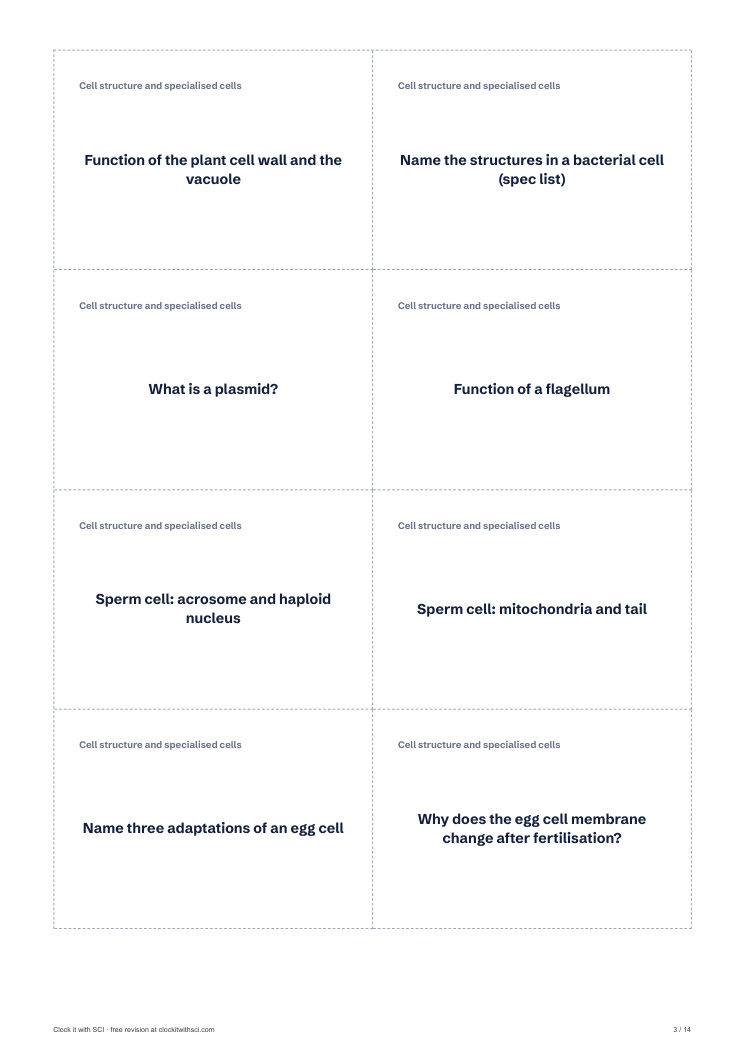
- Function of the plant cell wall and the vacuole
- The cell wall (cellulose) strengthens and supports the cell. The vacuole contains cell sap and keeps the cell firm.
- Name the structures in a bacterial cell (spec list)
- Chromosomal DNA, plasmid DNA, cell membrane, ribosomes and flagella.
- What is a plasmid?
- A small ring of extra DNA in a bacterial cell, separate from the chromosomal DNA.
- Function of a flagellum
- A whip-like structure that moves to make the bacterium swim.
- Sperm cell: acrosome and haploid nucleus
- The acrosome holds enzymes that digest the egg's outer layers. The haploid nucleus has half the chromosomes, so fertilisation restores the full number.
- Sperm cell: mitochondria and tail
- Mitochondria release energy by respiration for the tail. The tail moves to propel the sperm towards the egg.
- Name three adaptations of an egg cell
- Nutrients in the cytoplasm, a haploid nucleus, and changes in the cell membrane after fertilisation.
- Why does the egg cell membrane change after fertilisation?
- So that no more sperm can enter the egg.
- How are ciliated epithelial cells adapted?
- They have cilia that beat to move mucus, with trapped dust and microorganisms, away from the lungs.
Microscopy and measuring cells
- What is resolution?
- How well a microscope can show two points that are close together as separate points.
- Why do electron microscopes show more detail than light microscopes?
- They have a higher magnification and higher resolution.
- How have electron microscopes improved our understanding of cells?
- They show sub-cellular structures in detail, so we understand what each structure does.
- When should an estimation be used?
- To check an answer is sensible, or when an exact value is not needed or cannot be found.
- What are milli, micro, nano and pico as powers of ten?
- milli 10⁻³, micro 10⁻⁶, nano 10⁻⁹, pico 10⁻¹².
- How do you convert mm to µm, and µm to nm?
- Multiply by 1000 each time.
- Write 0.000 045 m in standard form Higher tier
- 4.5 × 10⁻⁵ m.
- Magnification equation
- magnification = size of image ÷ size of real object.
- Rearrange the magnification equation to find real size
- real size = image size ÷ magnification.
- Why is the coverslip lowered at an angle?
- To avoid trapping air bubbles over the specimen.
- Rules for a scientific drawing
- Sharp pencil, clear continuous lines, no shading, drawn large, ruled label lines, title and magnification.
Enzyme action and activity
- What is an enzyme?
- A protein that acts as a biological catalyst, speeding up a reaction without being used up.
- What is the active site?
- The region of an enzyme where the substrate binds, with a shape complementary to the substrate.
- Why are enzymes specific?
- Only a substrate with a shape complementary to the active site can fit, so each enzyme catalyses one type of reaction.
- What does denatured mean?
- The enzyme's shape, including the active site, has permanently changed, so the substrate no longer fits.
- Effect of increasing temperature up to the optimum
- The rate increases, because particles have more kinetic energy and collide more often.
- Why does the rate fall above the optimum temperature?
- The enzyme is denatured as the active site changes shape.
- Why does the rate level off as substrate concentration rises?
- All the active sites are occupied, so adding more substrate makes no difference.
- What happens to enzyme activity as pH moves away from the optimum?
- The rate decreases, and at extreme pH the enzyme is denatured.
- pH core practical: how do you know the starch has gone?
- The iodine solution stays orange-brown instead of turning blue-black.
- pH core practical: variables to control
- Temperature, volume and concentration of enzyme, and volume and concentration of starch.
- Rate of reaction equation
- rate = amount of product formed ÷ time taken. For example cm³/s.
Biological catalysts, food tests and energy in food
- What are carbohydrates, proteins and lipids broken down into?
- Sugars, amino acids, and fatty acids and glycerol.
- What do enzymes build from amino acids?
- Proteins. Enzymes also build carbohydrates from sugars and lipids from fatty acids and glycerol.
- Test for starch and positive result Triple only
- Iodine solution. Orange-brown turns blue-black.
- Test for reducing sugars and positive result Triple only
- Benedict's solution, heated in a hot water bath. Blue turns green, yellow, orange or brick-red.
- Test for protein and positive result Triple only
- Biuret reagent. Blue turns purple (lilac).
- Test for fats and positive result Triple only
- Shake with ethanol, then add water. A cloudy white emulsion forms.
- How is the energy in food measured using calorimetry? Triple only
- Burn the food to heat a known mass of water. Use the temperature rise to calculate the energy released.
- Energy released equation (calorimetry) Triple only
- energy (J) = mass of water (g) × 4.2 × temperature change (°C).
Transport in cells
- Define diffusion
- The net movement of particles from a region of higher concentration to a region of lower concentration.
- Define osmosis
- The diffusion of water from a dilute solution to a more concentrated solution through a partially permeable membrane.
- Define active transport
- Movement of substances against a concentration gradient, from dilute to concentrated, using energy from respiration.
- Factors that increase the rate of diffusion
- A steeper concentration gradient, a higher temperature and a larger surface area.
- Which of diffusion, osmosis and active transport need energy from respiration?
- Only active transport.
- Potato core practical: what is measured?
- The mass of potato cylinders before and after time in solutions of different concentrations.
- Potato core practical: why blot the cylinders dry?
- Water on the surface would add extra mass that is not from osmosis.
- What does a potato gaining mass show?
- The solution is more dilute than the cell contents, so water entered by osmosis.
- Percentage change in mass equation
- (final mass − initial mass) ÷ initial mass × 100.