

Keyboard: space to flip, 1 for not yet, 2 for got it, arrow keys to move.
See all 70 cards as a list
Health and disease
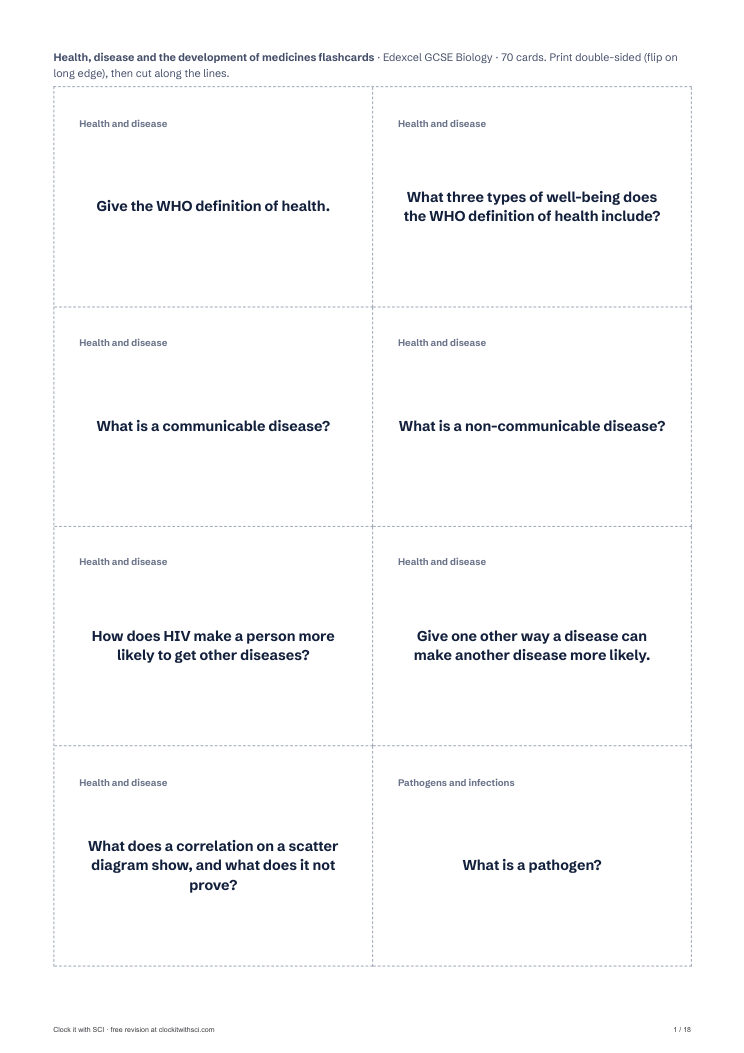
- Give the WHO definition of health.
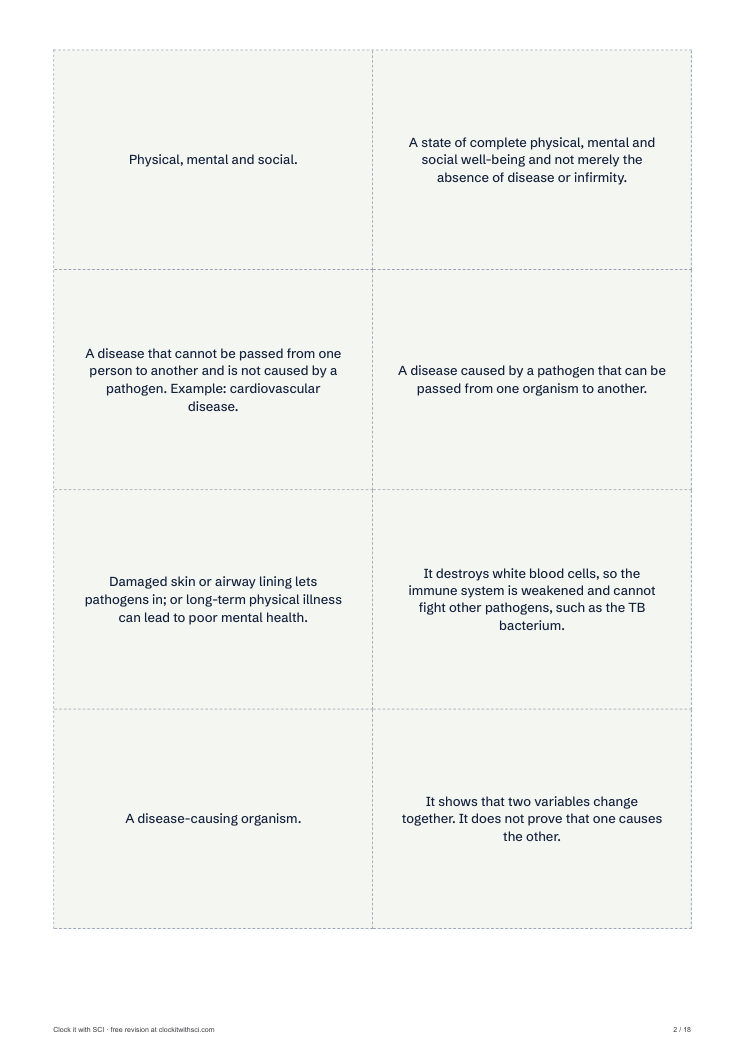
- A state of complete physical, mental and social well-being and not merely the absence of disease or infirmity.
- What three types of well-being does the WHO definition of health include?
- Physical, mental and social.
- What is a communicable disease?
- A disease caused by a pathogen that can be passed from one organism to another.
- What is a non-communicable disease?
- A disease that cannot be passed from one person to another and is not caused by a pathogen. Example: cardiovascular disease.
- How does HIV make a person more likely to get other diseases?
- It destroys white blood cells, so the immune system is weakened and cannot fight other pathogens, such as the TB bacterium.
- Give one other way a disease can make another disease more likely.
- Damaged skin or airway lining lets pathogens in; or long-term physical illness can lead to poor mental health.
- What does a correlation on a scatter diagram show, and what does it not prove?
- It shows that two variables change together. It does not prove that one causes the other.
Pathogens and infections
- What is a pathogen?
- A disease-causing organism.
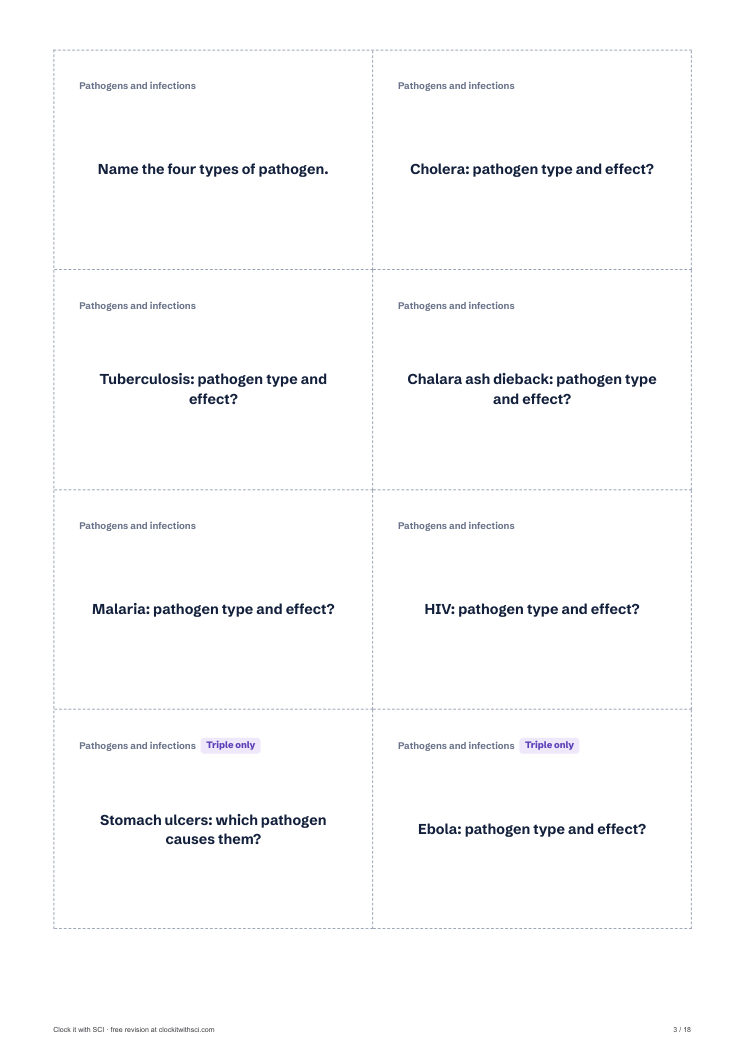
- Name the four types of pathogen.
- Viruses, bacteria, fungi and protists.
- Cholera: pathogen type and effect?
- Bacterium; causes diarrhoea.
- Tuberculosis: pathogen type and effect?
- Bacterium; causes lung damage.
- Chalara ash dieback: pathogen type and effect?
- Fungus; causes leaf loss and bark lesions in ash trees.
- Malaria: pathogen type and effect?
- Protist; causes damage to the blood and liver.
- HIV: pathogen type and effect?
- Virus; destroys white blood cells, leading to the onset of AIDS.
- Stomach ulcers: which pathogen causes them? Triple only
- Helicobacter, a bacterium.
- Ebola: pathogen type and effect? Triple only
- Virus; causes haemorrhagic fever.
- How is cholera spread and how can this be reduced?
- In contaminated water. Reduce by clean drinking water and sewage treatment.
- How is tuberculosis spread and how can this be reduced?
- Airborne, in droplets from coughs and sneezes. Reduce by isolating infected people and covering the mouth when coughing.
- How is Chalara ash dieback spread and how can this be reduced?
- Airborne spores. Reduce by destroying infected trees and restricting movement or import of ash plants.
- What is a vector? Name the vector for malaria.
- An organism that carries a pathogen from one host to another. The mosquito is the malaria vector.
- How are stomach ulcers (Helicobacter) spread and how can this be reduced? Triple only
- By oral transmission, for example swallowing bacteria in food or water. Reduce by good hygiene.
- How is Ebola spread and how can this be reduced? Triple only
- By contact with body fluids. Reduce by isolating patients and wearing protective clothing.
- Describe the lytic pathway of a virus. Triple only
- Viral genetic material takes over the host cell, new viruses are made, the cell bursts and releases them.
- Describe the lysogenic pathway of a virus. Triple only
- Viral genetic material joins the host DNA and stays dormant, copied when the cell divides, until it is triggered to become active.
- How is chlamydia spread and how can this be reduced?
- Unprotected sexual contact. Use condoms, screen and test, and treat with antibiotics.
- How is HIV spread and how can this be reduced?
- Sexual contact, sharing needles, infected blood, mother to baby. Use condoms, do not share needles, screen blood.
Plant defences and plant disease
- How does the leaf cuticle protect a plant? Triple only
- It is a waxy layer that forms a physical barrier, stopping pathogens and pests getting in.
- How does the cell wall protect a plant? Triple only
- It is a strong physical barrier around each cell that pathogens must get past.
- How do chemicals help to defend plants? Triple only
- Some kill or slow the growth of microorganisms, and some are poisons that deter pests.
- How can plant chemicals be used by humans? Triple only
- Some are used to treat disease or relieve symptoms. For example, aspirin was developed from a chemical in willow bark.
- Why eliminate environmental causes when diagnosing a plant disease? Triple onlyHigher tier
- To check that the symptoms are not caused by something like a mineral deficiency or drought rather than a pathogen.
- What is distribution analysis for plant disease? Triple onlyHigher tier
- Recording where affected plants are, to see whether the pattern suggests a spreading pathogen or a local environmental cause.
- What are the two other ways of detecting and identifying plant disease? Triple onlyHigher tier
- Observing visible symptoms, and diagnostic testing to identify the pathogen.
Human defences and immunity
- How do mucus and cilia protect the airways?
- Mucus traps pathogens; cilia move the mucus away from the lungs.
- How does the skin protect against pathogens?
- It is a physical barrier that pathogens cannot easily pass through.
- What are lysozymes?
- Enzymes that break down bacterial cell walls. A chemical defence.
- What does hydrochloric acid in the stomach do?
- It kills pathogens that are swallowed. A chemical defence.
- What is an antigen?
- A molecule, usually on the surface of a pathogen, that triggers an immune response.
- What are antibodies?
- Proteins made by white blood cells that bind to specific antigens and help to destroy the pathogen.
- What are memory lymphocytes?
- White blood cells made after exposure to an antigen that stay in the body and respond quickly if the antigen returns.
- Describe the secondary immune response.
- Memory lymphocytes recognise the antigen. The response is faster and produces more antibodies.
- How does immunisation protect against a disease?
- An inactive pathogen triggers antibody and memory lymphocyte production, so a later infection gets a fast secondary response.
- Why does an inactive pathogen in a vaccine not make you ill?
- It is dead or weakened, so it cannot cause the disease, but its antigens still trigger an immune response.
- What is herd immunity? Triple only
- When a large proportion of the population is immune, so the pathogen spreads poorly and non-immune people are protected.
- Give two advantages of immunisation. Triple only
- Protects the individual and reduces the spread of disease; also protects others through herd immunity.
- Give two disadvantages of immunisation. Triple only
- Side effects can occur; it does not always work or may need boosters.
Antibiotics, culturing microorganisms and new medicines
- Why can antibiotics only treat bacterial infections?
- They inhibit cell processes in the bacterium but not in the host. Viruses live inside host cells.
- What is an autoclave used for? Triple only
- Sterilising growth medium and petri dishes using high-pressure steam.
- How is an inoculating loop made sterile? Triple only
- Heated in a flame until red hot, then cooled before use.
- Why keep petri dishes and culture vials covered? Triple only
- To stop unwanted microorganisms getting in and the culture escaping.
- Core practical: what does a clear zone show? Triple only
- The substance (antiseptic, antibiotic or plant extract) killed bacteria or stopped them growing. A bigger zone means more effective.
- Core practical: why use a control disc soaked in sterile water? Triple only
- To show that the disc or water alone does not stop bacterial growth.
- Equation for the cross-sectional area of a clear zone? Triple only
- area = πr², where r is half the diameter.
- Name the stages in developing a new medicine in order.
- Discovery, development, preclinical testing, clinical testing.
- What happens in preclinical and clinical testing?
- Preclinical: tested on cells, tissues and live animals. Clinical: tested on people, first for safety and then for effectiveness.
- What are monoclonal antibodies? Triple onlyHigher tier
- Identical antibodies made from one type of cell that bind to one specific antigen.
- How are hybridoma cells made? Triple onlyHigher tier
- A lymphocyte that makes the desired antibody (but does not divide) is fused with a tumour cell.
- Why are hybridoma cells useful? Triple onlyHigher tier
- They divide to form many cells and they produce the antibody as they divide.
- Give three uses of monoclonal antibodies. Triple onlyHigher tier
- Pregnancy testing; diagnosis, including locating blood clots and cancer cells; treating diseases including cancer.
- Advantage of monoclonal antibodies over drugs and radiotherapy for cancer? Triple onlyHigher tier
- They target specific cells, so fewer healthy cells are damaged.
Non-communicable diseases
- What causes many non-communicable diseases?
- The interaction of a number of factors, such as lifestyle, environmental and inherited factors.
- What is the BMI equation?
- BMI = mass (kg) ÷ height (m)²
- What does a high waist : hip ratio show?
- More fat stored around the waist, linked to a higher risk of cardiovascular disease.
- How do you calculate waist : hip ratio?
- Waist circumference ÷ hip circumference, both in the same unit. The ratio has no units.
- What are obesity and malnutrition?
- Obesity is having too much body fat. Malnutrition is a diet without the right balance of nutrients.
- How does drinking too much alcohol affect health?
- It damages the liver, causing liver disease such as cirrhosis.
- How does smoking affect cardiovascular health?
- It damages artery linings, leading to fatty build-up and narrowing, and raises heart rate and blood pressure.
- What are the three levels at which lifestyle effects are considered?
- Local, national and global.
- Name three types of treatment for cardiovascular disease.
- Life-long medication, surgical procedures and lifestyle changes.
- Give a disadvantage of each treatment for cardiovascular disease.
- Medication: taken for life with side effects. Surgery: risks and recovery. Lifestyle changes: slow and need effort.