

Keyboard: space to flip, 1 for not yet, 2 for got it, arrow keys to move.
See all 57 cards as a list
Reproduction and meiosis
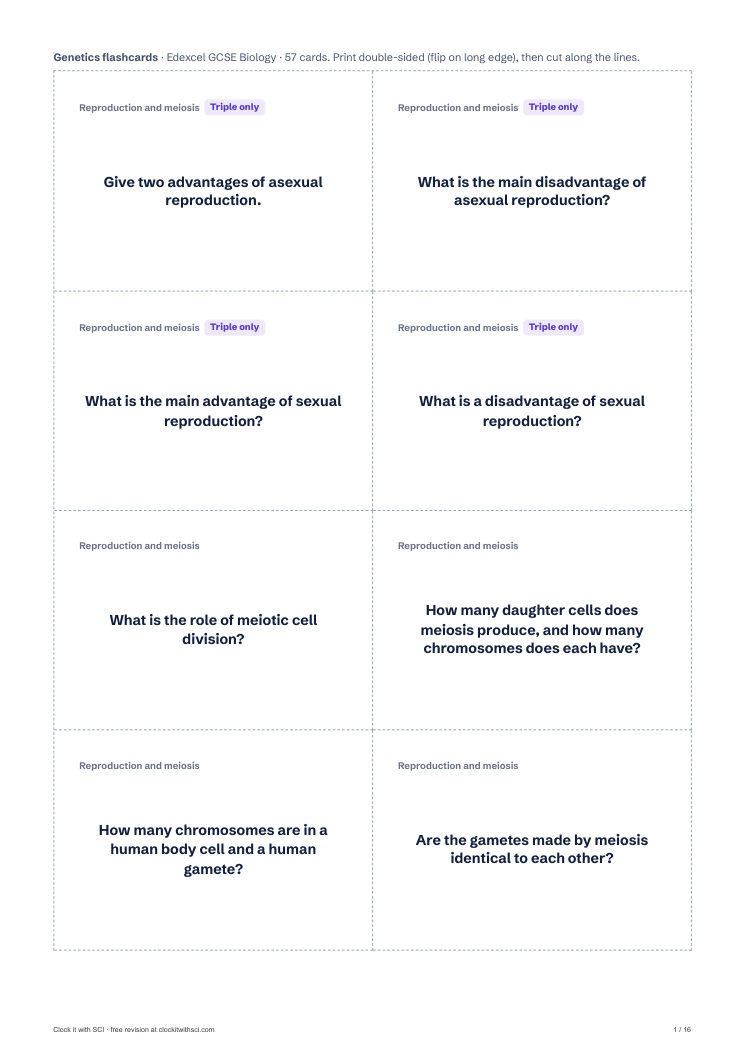
- Give two advantages of asexual reproduction. Triple only
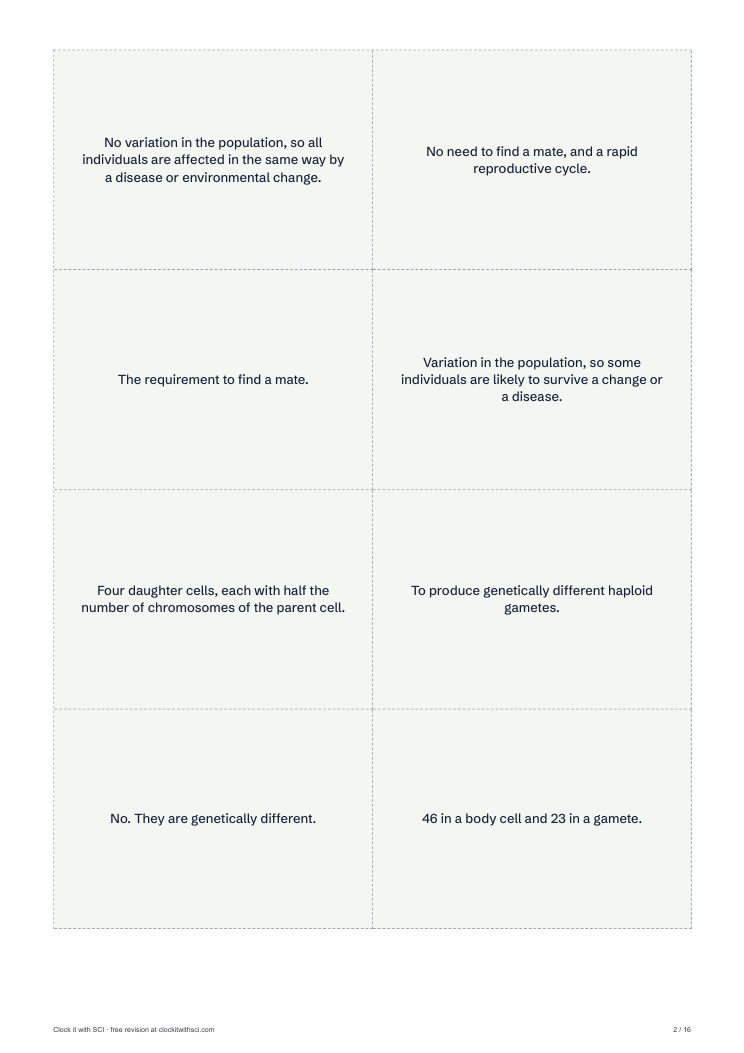
- No need to find a mate, and a rapid reproductive cycle.
- What is the main disadvantage of asexual reproduction? Triple only
- No variation in the population, so all individuals are affected in the same way by a disease or environmental change.
- What is the main advantage of sexual reproduction? Triple only
- Variation in the population, so some individuals are likely to survive a change or a disease.
- What is a disadvantage of sexual reproduction? Triple only
- The requirement to find a mate.
- What is the role of meiotic cell division?
- To produce genetically different haploid gametes.
- How many daughter cells does meiosis produce, and how many chromosomes does each have?
- Four daughter cells, each with half the number of chromosomes of the parent cell.
- How many chromosomes are in a human body cell and a human gamete?
- 46 in a body cell and 23 in a gamete.
- Are the gametes made by meiosis identical to each other?
- No. They are genetically different.
DNA and the genome
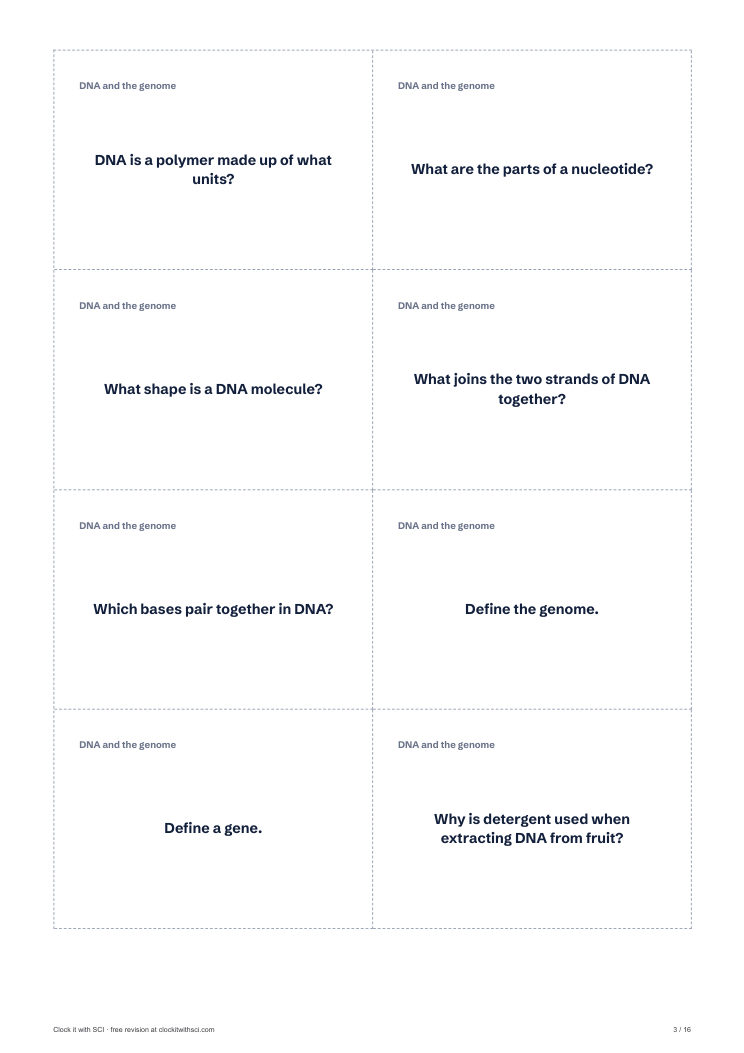
- DNA is a polymer made up of what units?
- Nucleotides.
- What are the parts of a nucleotide?
- A sugar and a phosphate group, with one of four different bases attached to the sugar.
- What shape is a DNA molecule?
- Two strands coiled to form a double helix.
- What joins the two strands of DNA together?
- Complementary base pairs joined by weak hydrogen bonds.
- Which bases pair together in DNA?
- A with T, and C with G.
- Define the genome.
- The entire DNA of an organism.
- Define a gene.
- A section of a DNA molecule that codes for a specific protein.
- Why is detergent used when extracting DNA from fruit?
- It breaks down the cell membranes to release the DNA.
- Why is ice-cold ethanol added when extracting DNA?
- DNA is not soluble in it, so it comes out of solution as white, stringy strands.
- Why is the mashed fruit mixture filtered?
- To remove solid pieces of cell, leaving the DNA in the filtrate.
Protein synthesis and gene variants
- What decides the order of amino acids in a protein? Triple onlyHigher tier
- The order of bases in a section of DNA.
- How does a protein get its specific shape? Triple onlyHigher tier
- The chain of amino acids folds. The way it folds depends on the order of amino acids.
- Name the two stages of protein synthesis. Triple onlyHigher tier
- Transcription and translation.
- What does RNA polymerase bind to? Triple onlyHigher tier
- Non-coding DNA located in front of a gene.
- What does RNA polymerase produce? Triple onlyHigher tier
- A complementary mRNA strand from the coding DNA of the gene.
- What is a codon? Triple onlyHigher tier
- A triplet of bases in mRNA that codes for a specific amino acid.
- What is the role of tRNA? Triple onlyHigher tier
- It transfers amino acids to the ribosome.
- What happens to amino acids at the ribosome? Triple onlyHigher tier
- They are linked together to form a polypeptide.
- How can a variant in non-coding DNA affect phenotype? Triple onlyHigher tier
- It can change the binding of RNA polymerase, altering the quantity of protein produced.
- How can a variant in coding DNA affect phenotype? Triple onlyHigher tier
- It can alter the sequence of amino acids, and so the activity of the protein produced.
Inheritance
- Who was Gregor Mendel and what did he do? Triple only
- A monk who bred pea plants and counted offspring over generations, discovering the basis of genetics.
- Why was inheritance difficult to understand before Mendel's work was explained? Triple only
- Genes, chromosomes and DNA were not known, so there was no mechanism to explain it.
- Why do individuals have different inherited characteristics?
- Because they inherit different combinations of alleles.
- Define a chromosome.
- A long molecule of DNA in the nucleus that carries many genes.
- Define an allele.
- A different version of the same gene.
- Dominant allele or recessive allele: which is expressed when only one copy is present?
- The dominant allele.
- Homozygous or heterozygous: which has two different alleles of a gene?
- Heterozygous. Homozygous means two identical alleles.
- What is the difference between genotype and phenotype?
- Genotype is the alleles an organism has. Phenotype is the characteristic that is expressed.
- What are a gamete and a zygote?
- A gamete is a sex cell with half the chromosomes. A zygote is the cell formed when two gametes fuse.
- What ratio of phenotypes is expected from Tt × Tt (T dominant)?
- 3 showing the dominant characteristic : 1 showing the recessive.
- Two parents without a characteristic have a child with it. What does this show?
- The characteristic is recessive and both parents are carriers.
- Which sex chromosomes do human males and females have?
- Males XY, females XX.
- What is the probability of a baby being male or female?
- 50% (a 1 : 1 ratio). The sperm decides, as it carries an X or a Y.
- How can the outcome of a cross be expressed?
- As a ratio, a probability or a percentage.
- Two carriers (Ff) have a child. What is the probability that it is ff?
- 1/4, 0.25 or 25%.
- What is codominance? Triple only
- Both alleles are expressed in the phenotype of a heterozygous organism, such as IA and IB giving blood group AB.
- What are multiple alleles? Give the ABO alleles. Triple only
- More than two alleles of a gene. The ABO alleles are IA, IB and IO.
- Which genotypes give blood group A? Triple only
- IA IA or IA IO.
- Why are sex-linked disorders more common in males? Triple onlyHigher tier
- Males have only one X, so one recessive allele on it causes the disorder. Females need two copies.
- A carrier mother has children with an unaffected father. What is the chance a son has the disorder? Triple onlyHigher tier
- 50%. No daughters are affected, but half are carriers.
Variation, mutations and the Human Genome Project
- Do most features depend on one gene or many?
- Most phenotypic features are the result of multiple genes rather than single gene inheritance.
- What is genetic variation?
- Different characteristics as a result of mutation and sexual reproduction.
- What is environmental variation?
- Different characteristics caused by an organism's environment (acquired characteristics).
- Continuous or discontinuous variation: which has distinct categories?
- Discontinuous. Continuous variation gives a range of values, such as height.
- How do you calculate an arithmetic mean?
- Add all the values and divide by the number of values.
- What was the Human Genome Project?
- A project that mapped the human genome, identifying the sequence of bases in human DNA.
- Give two medical applications of the Human Genome Project.
- Finding genes linked to inherited disorders for testing and risk prediction, and developing treatments matched to genes.
- How does extensive genetic variation in a population arise?
- Through mutations.
- What effects do mutations have on the phenotype?
- Most have no effect, some have a small effect, and rarely a single mutation significantly affects the phenotype.