

Keyboard: space to flip, 1 for not yet, 2 for got it, arrow keys to move.
See all 59 cards as a list
Transport and exchange surfaces
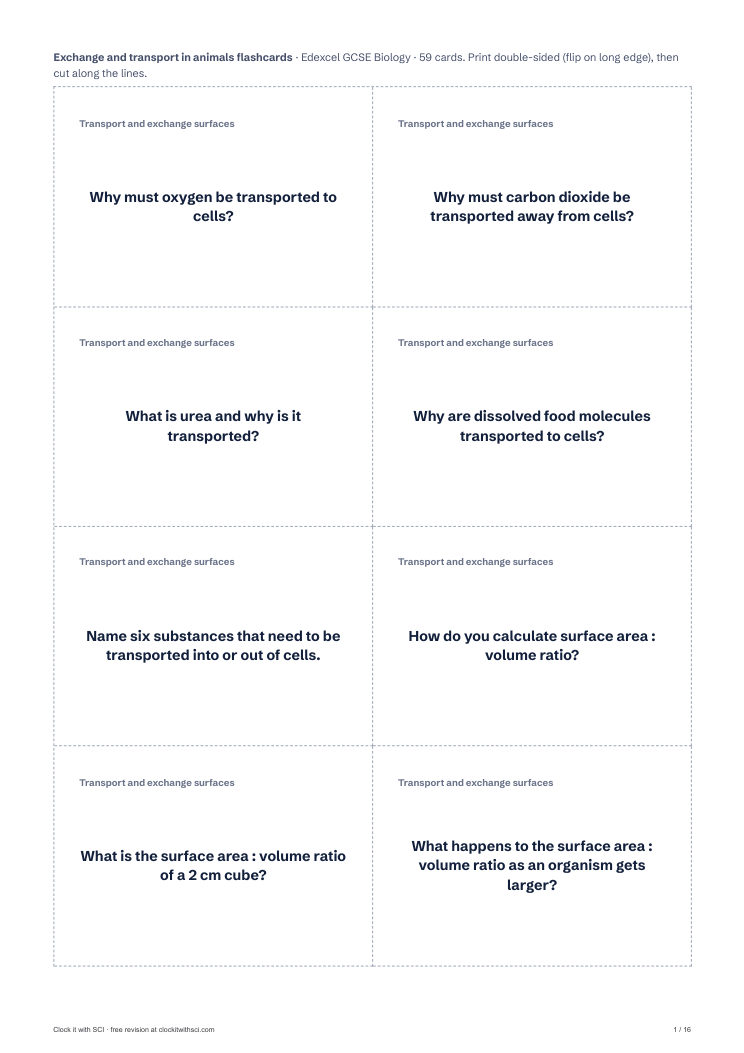
- Why must oxygen be transported to cells?
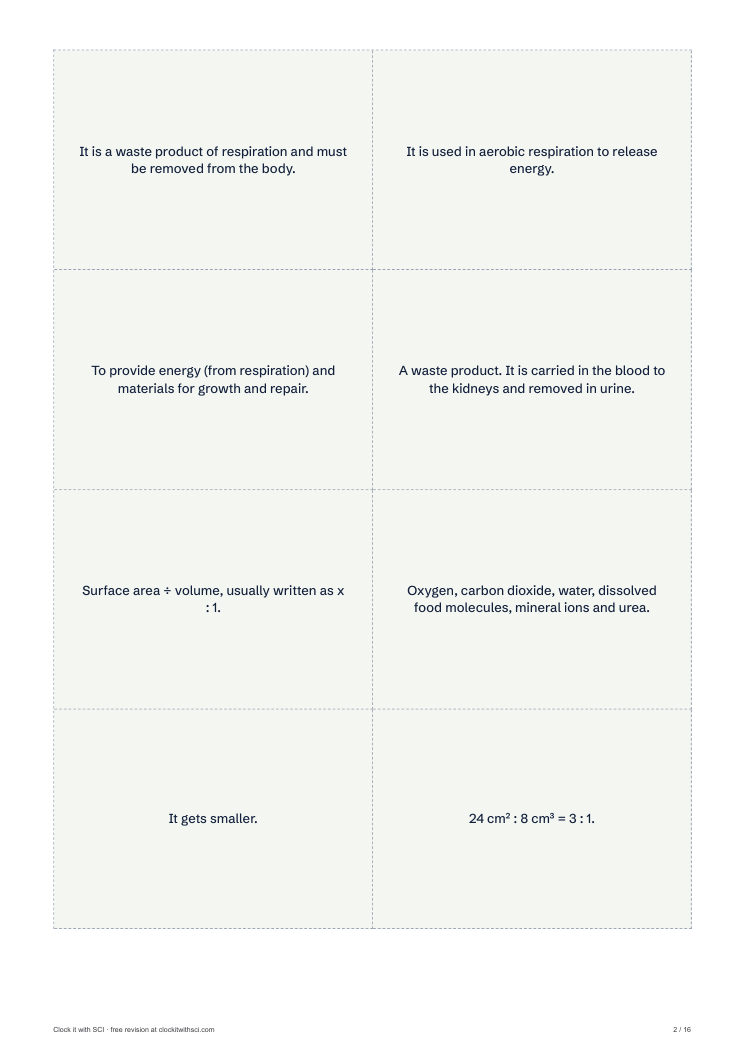
- It is used in aerobic respiration to release energy.
- Why must carbon dioxide be transported away from cells?
- It is a waste product of respiration and must be removed from the body.
- What is urea and why is it transported?
- A waste product. It is carried in the blood to the kidneys and removed in urine.
- Why are dissolved food molecules transported to cells?
- To provide energy (from respiration) and materials for growth and repair.
- Name six substances that need to be transported into or out of cells.
- Oxygen, carbon dioxide, water, dissolved food molecules, mineral ions and urea.
- How do you calculate surface area : volume ratio?
- Surface area ÷ volume, usually written as x : 1.
- What is the surface area : volume ratio of a 2 cm cube?
- 24 cm² : 8 cm³ = 3 : 1.
- What happens to the surface area : volume ratio as an organism gets larger?
- It gets smaller.
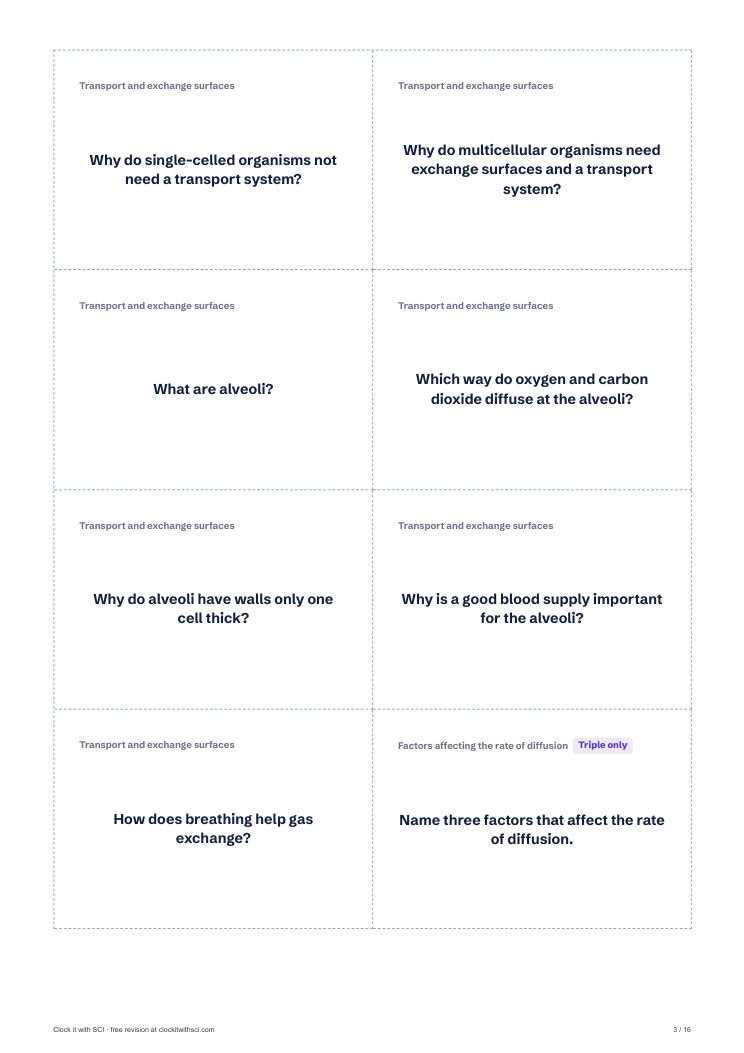
- Why do single-celled organisms not need a transport system?
- They have a large surface area : volume ratio and a short diffusion distance, so diffusion is fast enough.
- Why do multicellular organisms need exchange surfaces and a transport system?
- They have a small surface area : volume ratio and long diffusion distances, so diffusion alone is too slow.
- What are alveoli?
- Tiny air sacs in the lungs where gas exchange takes place.
- Which way do oxygen and carbon dioxide diffuse at the alveoli?
- Oxygen from the alveoli into the blood. Carbon dioxide from the blood into the alveoli.
- Why do alveoli have walls only one cell thick?
- To give a short diffusion distance, so gases diffuse quickly.
- Why is a good blood supply important for the alveoli?
- It carries oxygen away and brings carbon dioxide, maintaining a steep concentration gradient.
- How does breathing help gas exchange?
- Ventilation keeps oxygen high and carbon dioxide low in the alveoli, maintaining the concentration gradient.
Factors affecting the rate of diffusion
- Name three factors that affect the rate of diffusion. Triple only
- Surface area, concentration gradient and diffusion distance.
- How does a larger surface area affect the rate of diffusion? Triple only
- It increases the rate of diffusion.
- How does a steeper concentration gradient affect the rate of diffusion? Triple only
- It increases the rate of diffusion.
- How does a greater diffusion distance affect the rate of diffusion? Triple only
- It decreases the rate of diffusion.
- State Fick’s law. Triple only
- Rate of diffusion is proportional to surface area × concentration difference ÷ thickness of membrane.
- What does the symbol ∝ mean? Triple only
- Is proportional to.
- In Fick’s law, what happens to the rate if the membrane thickness doubles? Triple only
- The rate halves, if the other factors stay the same.
Blood and blood vessels
- What is the function of red blood cells?
- To carry oxygen from the lungs to the cells.
- What is haemoglobin?
- The red substance in red blood cells that combines with oxygen to form oxyhaemoglobin.
- Why do red blood cells have a biconcave shape?
- It gives a large surface area for absorbing oxygen.
- Why do red blood cells have no nucleus?
- To make more room for haemoglobin.
- What do phagocytes do?
- They engulf pathogens and digest them.
- What do lymphocytes do?
- They produce antibodies that destroy pathogens.
- What is plasma and what does it carry?
- The liquid part of blood. It carries blood cells, carbon dioxide, urea, digested food, mineral ions and hormones.
- What are platelets?
- Small fragments of cells with no nucleus that help the blood to clot.
- How is an artery adapted to carry blood at high pressure?
- Thick muscular wall, elastic fibres and a narrow lumen.
- How is a vein adapted to its function?
- Thinner wall, wide lumen and valves to stop backflow of blood at low pressure.
- How is a capillary adapted for exchange?
- Walls one cell thick for a short diffusion distance, and a large network for a large surface area.
- Which direction does blood flow in arteries, veins and capillaries?
- Arteries away from the heart, veins towards the heart, capillaries between them through the tissues.
The heart and circulation
- What is a double circulatory system?
- One circuit takes blood from the heart to the lungs and back, the other from the heart to the body and back.
- What does the vena cava do?
- Carries deoxygenated blood from the body to the right atrium.
- What does the pulmonary artery do?
- Carries deoxygenated blood from the right ventricle to the lungs.
- What does the pulmonary vein do?
- Carries oxygenated blood from the lungs to the left atrium.
- What does the aorta do?
- Carries oxygenated blood from the left ventricle to the body.
- How do you calculate heart rate from cardiac output and stroke volume?
- Heart rate = cardiac output ÷ stroke volume.
- What is the function of the heart valves?
- To prevent backflow so that blood flows in one direction.
- Why is the left ventricle wall thicker than the right?
- It pumps blood at higher pressure around the whole body. The right ventricle only pumps blood to the lungs.
- Why are the ventricle walls thicker than the atrium walls?
- The ventricles pump blood out of the heart, further than the atria pump it.
- What is the equation for cardiac output?
- Cardiac output = stroke volume × heart rate.
- What is stroke volume?
- The volume of blood pumped out of the heart in each beat.
- What is cardiac output?
- The volume of blood pumped out of the heart per minute.
- What are the units of cardiac output?
- cm³ per minute, if heart rate is in beats per minute and stroke volume in cm³.
Respiration
- What does exothermic mean?
- A reaction that transfers energy to the surroundings.
- What is cellular respiration?
- An exothermic reaction which occurs continuously in living cells to release energy for metabolic processes.
- Write the word equation for aerobic respiration.
- Glucose + oxygen → carbon dioxide + water.
- Write the symbol equation for aerobic respiration.
- C₆H₁₂O₆ + 6O₂ → 6CO₂ + 6H₂O.
- What is anaerobic respiration in animal cells?
- Glucose → lactic acid, without oxygen.
- What is anaerobic respiration in plant cells and yeast?
- Glucose → ethanol + carbon dioxide, without oxygen.
- Which releases more energy per glucose, aerobic or anaerobic respiration?
- Aerobic respiration, because glucose is completely broken down.
- Which type of respiration needs oxygen?
- Aerobic respiration.
- What does a respirometer measure?
- The rate at which a living organism takes in oxygen, shown by the movement of coloured liquid in a capillary tube.
- Why is soda lime used in a respirometer?
- To absorb the carbon dioxide produced, so the change in gas volume is due to oxygen used up.
- In a respirometer, which way does the coloured liquid move and why?
- Towards the organisms, because the volume of gas falls as oxygen is used up.
- Name two control variables in the respirometer investigation.
- Any two of: mass of organisms, type of organism, time, volume of soda lime.