

Keyboard: space to flip, 1 for not yet, 2 for got it, arrow keys to move.
See all 59 cards as a list
Communities and interdependence
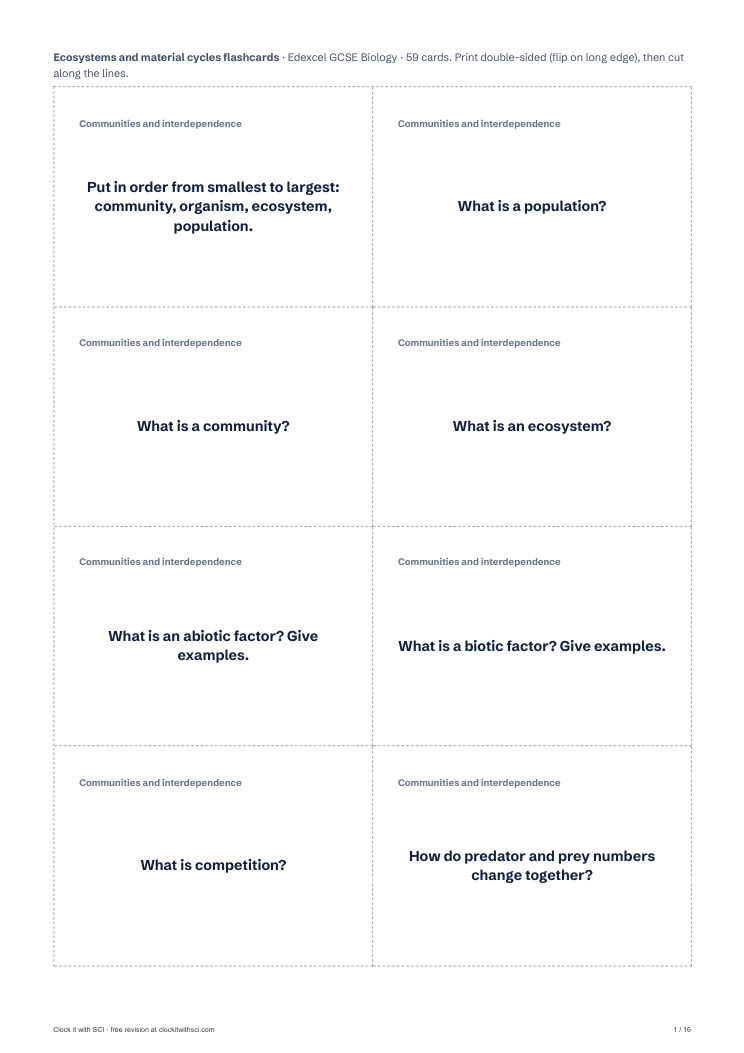
- Put in order from smallest to largest: community, organism, ecosystem, population.
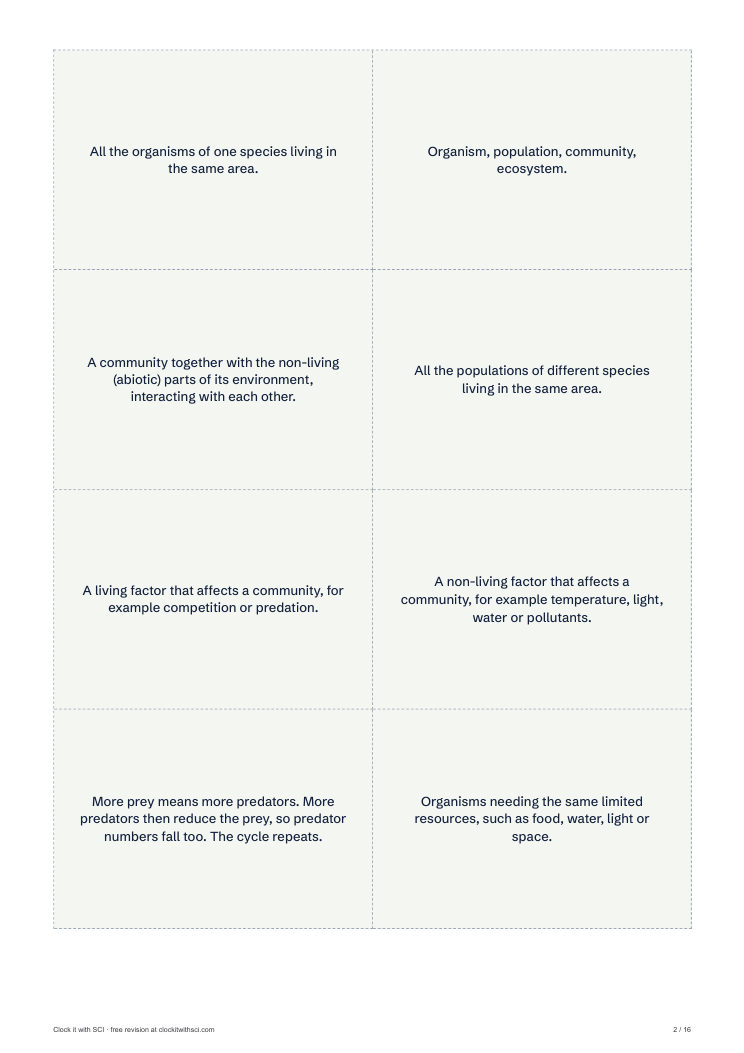
- Organism, population, community, ecosystem.
- What is a population?
- All the organisms of one species living in the same area.
- What is a community?
- All the populations of different species living in the same area.
- What is an ecosystem?
- A community together with the non-living (abiotic) parts of its environment, interacting with each other.
- What is an abiotic factor? Give examples.
- A non-living factor that affects a community, for example temperature, light, water or pollutants.
- What is a biotic factor? Give examples.
- A living factor that affects a community, for example competition or predation.
- What is competition?
- Organisms needing the same limited resources, such as food, water, light or space.
- How do predator and prey numbers change together?
- More prey means more predators. More predators then reduce the prey, so predator numbers fall too. The cycle repeats.
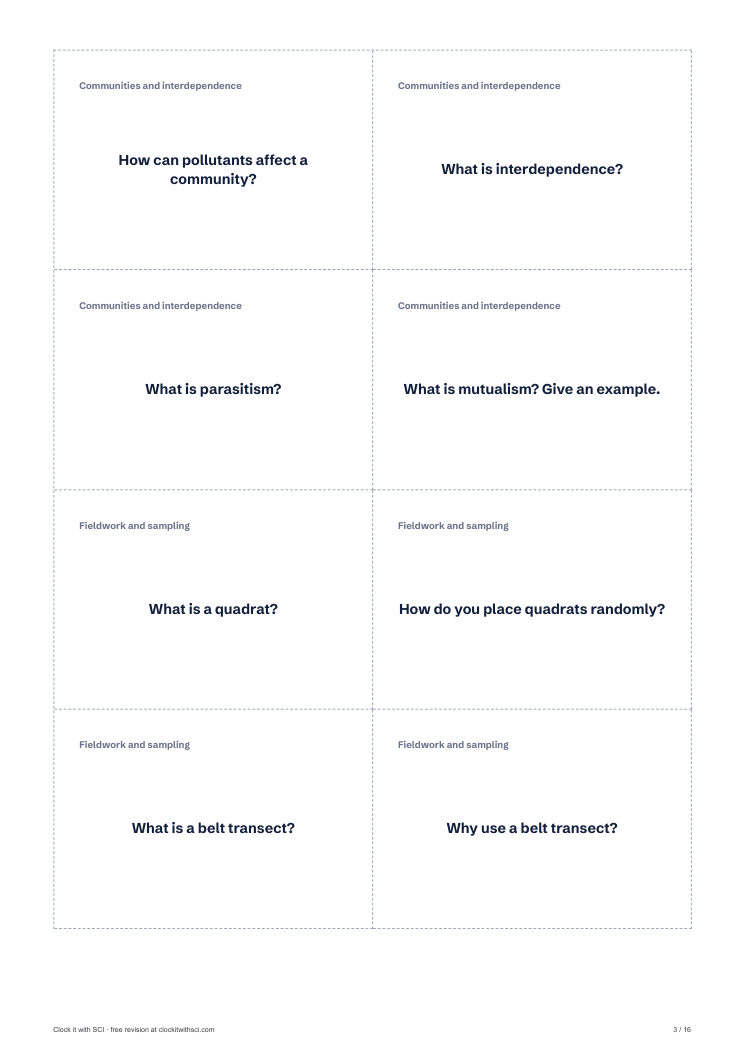
- How can pollutants affect a community?
- They can kill sensitive species, so the number of species and organisms falls.
- What is interdependence?
- Species in a community depend on each other for food, shelter, pollination and seed dispersal, so a change in one affects others.
- What is parasitism?
- A parasite lives on or in a host and takes food from it. The parasite benefits and the host is harmed.
- What is mutualism? Give an example.
- Both organisms benefit. For example, nitrogen-fixing bacteria in the root nodules of legumes.
Fieldwork and sampling
- What is a quadrat?
- A square frame used to sample the organisms in a small, known area.
- How do you place quadrats randomly?
- Lay two tape measures at right angles and use random numbers as coordinates for each quadrat.
- What is a belt transect?
- A line across a habitat with quadrats placed at regular intervals along it.
- Why use a belt transect?
- To see how the distribution of organisms changes along an environmental gradient, such as light or moisture.
- Equation for estimating a population using quadrats.
- Mean number per quadrat × (total area ÷ area of one quadrat).
- What is percentage cover?
- The percentage of a quadrat covered by a species. It is used when individuals are hard to count.
- Why take many quadrat samples?
- It gives a more representative, reliable sample and reduces the effect of anomalies.
Energy transfer in ecosystems
- Why do food chains have a limited length? Triple only
- Energy is lost at each trophic level, so too little energy is left to support more levels.
- Give ways energy is lost between trophic levels. Triple only
- Heat from respiration, movement, waste (faeces, urine), and parts of the organism not eaten.
- What is a pyramid of biomass? Triple only
- A diagram showing the biomass at each trophic level, with producers at the bottom. It gets narrower going up.
- Why are there fewer organisms at higher trophic levels? Triple only
- Less energy and biomass is available at each level, because energy is transferred to less useful forms.
- How do you calculate the efficiency of energy transfer? Triple only
- Energy transferred to next level ÷ energy available at previous level × 100.
- How do you calculate a percentage of biomass transferred? Triple only
- Biomass gained ÷ biomass available at the previous level × 100.
Human impacts, biodiversity and food security
- Give a positive and a negative effect of fish farming.
- Positive: reduces overfishing. Negative: waste can cause eutrophication, or disease can spread to wild fish.
- What is a non-indigenous species?
- A species that has been introduced to an area where it does not naturally live.
- How can a non-indigenous species reduce biodiversity?
- It can out-compete, eat or infect native species, so their numbers fall.
- What is eutrophication?
- Too many nutrients, such as nitrates, entering water, causing algal growth and then lack of oxygen.
- Give the order of events in eutrophication.
- Nitrates in, algal bloom, light blocked, plants die, bacteria increase and use up oxygen, fish die.
- Give a benefit of maintaining biodiversity.
- More stable ecosystems, and a source of food, materials and medicines.
- How can animal species be conserved?
- Protecting habitats, captive breeding programmes and laws against hunting.
- What is reforestation and how does it help?
- Replanting trees. It restores habitats, absorbs carbon dioxide and reduces soil erosion.
- What is food security? Triple only
- Having enough food to feed a population.
- List the biological factors affecting food security. Triple only
- Population growth, more animal farming and meat and fish eating, new pests and pathogens, human-caused environmental change, sustainability issues.
- Why does eating more meat reduce food security? Triple only
- Energy is lost between trophic levels, so more land and crops are needed to produce meat than plant food.
- Give two sustainability issues for food production. Triple only
- Land used for biofuels instead of food, and the cost of agricultural inputs such as fertiliser and feed.
Material cycles
- Why must materials be cycled in an ecosystem?
- The supply is limited, so materials are returned to the environment for new organisms to use.
- What are the abiotic and biotic components of an ecosystem?
- Abiotic: air, water, soil. Biotic: the living organisms.
- Which process removes carbon dioxide from the air?
- Photosynthesis.
- Which processes return carbon dioxide to the air?
- Respiration, decay by decomposers, and combustion.
- What do decomposers do?
- Microorganisms (bacteria and fungi) that break down dead material and waste and release carbon dioxide by respiration.
- Name the main processes in the water cycle.
- Evaporation, transpiration, condensation and precipitation.
- What is potable water?
- Water that is safe to drink.
- What is desalination and what is its disadvantage?
- Removing salt from sea water to make potable water. It needs a lot of energy so is expensive.
- Why do plants need nitrates?
- To make amino acids and proteins.
- What do nitrogen-fixing bacteria do?
- Convert nitrogen gas from the air into nitrogen compounds, which become nitrates. Some live in legume root nodules.
- What do nitrifying bacteria do?
- Convert ammonium ions in the soil into nitrates.
- What do denitrifying bacteria do?
- Convert nitrates in the soil into nitrogen gas, reducing soil fertility.
- How do fertilisers and crop rotation help plants get nitrates?
- Fertilisers add nitrates. In crop rotation, a legume crop adds nitrates through nitrogen-fixing bacteria.
Indicator species and decomposition
- Which indicator species show polluted water? Triple onlyHigher tier
- Bloodworms and sludgeworms.
- Which indicator species show clean water? Triple onlyHigher tier
- Freshwater shrimps and stonefly nymphs.
- How do lichens and blackspot fungus on roses indicate air quality? Triple onlyHigher tier
- They are sensitive to sulfur dioxide. Different lichen species tolerate different levels; blackspot is more common in cleaner air.
- Give a limitation of using indicator species. Triple onlyHigher tier
- Only a rough guide: other factors may affect the species, and it does not give an accurate measurement of the pollutant.
- Which factors affect the rate of decomposition? Triple only
- Temperature, water content and oxygen availability.
- How do freezing, drying and vacuum packing preserve food? Triple only
- They slow decomposition by microorganisms: low temperature slows their enzymes, and they have less water and less oxygen.
- What conditions give fast decomposition in composting? Triple only
- Warm, moist and plenty of oxygen.
- How do you calculate the rate of decay? Triple only
- Change in mass ÷ time.
- How do you calculate percentage loss in mass? Triple only
- Change in mass ÷ original mass × 100.