

Keyboard: space to flip, 1 for not yet, 2 for got it, arrow keys to move.
See all 59 cards as a list
Mitosis and cancer
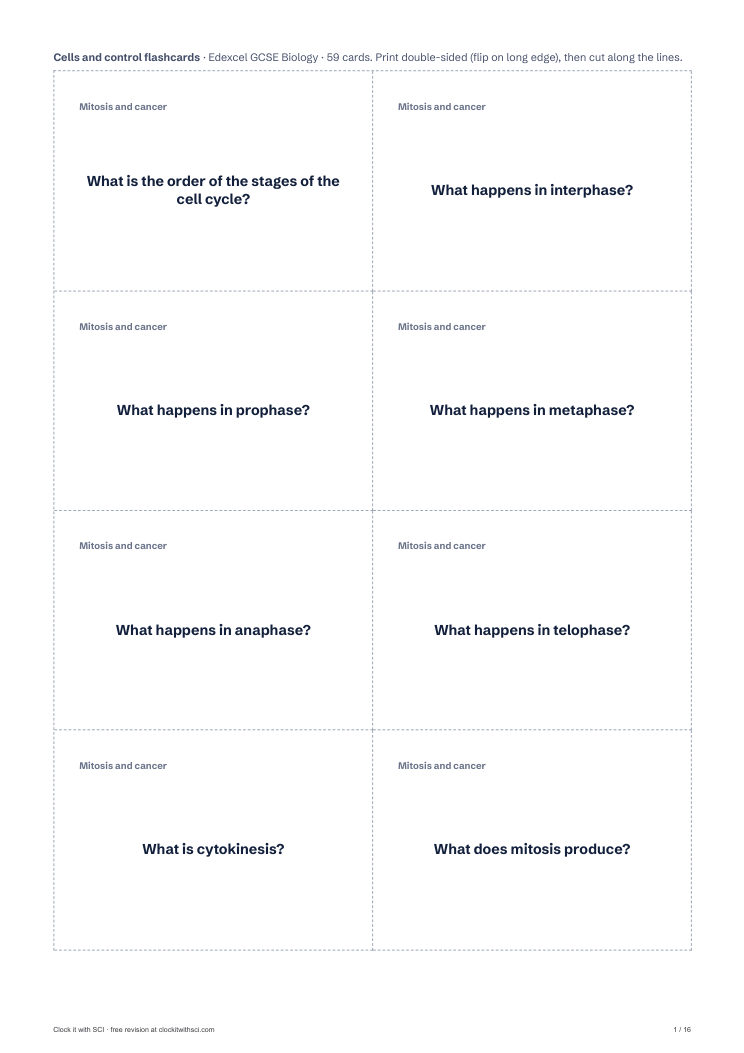
- What is the order of the stages of the cell cycle?
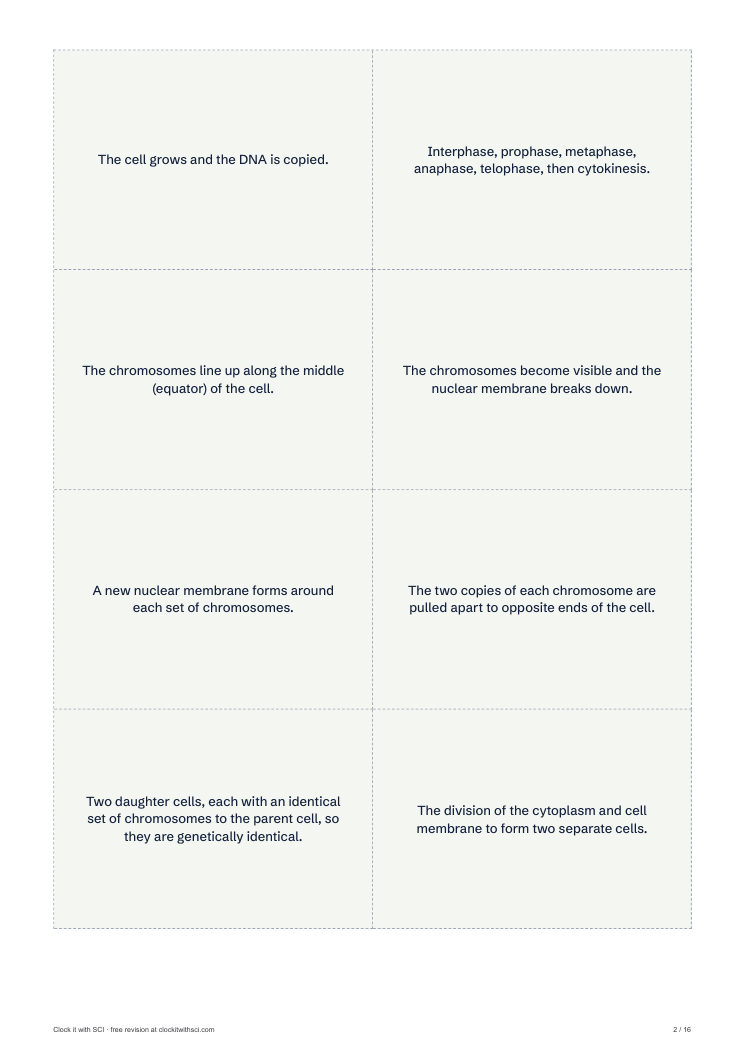
- Interphase, prophase, metaphase, anaphase, telophase, then cytokinesis.
- What happens in interphase?
- The cell grows and the DNA is copied.
- What happens in prophase?
- The chromosomes become visible and the nuclear membrane breaks down.
- What happens in metaphase?
- The chromosomes line up along the middle (equator) of the cell.
- What happens in anaphase?
- The two copies of each chromosome are pulled apart to opposite ends of the cell.
- What happens in telophase?
- A new nuclear membrane forms around each set of chromosomes.
- What is cytokinesis?
- The division of the cytoplasm and cell membrane to form two separate cells.
- What does mitosis produce?
- Two daughter cells, each with an identical set of chromosomes to the parent cell, so they are genetically identical.
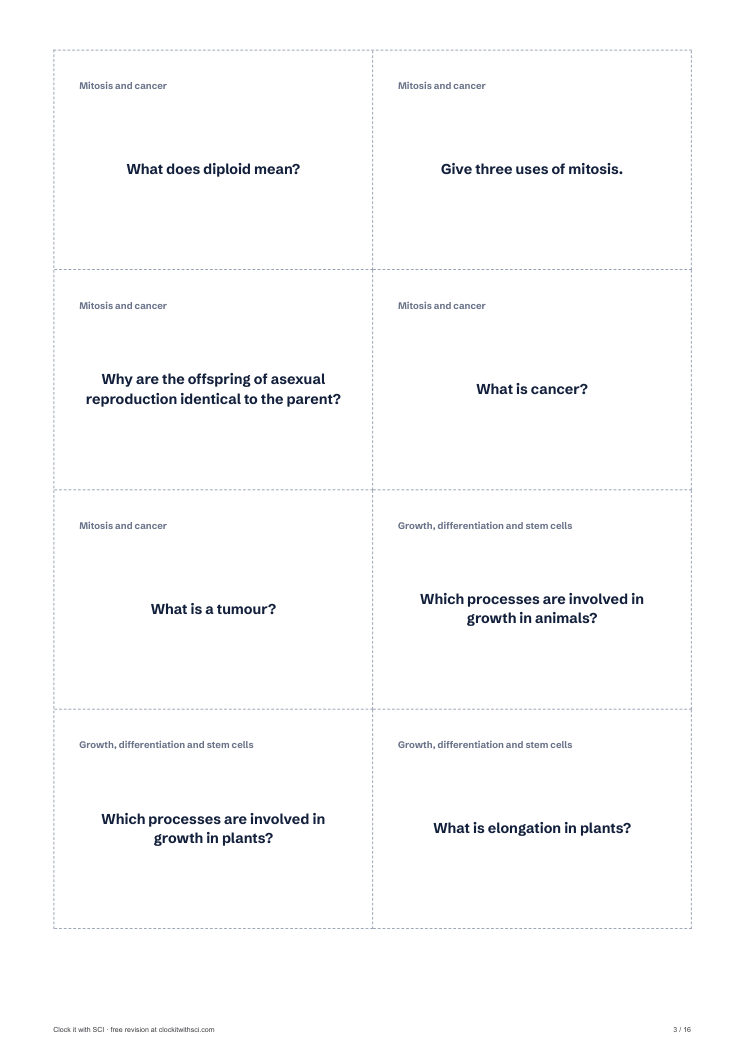
- What does diploid mean?
- The nucleus contains two sets of chromosomes, which form pairs. Human body cells have 46 (23 pairs).
- Give three uses of mitosis.
- Growth, repair and asexual reproduction.
- Why are the offspring of asexual reproduction identical to the parent?
- They are made by mitosis, which produces genetically identical cells, from only one parent.
- What is cancer?
- The result of changes in cells that lead to uncontrolled cell division.
- What is a tumour?
- A mass of cells formed when cells divide in an uncontrolled way.
Growth, differentiation and stem cells
- Which processes are involved in growth in animals?
- Cell division and differentiation.
- Which processes are involved in growth in plants?
- Cell division, elongation and differentiation.
- What is elongation in plants?
- Cells getting longer, mostly by taking in water so that they expand.
- What is differentiation?
- The process by which a cell becomes specialised for a particular job by gaining the structures it needs.
- Why is differentiation important?
- It produces specialised cells, so a multicellular organism can have different cells doing different jobs.
- What is a percentile chart used for?
- To monitor the growth of a child by comparing their measurements with those of other children of the same age and sex.
- A child is on the 75th percentile for mass. What does this mean?
- 75% of children of that age and sex have a lower mass, and 25% have a higher mass.
- What is the equation for percentage change?
- (change ÷ original value) × 100
- What is a stem cell?
- An undifferentiated cell that can divide and can differentiate into specialised cells.
- What is the function of embryonic stem cells?
- They can differentiate into any type of cell, producing all the specialised cells of the developing embryo.
- What is the function of stem cells in adult animals, such as in bone marrow?
- They replace damaged or worn-out cells. They can differentiate into only a limited range of cell types, for example blood cells.
- What is the function of meristems in plants?
- Found at root and shoot tips, they produce cells that can differentiate into any type of plant cell, so the plant keeps growing.
- Give two potential benefits of using stem cells in medicine.
- Treating conditions such as diabetes or paralysis, and replacing damaged cells with healthy ones.
- Give two risks of using stem cells in medicine.
- Tumour formation, and transfer of viruses from donor cells. Also immune rejection.
- Why do some people object to embryonic stem cell research?
- Embryos are used, and some people have ethical or religious objections to this.
Neurones and reflexes
- What is a sensory receptor?
- A cell that detects a stimulus and produces an electrical impulse.
- What does a sensory neurone do?
- Carries electrical impulses from a receptor to the CNS.
- What does a relay neurone do?
- It is in the CNS and connects the sensory neurone to the motor neurone.
- What does a motor neurone do?
- Carries electrical impulses from the CNS to an effector.
- What is the CNS?
- The central nervous system: the brain and spinal cord.
- What are the axon and the dendron?
- The axon carries impulses away from the cell body. The dendron carries impulses towards the cell body.
- What is the role of the myelin sheath?
- It insulates the neurone and speeds up the transmission of impulses.
- What is a synapse?
- A gap between two neurones.
- What is the role of a neurotransmitter?
- It diffuses across the synapse and binds to receptors on the next neurone, triggering a new impulse.
- What is the pathway of a reflex arc?
- Stimulus, receptor, sensory neurone, relay neurone, motor neurone, effector, response.
- Why are reflex actions important?
- They are fast and automatic and do not need conscious thought, so they protect the body from harm.
- In the ruler-drop test, what does a shorter distance show?
- A faster reaction time.
The brain
- What do the cerebral hemispheres do? Triple only
- They are involved in consciousness, intelligence, memory and language.
- What does the cerebellum do? Triple only
- Coordinates movement and helps to control balance.
- What does the medulla oblongata do? Triple only
- Controls unconscious activities, such as heart rate and breathing rate.
- How does a CT scan help investigate the brain? Triple onlyHigher tier
- X-rays from many angles build images of the brain's structure, without surgery. It can show damage or tumours.
- How does a PET scan help investigate the brain? Triple onlyHigher tier
- A radioactive tracer shows which areas of the brain are active, so it shows brain function, without surgery.
- Why are spinal injuries difficult to treat? Triple onlyHigher tier
- Neurones in the spinal cord do not easily repair, so impulses cannot pass the damaged region and paralysis can be permanent.
- Why are brain tumours difficult to treat? Triple onlyHigher tier
- They may be hard to reach, and treatment can damage healthy brain tissue around them.
The eye
- What do the cornea and lens do? Triple only
- They refract (bend) light. The cornea bends light entering the eye and the lens focuses it on the retina.
- What does the iris do? Triple only
- Controls how much light enters the eye by changing the size of the pupil.
- What do rod cells do? Triple only
- Detect dim light. They do not detect colour.
- What do cone cells do? Triple only
- Detect colour and work in bright light.
- What is a cataract? Triple only
- The lens becomes cloudy, so less light reaches the retina and vision is blurred.
- What is long-sightedness? Triple only
- Near objects look blurred because light is focused behind the retina.
- What is short-sightedness? Triple only
- Distant objects look blurred because light is focused in front of the retina.
- What causes colour blindness? Triple only
- One or more types of cone cell are missing or not working properly.
- How is long-sightedness corrected? Triple only
- With a convex lens, which bends light inwards so it focuses on the retina.
- How is short-sightedness corrected? Triple only
- With a concave lens, which spreads light out so it focuses on the retina.
- How are cataracts corrected? Triple only
- Surgery removes the cloudy lens and replaces it with an artificial lens.
- How can laser eye surgery correct long- or short-sightedness? Triple only
- It changes the shape of the cornea, so light is focused on the retina.