

Keyboard: space to flip, 1 for not yet, 2 for got it, arrow keys to move.
See all 65 cards as a list
Hormones and the endocrine system
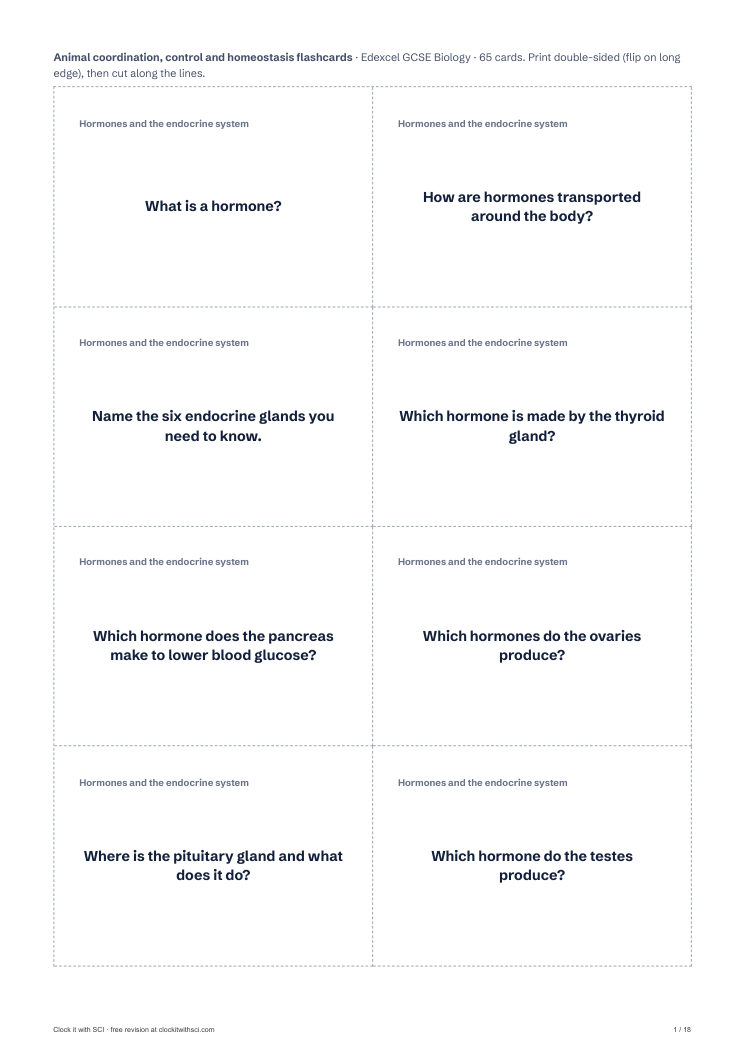
- What is a hormone?
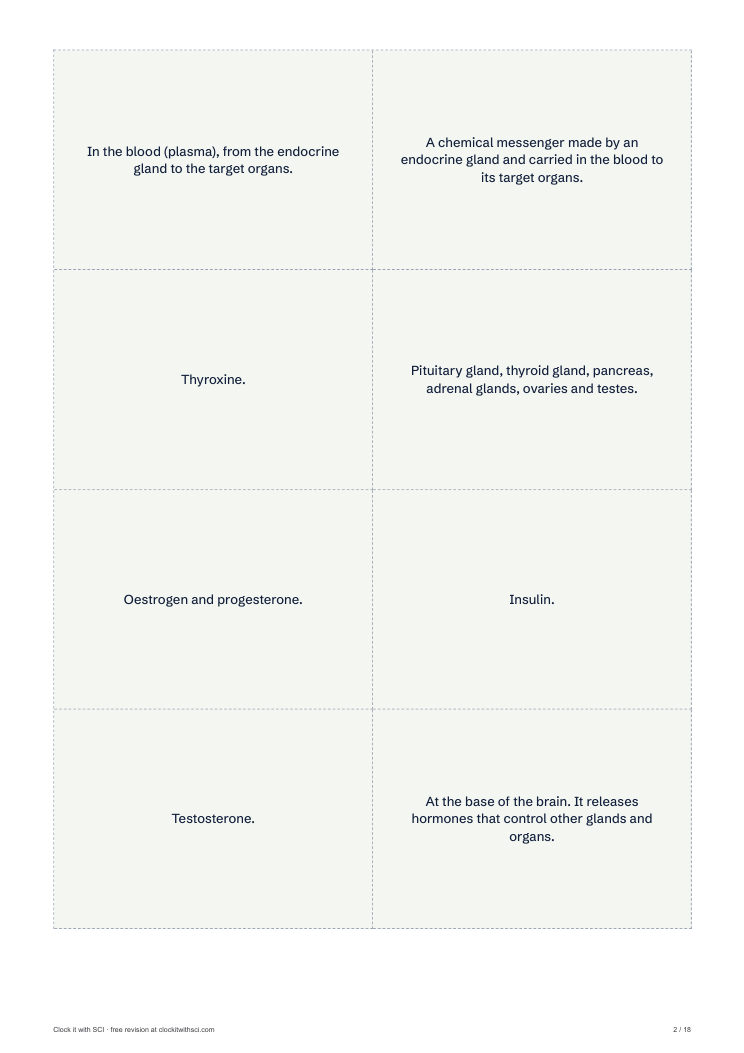
- A chemical messenger made by an endocrine gland and carried in the blood to its target organs.
- How are hormones transported around the body?
- In the blood (plasma), from the endocrine gland to the target organs.
- Name the six endocrine glands you need to know.
- Pituitary gland, thyroid gland, pancreas, adrenal glands, ovaries and testes.
- Which hormone is made by the thyroid gland?
- Thyroxine.
- Which hormone does the pancreas make to lower blood glucose?
- Insulin.
- Which hormones do the ovaries produce?
- Oestrogen and progesterone.
- Where is the pituitary gland and what does it do?
- At the base of the brain. It releases hormones that control other glands and organs.
- Which hormone do the testes produce?
- Testosterone.
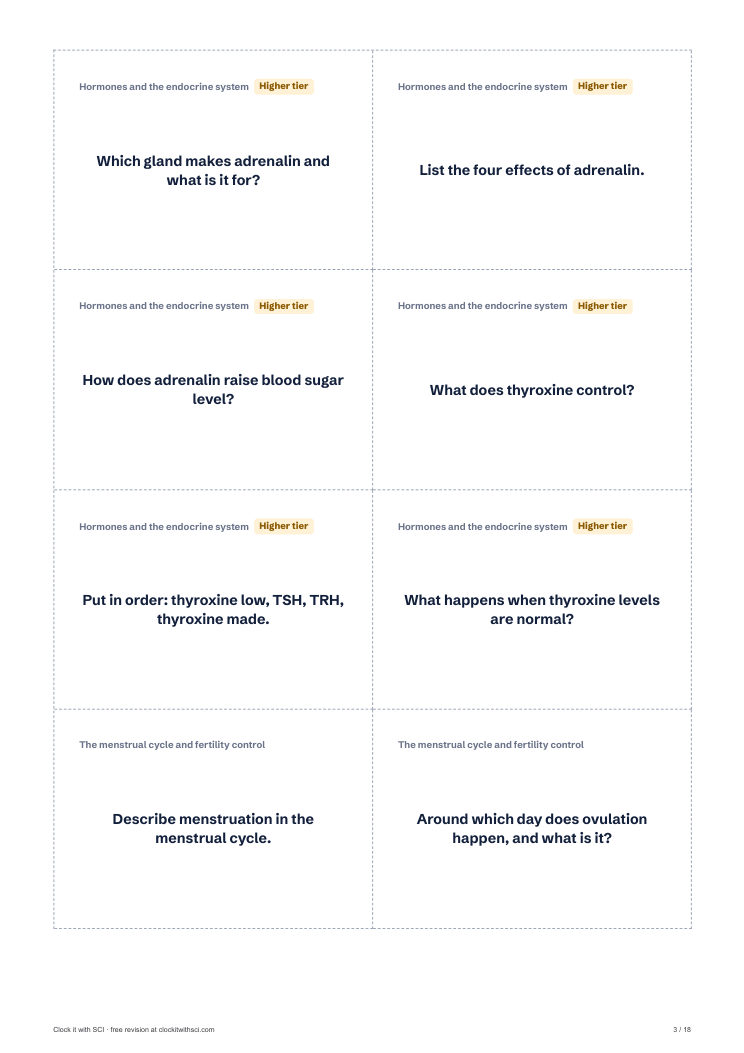
- Which gland makes adrenalin and what is it for? Higher tier
- The adrenal glands. Adrenalin prepares the body for fight or flight.
- List the four effects of adrenalin. Higher tier
- Increased heart rate, increased blood pressure, increased blood flow to the muscles, and raised blood sugar level.
- How does adrenalin raise blood sugar level? Higher tier
- It stimulates the liver to change glycogen into glucose.
- What does thyroxine control? Higher tier
- Metabolic rate, as an example of negative feedback.
- Put in order: thyroxine low, TSH, TRH, thyroxine made. Higher tier
- Low thyroxine, TRH from the hypothalamus, TSH from the pituitary, thyroid makes thyroxine.
- What happens when thyroxine levels are normal? Higher tier
- Thyroxine inhibits the release of TRH and the production of TSH.
The menstrual cycle and fertility control
- Describe menstruation in the menstrual cycle.
- Around days 1 to 5. The uterus lining breaks down and is lost through the vagina.
- Around which day does ovulation happen, and what is it?
- Around day 14. An egg is released from an ovary.
- What is the role of oestrogen in the menstrual cycle?
- It causes repair and growth of the uterus lining.
- What is the role of progesterone in the menstrual cycle?
- It maintains the lining of the uterus.
- What does FSH do? Higher tier
- Causes an egg to mature in the ovary and stimulates the ovaries to produce oestrogen.
- What does LH do? Higher tier
- Causes ovulation.
- How does high oestrogen affect FSH and LH? Higher tier
- It inhibits FSH and stimulates the release of LH.
- How does progesterone affect FSH and LH? Higher tier
- It inhibits them, so no more eggs mature.
- Why does menstruation happen? Higher tier
- Progesterone falls, so the uterus lining is no longer maintained and it breaks down.
- How does hormonal contraception prevent pregnancy?
- It stops eggs maturing, so no ovulation, and progesterone thickens cervical mucus so sperm cannot get through.
- Which hormones can hormonal contraceptives contain?
- Oestrogen, progesterone, or both.
- How does the oestrogen in the pill stop eggs maturing? Higher tier
- It inhibits the release of FSH from the pituitary gland.
- Give two disadvantages of hormonal contraception.
- It does not protect against sexually transmitted infections, and it can cause side effects.
- Give two advantages and one disadvantage of condoms.
- They protect against sexually transmitted infections and have no hormone side effects. They can split or slip.
- How are hormones used in IVF? Higher tier
- FSH and LH are given to make several eggs mature. The eggs are fertilised outside the body.
- What is clomifene therapy? Higher tier
- A drug for women who do not ovulate. It stimulates the release of FSH and LH.
Homeostasis and temperature control
- Define homeostasis.
- Maintaining a constant internal environment in response to internal and external change.
- Why must the body keep its internal environment constant?
- Enzymes and cells work best in a narrow range of conditions.
- What is thermoregulation and what temperature is maintained? Triple only
- Control of body temperature, at about 37°C, the optimum for enzymes.
- What happens to enzymes if body temperature is too high? Triple only
- They are denatured. The active site changes shape and the reaction stops.
- What is osmoregulation? Triple only
- Control of the water content of the blood.
- What happens to animal cells if the blood is too dilute? Triple only
- Water enters by osmosis. The cells swell and may burst.
- What happens to animal cells if the blood is too concentrated? Triple only
- Water leaves by osmosis and the cells shrink.
- What is the role of the dermis in thermoregulation? Triple only
- It contains the sweat glands, blood vessels and temperature receptors that respond to temperature change.
- What is the role of the epidermis in thermoregulation? Triple only
- The outer layer of skin. Sweat reaches the surface through pores in it, so heat is lost from the surface.
- What is the role of the hypothalamus in thermoregulation? Triple only
- It monitors blood temperature and coordinates the response by sending nerve impulses to effectors.
- How does shivering help when the body is cold? Triple only
- Muscles contract rapidly. Respiration in the muscle cells transfers energy as heat.
- What is vasoconstriction and when does it happen? Triple onlyHigher tier
- Blood vessels supplying the skin narrow when cold, so less blood flows near the surface and less heat is lost.
- What is vasodilation and when does it happen? Triple onlyHigher tier
- Blood vessels supplying the skin widen when hot, so more blood flows near the surface and more heat is lost.
- How does sweating cool the body? Triple only
- Sweat evaporates from the skin and takes heat from it.
Blood glucose and diabetes
- How does insulin lower blood glucose?
- It makes cells take up glucose, and the liver converts glucose into glycogen for storage.
- Which organ detects high blood glucose and releases insulin?
- The pancreas.
- How does glucagon raise blood glucose? Higher tier
- It acts on the liver, which changes glycogen into glucose and releases it into the blood.
- When is glucagon released? Higher tier
- When blood glucose concentration is too low.
- What causes type 1 diabetes?
- The pancreas does not produce enough insulin.
- How is type 1 diabetes controlled?
- Insulin injections, monitoring blood glucose, and controlling the carbohydrate in the diet.
- What causes type 2 diabetes?
- Body cells no longer respond to insulin.
- How is type 2 diabetes controlled?
- Diet, regular exercise and losing weight. Some people also need medication.
- How can you test simulated urine for sugar?
- Add Benedict's solution and heat in a hot water bath. Blue turns green, yellow, orange or brick red if sugar is present.
- Write the BMI equation.
- BMI = mass (kg) ÷ height (m)².
- How do you calculate waist:hip ratio?
- Waist circumference ÷ hip circumference.
- Does a correlation between BMI and type 2 diabetes prove cause?
- No. Other factors may be involved, and BMI does not show fat compared with muscle.
The urinary system and the kidneys
- Name the parts of the urinary system. Triple only
- Kidneys, ureters, bladder and urethra, with the renal artery and renal vein supplying each kidney.
- Where is urea made and from what? Triple only
- In the liver, from the breakdown of excess amino acids.
- What happens in the glomerulus and Bowman's capsule? Triple only
- Filtration. High pressure forces small molecules into the capsule. Proteins and blood cells stay in the blood.
- What happens to glucose in the nephron? Triple only
- All of it is selectively reabsorbed into the blood, by active transport.
- What happens to water in the nephron, and what is left in urine? Triple only
- Water is reabsorbed into the blood in the loop of Henle and collecting duct. Urine contains urea, excess ions and the remaining water.
- What does ADH do to the collecting duct? Triple onlyHigher tier
- It makes it more permeable to water, so more water is reabsorbed into the blood.
- What happens to ADH and urine if blood water content is too high? Triple onlyHigher tier
- Less ADH is released, so less water is reabsorbed and a large volume of dilute urine is made.
- How does kidney dialysis work? Triple only
- Blood flows past a partially permeable membrane with dialysis fluid on the other side. Urea and excess ions pass out.
- What is needed for a successful kidney transplant? Triple only
- A donor kidney with a good tissue match, plus drugs so the immune system does not reject it.