

Keyboard: space to flip, 1 for not yet, 2 for got it, arrow keys to move.
See all 70 cards as a list
Principles of organisation
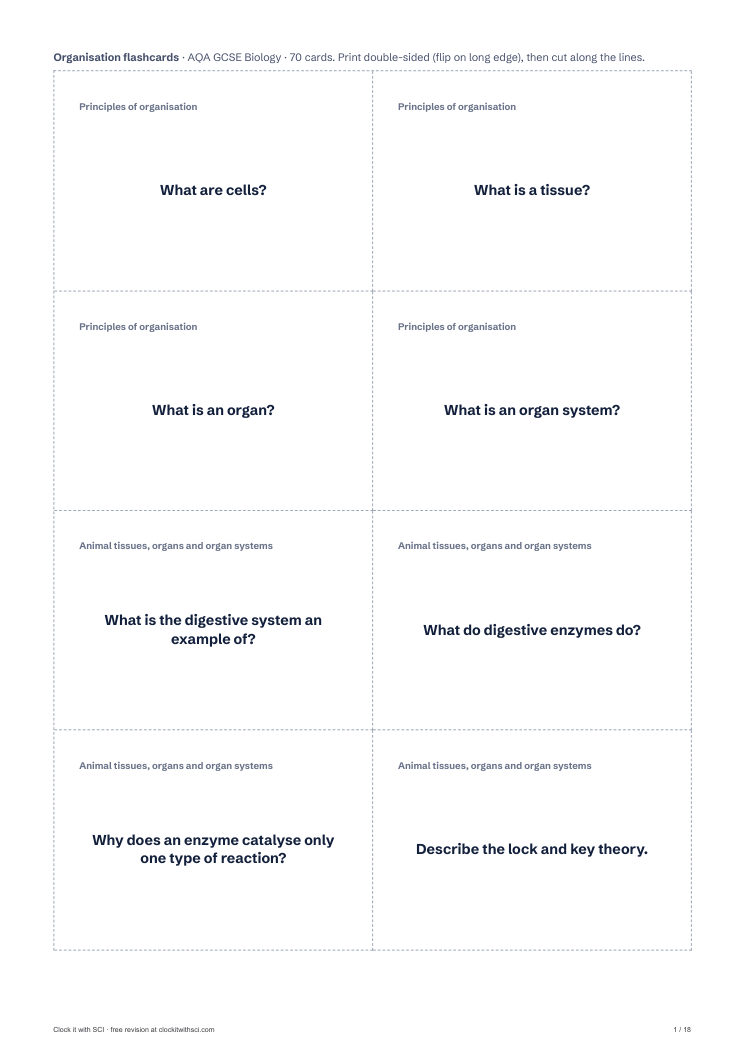
- What are cells?
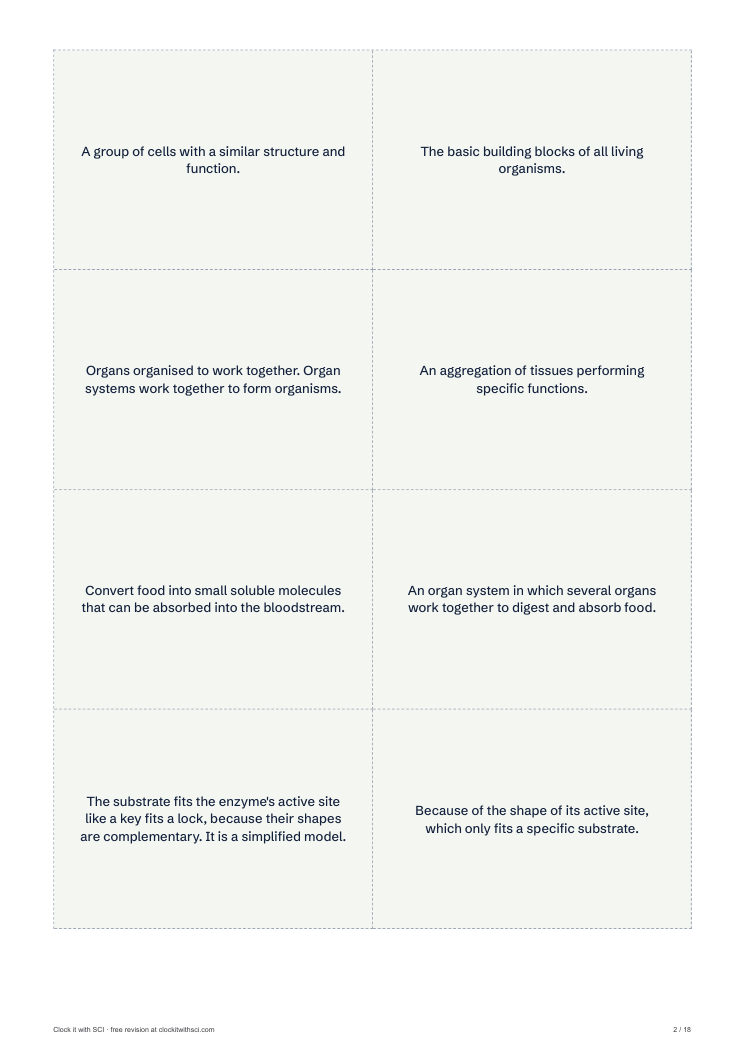
- The basic building blocks of all living organisms.
- What is a tissue?
- A group of cells with a similar structure and function.
- What is an organ?
- An aggregation of tissues performing specific functions.
- What is an organ system?
- Organs organised to work together. Organ systems work together to form organisms.
Animal tissues, organs and organ systems
- What is the digestive system an example of?
- An organ system in which several organs work together to digest and absorb food.
- What do digestive enzymes do?
- Convert food into small soluble molecules that can be absorbed into the bloodstream.
- Why does an enzyme catalyse only one type of reaction?
- Because of the shape of its active site, which only fits a specific substrate.
- Describe the lock and key theory.
- The substrate fits the enzyme's active site like a key fits a lock, because their shapes are complementary. It is a simplified model.
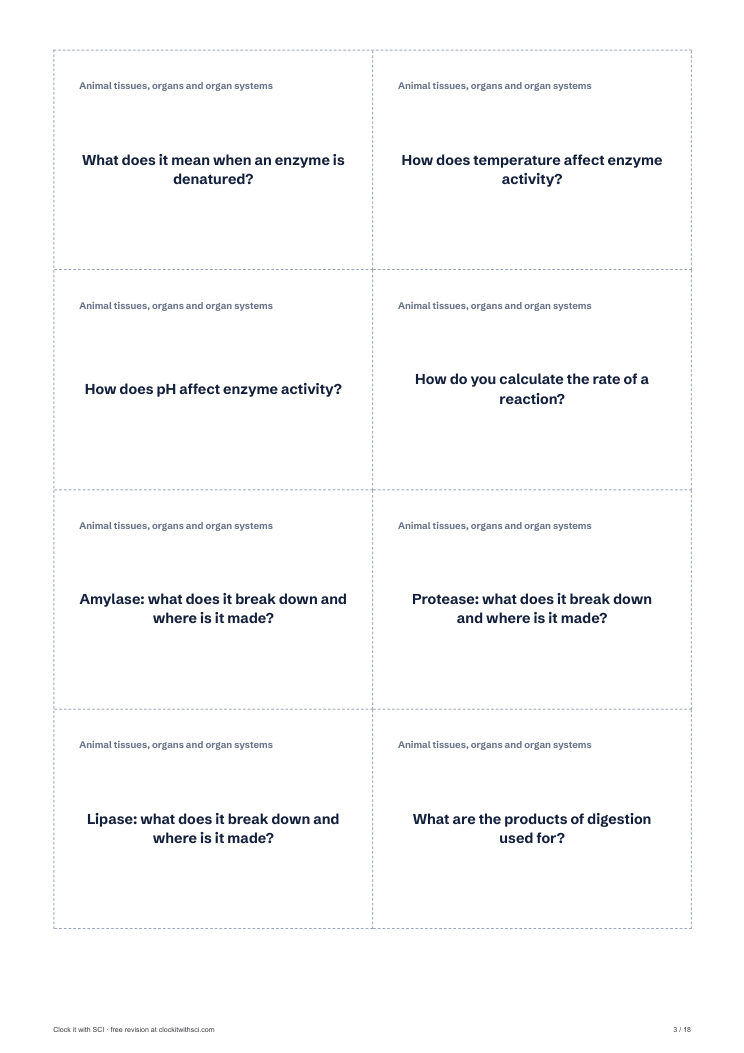
- What does it mean when an enzyme is denatured?
- The shape of its active site has changed, so the substrate no longer fits. It happens at high temperature or extreme pH.
- How does temperature affect enzyme activity?
- Rate rises with temperature up to the optimum, then falls quickly as the enzyme denatures.
- How does pH affect enzyme activity?
- Each enzyme has an optimum pH. Away from the optimum the active site changes shape and the enzyme is denatured.
- How do you calculate the rate of a reaction?
- Rate = amount of product formed ÷ time. If the end point is a colour change, rate = 1 ÷ time taken.
- Amylase: what does it break down and where is it made?
- A carbohydrase that breaks starch into simple sugars. Made in the salivary glands, pancreas and small intestine.
- Protease: what does it break down and where is it made?
- Breaks proteins into amino acids. Made in the stomach, pancreas and small intestine.
- Lipase: what does it break down and where is it made?
- Breaks lipids (fats) into glycerol and fatty acids. Made in the pancreas and small intestine.
- What are the products of digestion used for?
- To build new carbohydrates, lipids and proteins. Some glucose is used in respiration.
- Where is bile made and stored, and what does it do?
- Made in the liver and stored in the gall bladder. It is alkaline, so it neutralises stomach acid, and it emulsifies fat into small droplets, increasing the surface area.
- Why does emulsifying fat speed up digestion?
- It breaks fat into small droplets, which have a larger surface area for lipase to act on, so fat is broken down faster.
- Benedict's test: what is it for and what is the positive result?
- Tests for sugars. Heat with Benedict's solution. Blue changes to green, yellow, orange or brick-red.
- Iodine test: what is it for and what is the positive result?
- Tests for starch. Orange-brown changes to blue-black.
- Biuret test: what is it for and what is the positive result?
- Tests for protein. Blue changes to purple (lilac).
- How do you test for lipids?
- Add Sudan III stain and shake: a red-stained oily layer forms on top. (Alternative: ethanol emulsion test gives a cloudy white emulsion.)
- Amylase and pH practical: how do you tell when all the starch is digested?
- Test samples with iodine every 30 seconds. When the iodine stays orange-brown there is no starch left.
- What is a double circulatory system?
- Blood passes through the heart twice per circuit: once to the lungs and once around the rest of the body.
- What does each ventricle pump blood to?
- Right ventricle: to the lungs, where gas exchange takes place. Left ventricle: around the rest of the body.
- Which vessels carry blood to and from the lungs?
- The pulmonary artery carries blood from the heart to the lungs. The pulmonary vein carries blood back from the lungs.
- Which vessels carry blood to and from the body?
- The aorta carries oxygenated blood from the left ventricle. The vena cava brings blood back to the right atrium.
- What do the coronary arteries do?
- They supply the heart muscle with oxygenated blood.
- How are the alveoli adapted for gas exchange?
- Large surface area, thin walls, a good blood supply from the capillary network, and ventilation, which keeps a steep concentration gradient.
- What route does air take to reach the blood in the lungs?
- Trachea, then bronchi, then alveoli. Oxygen diffuses from the alveoli into the capillary network surrounding them.
- What controls the natural resting heart rate?
- A group of cells in the right atrium that act as a pacemaker. Artificial pacemakers are electrical devices that correct irregular heart rate.
- How is an artery adapted to its function?
- Carries blood at high pressure away from the heart. Thick walls with muscle and elastic fibres, and a narrow lumen.
- How is a vein adapted to its function?
- Carries blood at low pressure to the heart. Thinner walls, a wide lumen and valves to prevent backflow.
- How is a capillary adapted to its function?
- Exchanges substances with cells. Walls are one cell thick, giving a short diffusion distance, and are permeable.
- What is the equation for rate of blood flow?
- Rate of blood flow = volume of blood ÷ time (for example cm³/min).
- What is blood made of?
- A tissue of plasma, in which red blood cells, white blood cells and platelets are suspended.
- What does plasma transport?
- Carbon dioxide, soluble products of digestion, urea and hormones.
- What is the function of red blood cells and how are they adapted?
- Carry oxygen using haemoglobin. Biconcave shape gives a large surface area, and no nucleus leaves room for haemoglobin.
- What do white blood cells do?
- Defend the body against pathogens, for example by engulfing them or producing antibodies and antitoxins.
- What are platelets and what do they do?
- Small fragments of cells with no nucleus. They help the blood to clot at a wound.
- How can you tell a red blood cell from a white blood cell in a photograph?
- Red blood cells are small, round and have no nucleus. White blood cells are larger with a visible nucleus.
- What happens in coronary heart disease?
- Layers of fatty material build up inside the coronary arteries, narrowing them. Less blood flows, so the heart muscle gets less oxygen.
- What is a stent?
- A device used to keep the coronary arteries open.
- What do statins do?
- Reduce blood cholesterol levels, which slows down the rate of fatty material deposit.
- What can go wrong with a heart valve, and how can it be treated?
- It may not open fully, so less blood flows through, or it may leak, so blood flows backwards. Faulty valves can be replaced with biological or mechanical valves.
- What treatments are used for heart failure?
- A donor heart, or heart and lungs, can be transplanted. Artificial hearts keep patients alive while waiting, or let the heart rest.
- What is health?
- The state of physical and mental well-being. Disease, diet, stress and life situations can all affect health.
- Give two ways different types of disease can interact.
- Immune system defects make infections more likely. Viruses can trigger cancers. Immune reactions to a pathogen can trigger allergies. Severe physical illness can lead to depression.
- Why should a study of disease or risk factors use a large, representative sample?
- Not everyone can be tested. A large sample that represents the population gives more reliable data and conclusions.
- What is a risk factor?
- Something linked to an increased rate of a disease, such as an aspect of lifestyle or a substance in the body or environment.
- What is a causal mechanism?
- An explanation of how a risk factor causes a disease. It has been proven for some risk factors but not others.
- Which disease is obesity a risk factor for?
- Type 2 diabetes.
- What are the effects of alcohol and smoking on unborn babies?
- Smoking can cause low birth weight and premature birth. Alcohol can damage the baby's development, including the brain.
- How does smoking affect health?
- It raises the risk of cardiovascular disease, lung disease and lung cancer.
- What is a carcinogen?
- A substance or radiation that can cause cancer. Ionising radiation is one example.
- What costs do non-communicable diseases have?
- Human costs (suffering, early death) and financial costs (treatment, lost work), for individuals, communities, nations and globally.
- What is cancer?
- The result of changes in cells that lead to uncontrolled growth and division.
- Benign tumour or malignant tumour: which is cancer, and how do they differ?
- Malignant tumours are cancers: they invade neighbouring tissues and spread in the blood to form secondary tumours. Benign tumours stay in one area, usually within a membrane.
Plant tissues, organs and systems
- List the plant tissues you need to know.
- Epidermal tissues, palisade mesophyll, spongy mesophyll, xylem and phloem, and meristem tissue. The leaf is an organ made of these tissues.
- What is meristem tissue and where is it found?
- Tissue at the growing tips of shoots and roots, where cells divide to produce new cells.
- How is palisade mesophyll adapted for photosynthesis?
- Tightly packed cells near the top of the leaf containing many chloroplasts, to absorb light.
- What is the role of spongy mesophyll?
- Air spaces let gases diffuse through the leaf, such as carbon dioxide for photosynthesis.
- What do the roots, stem and leaves form?
- A plant organ system for transport of substances around the plant.
- How is a root hair cell adapted?
- Long root hair gives a large surface area. Takes up water by osmosis and mineral ions by active transport, which needs energy from respiration (many mitochondria).
- What does xylem do and how is it adapted?
- Transports water and mineral ions from roots to stems and leaves. Hollow tubes strengthened by lignin.
- What is translocation?
- The movement of dissolved sugars through phloem from the leaves to the rest of the plant. Phloem is tubes of elongated cells with pores in the end walls.
- What is transpiration?
- The loss of water vapour from the leaves. Water moves up the xylem, evaporates from leaf cells and diffuses out through the stomata.
- What do stomata and guard cells do?
- They control gas exchange and water loss. Guard cells open and close the stomata.
- How do temperature, humidity, air movement and light affect transpiration?
- Higher temperature, more air movement and more light increase the rate. Higher humidity decreases it.
- How can you measure the rate of transpiration?
- Use a potometer to measure water uptake by a shoot. Rate = distance the bubble moves ÷ time.