

Keyboard: space to flip, 1 for not yet, 2 for got it, arrow keys to move.
See all 70 cards as a list
Reproduction
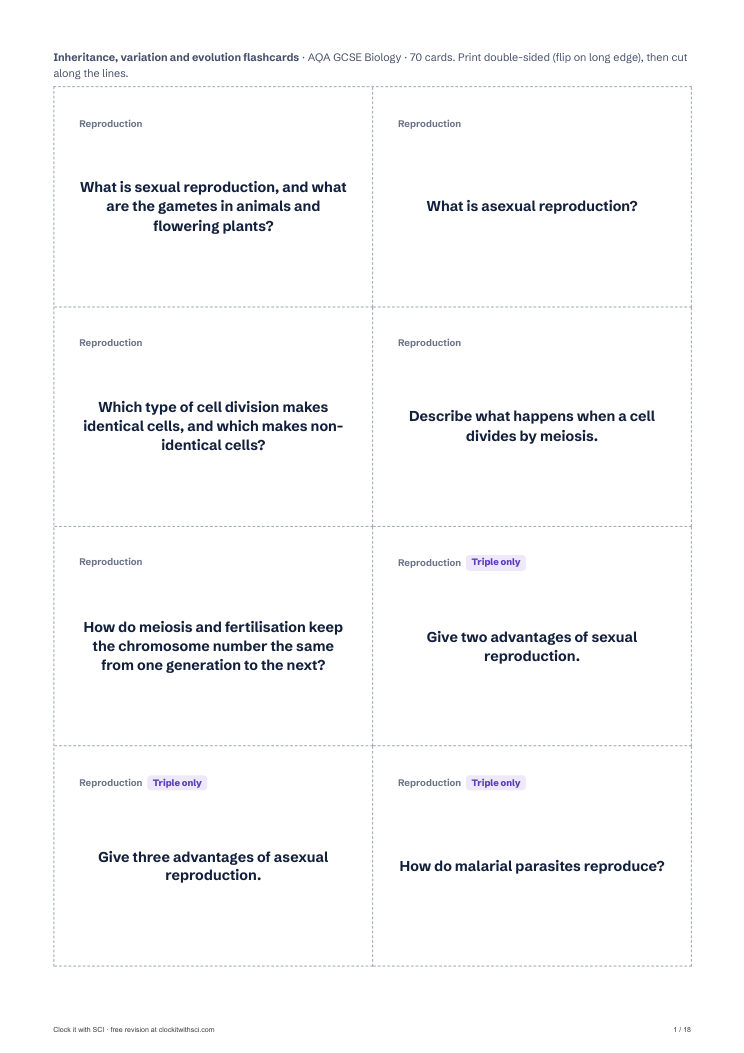
- What is sexual reproduction, and what are the gametes in animals and flowering plants?
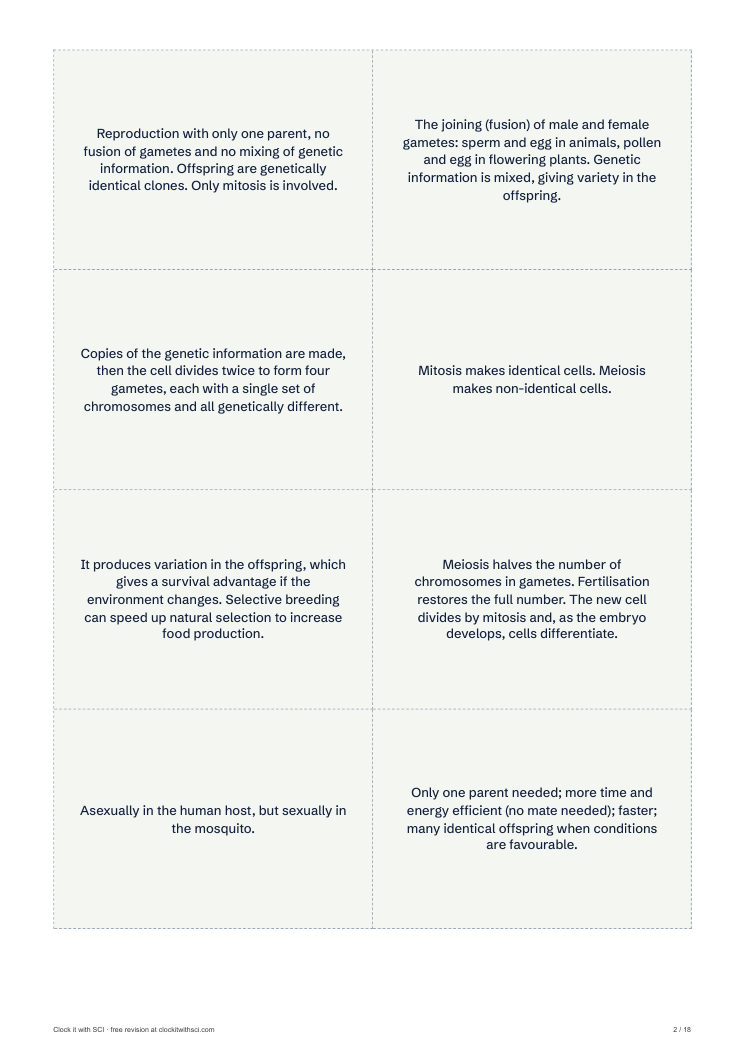
- The joining (fusion) of male and female gametes: sperm and egg in animals, pollen and egg in flowering plants. Genetic information is mixed, giving variety in the offspring.
- What is asexual reproduction?
- Reproduction with only one parent, no fusion of gametes and no mixing of genetic information. Offspring are genetically identical clones. Only mitosis is involved.
- Which type of cell division makes identical cells, and which makes non-identical cells?
- Mitosis makes identical cells. Meiosis makes non-identical cells.
- Describe what happens when a cell divides by meiosis.
- Copies of the genetic information are made, then the cell divides twice to form four gametes, each with a single set of chromosomes and all genetically different.
- How do meiosis and fertilisation keep the chromosome number the same from one generation to the next?
- Meiosis halves the number of chromosomes in gametes. Fertilisation restores the full number. The new cell divides by mitosis and, as the embryo develops, cells differentiate.
- Give two advantages of sexual reproduction. Triple only
- It produces variation in the offspring, which gives a survival advantage if the environment changes. Selective breeding can speed up natural selection to increase food production.
- Give three advantages of asexual reproduction. Triple only
- Only one parent needed; more time and energy efficient (no mate needed); faster; many identical offspring when conditions are favourable.
- How do malarial parasites reproduce? Triple only
- Asexually in the human host, but sexually in the mosquito.
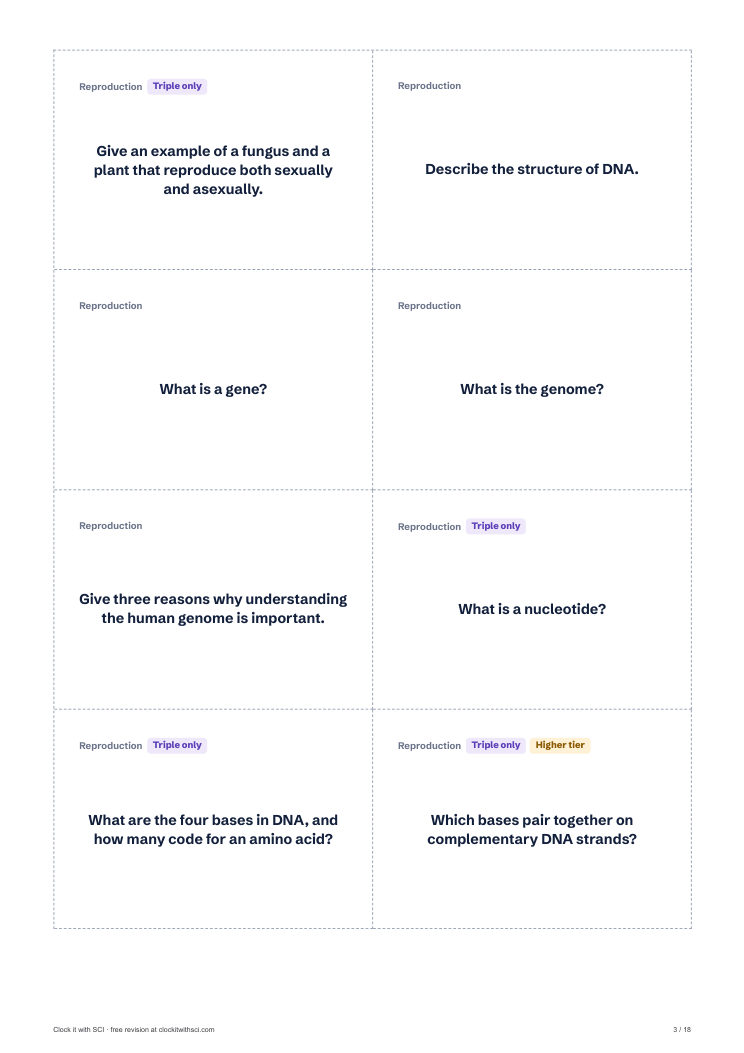
- Give an example of a fungus and a plant that reproduce both sexually and asexually. Triple only
- Many fungi: asexual by spores, sexual to give variation. Plants: seeds (sexual); runners in strawberry plants or bulb division in daffodils (asexual).
- Describe the structure of DNA.
- A polymer made of two strands forming a double helix, contained in chromosomes in the nucleus.
- What is a gene?
- A small section of DNA on a chromosome that codes for a particular sequence of amino acids, to make a specific protein.
- What is the genome?
- The entire genetic material of an organism.
- Give three reasons why understanding the human genome is important.
- Searching for genes linked to disease; understanding and treating inherited disorders; tracing human migration patterns from the past.
- What is a nucleotide? Triple only
- The repeating unit of DNA: a common sugar and phosphate group with one of four bases attached to the sugar. The strands have alternating sugar and phosphate sections.
- What are the four bases in DNA, and how many code for an amino acid? Triple only
- A, C, G and T. A sequence of three bases codes for a particular amino acid. The order of bases controls the order of amino acids.
- Which bases pair together on complementary DNA strands? Triple onlyHigher tier
- C always links to G, and T always links to A.
- Give a simple description of protein synthesis. Triple onlyHigher tier
- Proteins are made on ribosomes according to a template. Carrier molecules bring specific amino acids to add to the growing chain in the correct order.
- What happens when a protein chain is complete? Triple onlyHigher tier
- It folds up to form a unique shape, which lets it do its job, for example as an enzyme, a hormone or a structure such as collagen.
- How can a mutation change a protein? Triple onlyHigher tier
- It changes the base order, so the amino acid order may change. A few mutations alter the protein's shape, so an enzyme may not fit its substrate or a structural protein loses strength.
- What is the role of non-coding DNA? Triple onlyHigher tier
- Non-coding parts of DNA can switch genes on and off, so variants there may change how genes are expressed.
- Define allele.
- A different form of the same gene.
- What is the difference between a dominant and a recessive allele?
- A dominant allele is always expressed, even if only one copy is present. A recessive allele is only expressed if two copies are present.
- What do homozygous and heterozygous mean?
- Homozygous: two alleles the same for a trait. Heterozygous: two different alleles.
- What is the difference between genotype and phenotype?
- Genotype is the alleles present. Phenotype is how the characteristic is expressed.
- Give two examples of characteristics controlled by a single gene. Are most characteristics like this?
- Fur colour in mice and red-green colour blindness in humans. No, most are the result of multiple genes interacting.
- What ratio of phenotypes do you expect from a cross between two heterozygous parents?
- 3 dominant : 1 recessive, so a probability of 1 in 4 (25%) for the recessive phenotype.
- Construct a Punnett square for Bb × bb. What is the probability of a bb offspring? Higher tier
- Gametes B, b and b, b. Offspring Bb, Bb, bb, bb. Probability of bb = 2 in 4 = 1/2 (50%).
- In a family tree, two parents without a trait have a child with the trait. What does this show?
- The trait is recessive and both parents are heterozygous carriers.
- Which disorder is caused by a dominant allele: polydactyly or cystic fibrosis?
- Polydactyly (extra fingers or toes) is caused by a dominant allele. Cystic fibrosis, a disorder of cell membranes, is caused by a recessive allele.
- Give issues to consider about embryo screening.
- It may alleviate suffering, but embryos are destroyed and there are economic, social and ethical concerns. Gene therapy research also raises ethical issues.
- What are the human sex chromosomes?
- Females XX, males XY. Humans have 23 pairs of chromosomes; 22 pairs control characteristics only.
- What is the chance that a baby is a girl or a boy, and why?
- 50% each (1 : 1). All eggs carry X; half the sperm carry X and half carry Y.
Variation and evolution
- What causes variation within a population?
- Genes inherited (genetic), the conditions in which individuals developed (environmental), or both. The phenotype develops from the genome and its interaction with the environment.
- Where do all variants come from, and how many affect the phenotype?
- Mutations. Most have no effect on the phenotype, some influence it, very few determine it. Rarely a new phenotype suited to an environmental change causes a relatively rapid change in the species.
- Define evolution.
- A change in the inherited characteristics of a population over time through natural selection, which may result in a new species.
- Explain how natural selection leads to evolution.
- Variants with phenotypes best suited to their environment survive and breed, passing on their alleles. Over generations these characteristics become more common.
- When have two populations formed two new species?
- When they become so different in phenotype that they can no longer interbreed to produce fertile offspring.
- When did the first simple life forms develop?
- More than three billion years ago. All species have evolved from them.
- What is selective breeding?
- The process by which humans breed plants and animals for particular genetic characteristics. It is also called artificial selection.
- Describe the steps of selective breeding.
- Choose parents with the desired characteristic and breed them together. Breed the best offspring together. Repeat over many generations.
- Give four examples of characteristics chosen by selective breeding.
- Disease resistance in crops; more meat or milk from animals; gentle nature in dogs; large or unusual flowers.
- What is inbreeding and what problem does it cause?
- Breeding closely related individuals. Some breeds become prone to disease or inherited defects.
- Define genetic engineering.
- Modifying the genome of an organism by introducing a gene from another organism to give a desired characteristic.
- Give examples of genetic engineering in plants and in bacteria.
- Plants: resistance to disease or bigger, better fruit. Bacteria: human insulin to treat diabetes.
- What are GM crops and what are the concerns about them?
- Crops with modified genes, for example resistant to insects or herbicides, with increased yields. Concerns: wild flowers and insects, and human health effects not fully explored.
- Describe the main steps in genetic engineering. Higher tier
- Enzymes isolate the gene. It is inserted into a vector (plasmid or virus). The vector inserts the gene into the required cells, at an early stage of development.
- What is tissue culture? Triple only
- Using small groups of cells from part of a plant to grow identical new plants, to preserve rare species or commercially in nurseries.
- What are cuttings and embryo transplants? Triple only
- Cuttings: a simple method gardeners use to make identical plants. Embryo transplants: splitting a developing embryo's cells before they specialise, then transplanting the identical embryos into host mothers.
- Describe adult cell cloning. Triple only
- Remove the nucleus from an unfertilised egg cell and insert the nucleus from an adult body cell. An electric shock makes it divide into an embryo, which is inserted into the womb of an adult female.
- Give a benefit and a risk of cloning. Triple only
- Benefit: many identical copies with a useful characteristic, or preserving rare species. Risk: reduced genetic variation, and some people have ethical objections.
The development of understanding of genetics and evolution
- What did Darwin propose, and where did he publish it? Triple only
- Evolution by natural selection, in On the Origin of Species (1859). Individuals vary; those most suited to the environment survive to breed and pass on their characteristics.
- Why was Darwin's theory only gradually accepted? Triple only
- It challenged the idea that God made all species, there was insufficient evidence at the time, and the mechanism of inheritance was not known until 50 years later.
- What did Lamarck suggest? Triple only
- That changes in an organism during its lifetime can be inherited. In the vast majority of cases this cannot occur.
- What was Wallace's contribution? Triple only
- He independently proposed natural selection, published joint writings with Darwin in 1858, and is best known for work on warning colouration and speciation.
- Describe the steps that give rise to new species. Triple only
- Isolation, genetic variation from mutations, different selection pressures in different environments, alleles passed on, until populations cannot interbreed to produce fertile offspring.
- What was Mendel's key observation? Triple only
- In the mid-19th century, his breeding experiments on plants showed that inheritance of each characteristic is determined by 'units' passed on unchanged.
- Why was Mendel's work not recognised until after his death? Triple only
- When he published, the behaviour of chromosomes had not been observed, so his 'units' could not be linked to anything in cells. Few scientists read or understood his work.
- Describe how the gene theory developed after Mendel. Triple only
- Late 19th century: chromosome behaviour seen. Early 20th: chromosomes and 'units' behave similarly, so genes are on chromosomes. Mid-20th: DNA structure determined.
- What evidence supports the theory of evolution?
- Characteristics are passed on in genes, the fossil record, and how antibiotic resistance evolves in bacteria.
- What are fossils and how may they form?
- Remains of organisms from millions of years ago, found in rocks. They form when decay conditions are absent, by mineral replacement, or as preserved traces.
- Why is the fossil record incomplete?
- Early life forms were soft-bodied and left few traces, and many traces were destroyed by geological activity.
- What is extinction?
- When there are no remaining individuals of a species still alive. Factors include new predators, diseases or competitors, environmental change, or a single catastrophic event.
- How do antibiotic-resistant bacteria arise and spread?
- Mutation produces a resistant strain; antibiotics kill other bacteria, so the resistant ones survive, reproduce and spread because people are not immune.
- How can the development of antibiotic resistance be reduced?
- Do not prescribe antibiotics inappropriately (such as for viral infections), complete the course, and restrict agricultural use.
- What is MRSA, and why do new antibiotics not solve the problem?
- MRSA is resistant to antibiotics. New antibiotics are costly and slow to develop, so unlikely to keep up with new resistant strains.
Classification of living organisms
- List the Linnaean groups in order.
- Kingdom, phylum, class, order, family, genus, species.
- What is the binomial system?
- Naming organisms using their genus and species, for example Homo sapiens. The genus has a capital letter; the species does not.
- Name the three domains in Woese's system.
- Archaea (primitive bacteria in extreme environments), bacteria (true bacteria) and eukaryota (protists, fungi, plants and animals).
- Why was the three-domain system developed?
- Better microscopes showed internal structures, biochemical understanding progressed, and chemical analysis provided new evidence.
- What is an evolutionary tree?
- A method showing how scientists believe organisms are related, using classification data for living organisms and fossil data for extinct ones.