

Keyboard: space to flip, 1 for not yet, 2 for got it, arrow keys to move.
See all 66 cards as a list
Communicable diseases
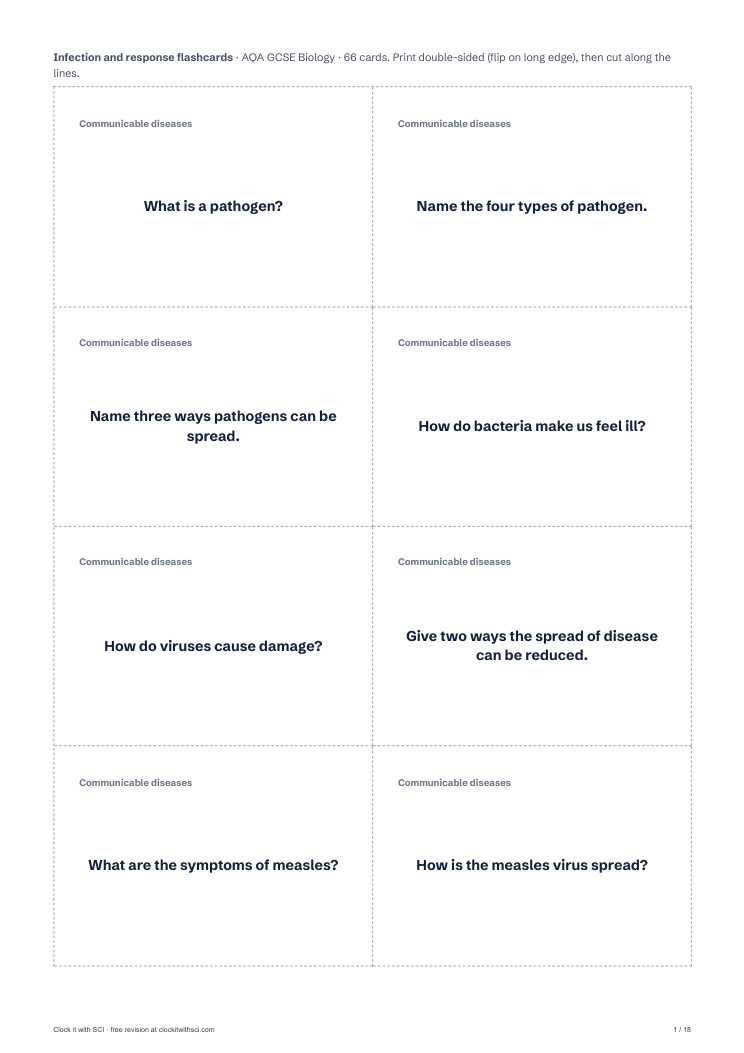
- What is a pathogen?
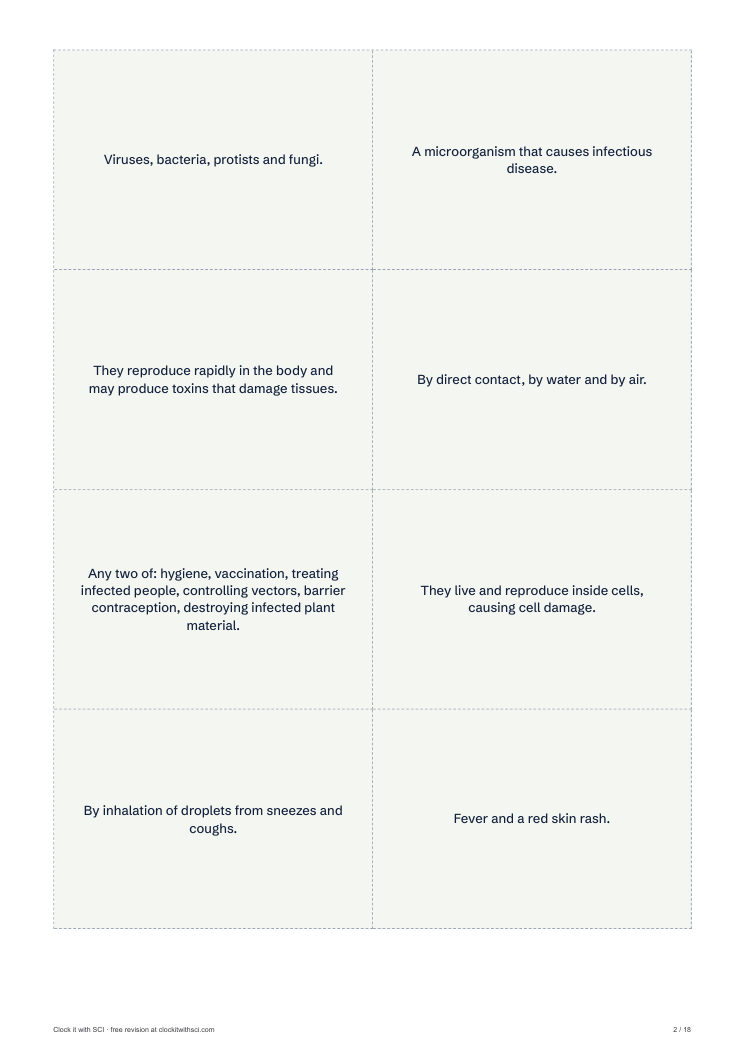
- A microorganism that causes infectious disease.
- Name the four types of pathogen.
- Viruses, bacteria, protists and fungi.
- Name three ways pathogens can be spread.
- By direct contact, by water and by air.
- How do bacteria make us feel ill?
- They reproduce rapidly in the body and may produce toxins that damage tissues.
- How do viruses cause damage?
- They live and reproduce inside cells, causing cell damage.
- Give two ways the spread of disease can be reduced.
- Any two of: hygiene, vaccination, treating infected people, controlling vectors, barrier contraception, destroying infected plant material.
- What are the symptoms of measles?
- Fever and a red skin rash.
- How is the measles virus spread?
- By inhalation of droplets from sneezes and coughs.
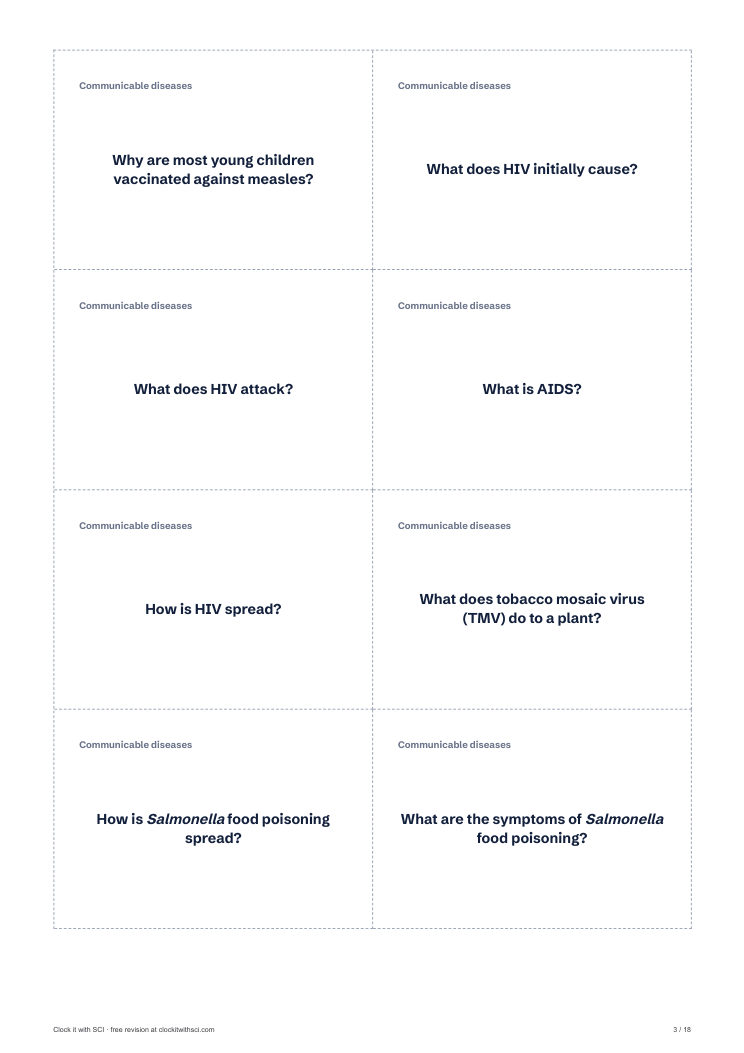
- Why are most young children vaccinated against measles?
- It is a serious illness that can be fatal if complications arise.
- What does HIV initially cause?
- A flu-like illness.
- What does HIV attack?
- The body's immune cells (unless controlled with antiretroviral drugs).
- What is AIDS?
- Late stage HIV infection, when the immune system is so badly damaged that it cannot deal with other infections or cancers.
- How is HIV spread?
- By sexual contact or exchange of body fluids such as blood, for example drug users sharing needles.
- What does tobacco mosaic virus (TMV) do to a plant?
- Causes a 'mosaic' pattern of discolouration on leaves, reducing photosynthesis and so growth.
- How is Salmonella food poisoning spread?
- By bacteria ingested in food, or on food prepared in unhygienic conditions.
- What are the symptoms of Salmonella food poisoning?
- Fever, abdominal cramps, vomiting and diarrhoea, caused by the bacteria and the toxins they secrete.
- How is the spread of Salmonella controlled in the UK?
- Poultry are vaccinated against Salmonella.
- What are the symptoms of gonorrhoea?
- A thick yellow or green discharge from the vagina or penis, and pain on urinating.
- How is the spread of gonorrhoea controlled?
- Treatment with antibiotics, or a barrier method of contraception such as a condom.
- Why is gonorrhoea harder to treat than it used to be?
- Many resistant strains have appeared; it was once easily treated with penicillin.
- What are the symptoms of rose black spot?
- Purple or black spots on leaves, which often turn yellow and drop early.
- How does rose black spot affect a plant's growth?
- Photosynthesis is reduced, so the plant grows less.
- How is rose black spot spread, and how is it treated?
- Spread by water or wind. Treated with fungicides and/or removing and destroying affected leaves.
- What type of pathogen causes malaria?
- A protist.
- What is the vector for malaria?
- The mosquito; the protist's life cycle includes the mosquito.
- What are the symptoms of malaria?
- Recurrent episodes of fever. It can be fatal.
- How is the spread of malaria controlled?
- Prevent mosquitos breeding, and use mosquito nets to avoid being bitten.
- Name the non-specific defence systems of the human body.
- Skin, nose, trachea and bronchi, and stomach.
- How does the stomach defend against pathogens?
- It produces hydrochloric acid, which kills pathogens.
- How do the nose and the trachea and bronchi defend against pathogens?
- Hairs and mucus trap pathogens; in the trachea and bronchi, cilia move the mucus away.
- Name three ways white blood cells defend against pathogens.
- Phagocytosis, antibody production and antitoxin production.
- What is phagocytosis?
- A white blood cell engulfs a pathogen and digests it.
- What do antitoxins do?
- They neutralise the toxins produced by pathogens.
- What does a vaccine contain?
- Small quantities of dead or inactive forms of a pathogen.
- How does vaccination prevent illness?
- It stimulates white blood cells to make antibodies. On re-infection they quickly make the correct antibodies.
- How does vaccinating most of a population reduce the spread of a pathogen?
- Most people are immune, so the pathogen cannot spread easily, which protects those not vaccinated.
- What do antibiotics such as penicillin do?
- Cure bacterial disease by killing infective bacteria inside the body.
- Why must specific antibiotics be used?
- Specific bacteria need to be treated by specific antibiotics.
- Can antibiotics kill viruses?
- No. It is also difficult to make drugs that kill viruses without damaging body tissues.
- Why is the emergence of antibiotic-resistant strains of concern?
- The antibiotics no longer kill them, so deaths from bacterial disease could rise again.
- What do painkillers do?
- Treat the symptoms of disease. They do not kill pathogens.
- Which plant is the source of digitalis?
- Foxgloves. It is a heart drug.
- Which plant is the source of aspirin?
- Willow. It is a painkiller.
- Who discovered penicillin, and from what?
- Alexander Fleming, from the Penicillium mould.
- How are most new drugs made?
- Synthesised by chemists in the pharmaceutical industry, though the starting point may be a plant chemical.
- What three things are new drugs tested for?
- Toxicity, efficacy and dose.
- What is preclinical testing?
- Testing in a laboratory using cells, tissues and live animals.
- Who is used in clinical trials?
- Healthy volunteers and patients.
- How are doses used in clinical trials?
- Very low doses first. If safe, further trials find the optimum dose.
- What is a placebo, and what is a double blind trial?
- A placebo contains no active drug. In a double blind trial neither patients nor doctors know who gets it.
- What happens to the results of drug trials before they are published?
- They are scrutinised by peer review: other scientists check the methods and conclusions.
Monoclonal antibodies
- What are monoclonal antibodies? Triple onlyHigher tier
- Antibodies produced from a single clone of cells, specific to one binding site on one protein antigen.
- Which cells are stimulated to make the antibody? Triple onlyHigher tier
- Mouse lymphocytes.
- What is a hybridoma cell? Triple onlyHigher tier
- A lymphocyte combined with a tumour cell. It can both divide and make the antibody.
- How is a large amount of one monoclonal antibody obtained? Triple onlyHigher tier
- Single hybridoma cells are cloned, then the antibody is collected and purified.
- Give three uses of monoclonal antibodies. Triple onlyHigher tier
- Diagnosis (pregnancy tests), lab measurement or detection, research with fluorescent dye, treating disease.
- How can monoclonal antibodies treat cancer? Triple onlyHigher tier
- They carry a radioactive substance, toxic drug or growth-stopping chemical to cancer cells without harming other cells.
- What are the disadvantages of monoclonal antibodies? Triple onlyHigher tier
- More side effects than expected, and not yet as widely used as hoped.
Plant disease
- How can plant disease be detected? Triple onlyHigher tier
- Stunted growth, spots, decay, growths, malformed parts, discolouration or pests.
- How can a plant disease be identified? Triple onlyHigher tier
- Gardening manual or website, laboratory testing, or testing kits containing monoclonal antibodies.
- Which plant diseases and pests do you need to know? Triple only
- Tobacco mosaic virus (viral), black spot (fungal) and aphids (insects).
- What causes stunted growth in plants? Triple only
- Nitrate deficiency. Nitrate ions are needed for protein synthesis and therefore growth.
- What causes chlorosis in plants? Triple only
- Magnesium deficiency. Magnesium ions are needed to make chlorophyll.
- Name three physical plant defences. Triple only
- Cellulose cell walls, tough waxy cuticle on leaves, layers of dead cells around stems that fall off.
- Name two chemical plant defences. Triple only
- Antibacterial chemicals and poisons to deter herbivores.
- Name three mechanical adaptations of plants. Triple only
- Thorns and hairs, leaves that droop or curl when touched, and mimicry to trick animals.