

Keyboard: space to flip, 1 for not yet, 2 for got it, arrow keys to move.
See all 78 cards as a list
Adaptations, interdependence and competition
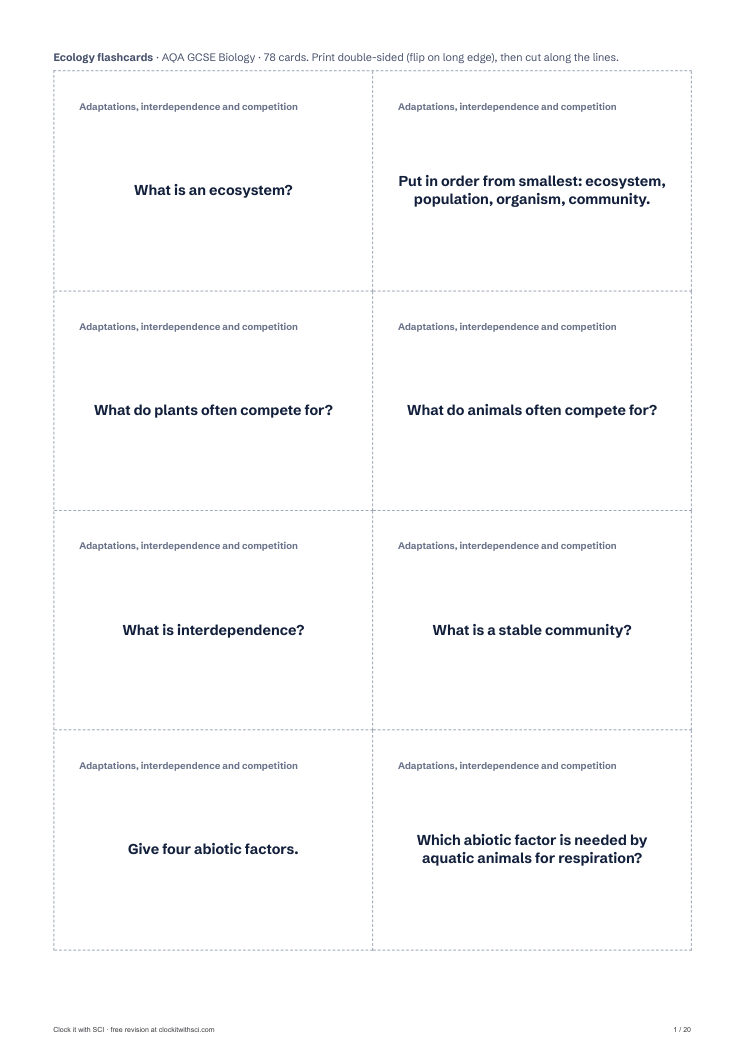
- What is an ecosystem?
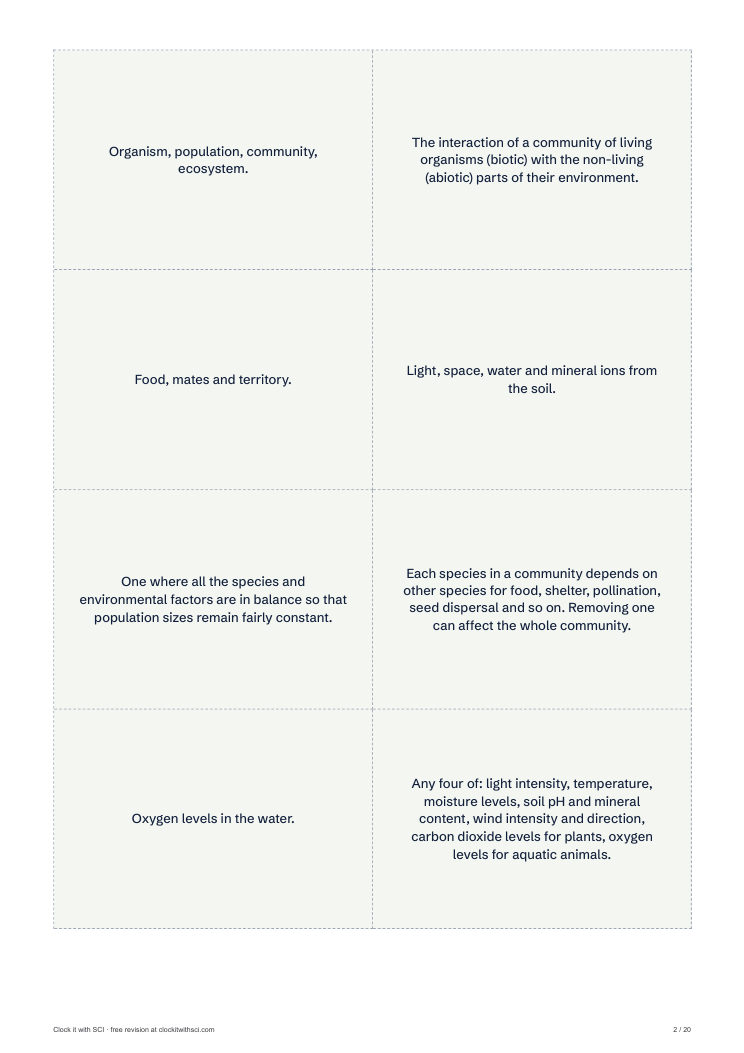
- The interaction of a community of living organisms (biotic) with the non-living (abiotic) parts of their environment.
- Put in order from smallest: ecosystem, population, organism, community.
- Organism, population, community, ecosystem.
- What do plants often compete for?
- Light, space, water and mineral ions from the soil.
- What do animals often compete for?
- Food, mates and territory.
- What is interdependence?
- Each species in a community depends on other species for food, shelter, pollination, seed dispersal and so on. Removing one can affect the whole community.
- What is a stable community?
- One where all the species and environmental factors are in balance so that population sizes remain fairly constant.
- Give four abiotic factors.
- Any four of: light intensity, temperature, moisture levels, soil pH and mineral content, wind intensity and direction, carbon dioxide levels for plants, oxygen levels for aquatic animals.
- Which abiotic factor is needed by aquatic animals for respiration?
- Oxygen levels in the water.
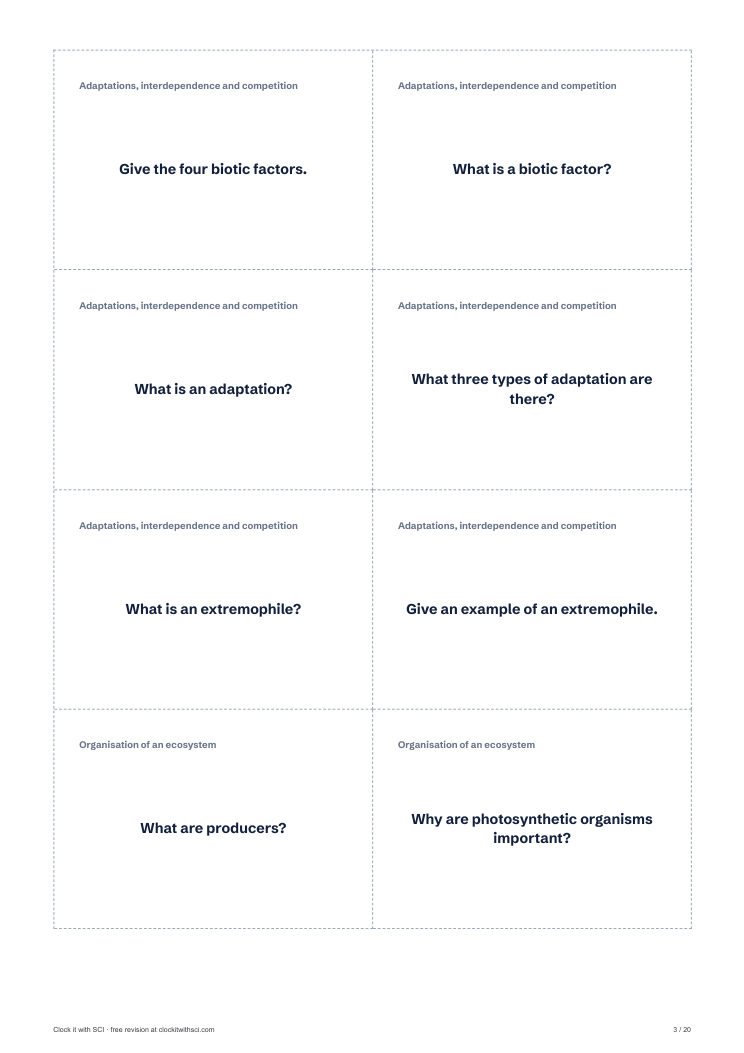
- Give the four biotic factors.
- Availability of food, new predators arriving, new pathogens, and one species outcompeting another so the numbers are no longer sufficient to breed.
- What is a biotic factor?
- A living factor that can affect a community.
- What is an adaptation?
- A feature that enables an organism to survive in the conditions in which it normally lives.
- What three types of adaptation are there?
- Structural, behavioural and functional.
- What is an extremophile?
- An organism that lives in very extreme conditions such as high temperature, pressure or salt concentration.
- Give an example of an extremophile.
- Bacteria living in deep sea vents.
Organisation of an ecosystem
- What are producers?
- Organisms that make their own glucose by photosynthesis, usually green plants or algae. All food chains begin with one.
- Why are photosynthetic organisms important?
- They are the producers of biomass for life on Earth.
- What is a predator? What is prey?
- A predator is a consumer that kills and eats other animals. Prey are the animals that are eaten.
- What do primary consumers eat?
- Producers. Secondary consumers eat primary consumers, and tertiary consumers eat secondary consumers.
- What are quadrats and transects used for?
- To find the distribution and abundance of species in an ecosystem.
- How do you estimate a population size using quadrats?
- Place quadrats at random, count the organisms, find the mean per square metre and multiply by the total area.
- Why place quadrats at random?
- To avoid bias, so the sample represents the whole area.
- How do you investigate the effect of a factor on distribution?
- Lay a transect across the change in the factor, place quadrats at regular intervals, count the species and measure the factor.
- What are the mean, mode and median?
- Mean: total divided by number of values. Mode: most common value. Median: middle value when in order.
- In predator-prey cycles, which peak comes first?
- The prey peak. The predator peak follows a short time later.
- Why do predator numbers fall after prey numbers fall?
- There is less food available for the predators.
- What does the carbon cycle return to the atmosphere?
- Carbon, as carbon dioxide, to be used by plants in photosynthesis.
- Which process takes carbon dioxide out of the atmosphere?
- Photosynthesis.
- Which process puts carbon dioxide into the atmosphere from organisms?
- Respiration, by plants, animals and decomposing microorganisms.
- What does the water cycle provide?
- Fresh water for plants and animals on land before it drains into the seas.
- Name the two main processes in the water cycle.
- Evaporation and precipitation (water is continuously evaporated and precipitated).
- What is the role of microorganisms in cycling materials?
- They return carbon to the atmosphere as carbon dioxide and mineral ions to the soil.
- Which cycle are you not expected to study?
- The nitrogen cycle.
- How does temperature affect the rate of decay? Triple only
- Warmer conditions speed up decay until an optimum. Too hot and enzymes denature; cold slows decay.
- How do water and oxygen affect the rate of decay? Triple only
- More water and more oxygen increase the rate of decay, because decomposers need them.
- What is compost used for? Triple only
- A natural fertiliser for growing garden plants or crops.
- What does anaerobic decay produce? Triple only
- Methane gas. Biogas generators use it as a fuel.
- How do you calculate the rate of decay? Triple only
- Change in amount of material divided by time.
- Required practical 10: what is investigated? Triple only
- The effect of temperature on the rate of decay of fresh milk, by measuring pH change.
- Name three environmental changes that affect the distribution of species. Triple onlyHigher tier
- Temperature, availability of water and composition of atmospheric gases.
- What three types of environmental change are there? Triple onlyHigher tier
- Seasonal, geographic, or caused by human interaction.
Biodiversity and the effect of human interaction on ecosystems
- What is biodiversity?
- The variety of all the different species of organisms on Earth, or within an ecosystem.
- Why does great biodiversity make an ecosystem more stable?
- It reduces the dependence of one species on another for food, shelter and maintenance of the physical environment.
- Give three causes of pollution in water.
- Sewage, fertiliser and toxic chemicals.
- Give two causes of pollution in air.
- Smoke and acidic gases.
- Give two causes of pollution on land.
- Landfill and toxic chemicals.
- Why is more waste being produced?
- Rapid population growth and a higher standard of living mean more resources are used and more waste is produced.
- How do humans reduce the land available for other organisms?
- By building, quarrying, farming and dumping waste.
- Why is destroying peat bogs a problem?
- It reduces biodiversity of the habitat and the decay or burning of peat releases carbon dioxide.
- Why has large-scale tropical deforestation occurred?
- To provide land for cattle and rice fields and to grow crops for biofuels.
- Give an environmental implication of deforestation.
- Less biodiversity, less photosynthesis, and more carbon dioxide from burning and decay.
- Which gases in the atmosphere contribute to global warming?
- Carbon dioxide and methane, whose levels are increasing.
- Give a biological consequence of global warming.
- Loss of habitat, changes in the distribution of species, or changes in migration patterns.
- What is the scientific consensus on global warming based on?
- Systematic reviews of thousands of peer reviewed publications.
- Give five programmes to reduce negative effects on biodiversity.
- Breeding programmes, protecting rare habitats, hedgerows and field margins, reducing deforestation and emissions, recycling instead of landfill.
- Why are field margins and hedgerows reintroduced?
- They provide habitats and food for wildlife where farmers grow only one type of crop.
Trophic levels in an ecosystem
- What are trophic levels? Triple only
- Levels in a food chain, numbered from 1 (plants and algae) according to how far along the chain the organism is.
- What is trophic level 1? Triple only
- Producers: plants and algae, which make their own food.
- What are primary consumers? Triple only
- Level 2: herbivores that eat plants or algae.
- What are secondary and tertiary consumers? Triple only
- Secondary (level 3): carnivores that eat herbivores. Tertiary (level 4): carnivores that eat other carnivores.
- What is an apex predator? Triple only
- A carnivore with no predators.
- How do decomposers feed? Triple only
- They secrete enzymes into the environment. Small soluble food molecules then diffuse into the microorganism.
- What does a pyramid of biomass show? Triple only
- The relative amount of biomass in each level of a food chain, with trophic level 1 at the bottom.
- What percentage of incident light energy do producers transfer? Triple only
- About 1%.
- What percentage of biomass passes to the next trophic level? Triple only
- Approximately 10%.
- How is biomass lost between trophic levels? Triple only
- Egested as faeces; lost as carbon dioxide and water in respiration; water and urea lost in urine.
- How do you calculate efficiency of biomass transfer? Triple only
- Biomass transferred to the next level divided by biomass at the previous level, multiplied by 100.
- How does biomass loss affect the number of organisms? Triple only
- Less biomass is available at each higher level, so fewer organisms can be supported at each higher trophic level.
Food production
- What is food security? Triple only
- Having enough food to feed a population.
- Give three biological factors threatening food security. Triple only
- Any three of: increasing birth rate, new pests and pathogens, environmental changes such as failing rains, cost of agricultural inputs, conflicts, changing diets in developed countries.
- How can the efficiency of animal food production be improved? Triple only
- Restrict energy transfer to the environment by limiting movement and controlling temperature.
- Why are some farm animals fed high protein foods? Triple only
- To increase growth.
- What objection do some people have to intensive farming? Triple only
- Ethical objections to the methods and the conditions in which the animals are kept.
- Why is the decline in fish stocks a problem? Triple only
- Stocks must be kept at a level where breeding continues, or certain species may disappear altogether in some areas.
- How do net size and quotas help conserve fish? Triple only
- A larger mesh lets young fish escape to grow and breed. Quotas limit the catch, so enough fish are left to breed and stocks stay sustainable.
- What is mycoprotein? Triple only
- A protein-rich food suitable for vegetarians, made from the fungus Fusarium.
- How is mycoprotein produced? Triple only
- Fusarium is grown on glucose syrup in aerobic conditions, and the biomass is harvested and purified.
- What does a genetically modified bacterium produce for diabetics? Triple only
- Human insulin, which is harvested and purified.
- What is golden rice? Triple only
- A GM crop with improved nutritional value.