

Keyboard: space to flip, 1 for not yet, 2 for got it, arrow keys to move.
See all 70 cards as a list
Cell structure
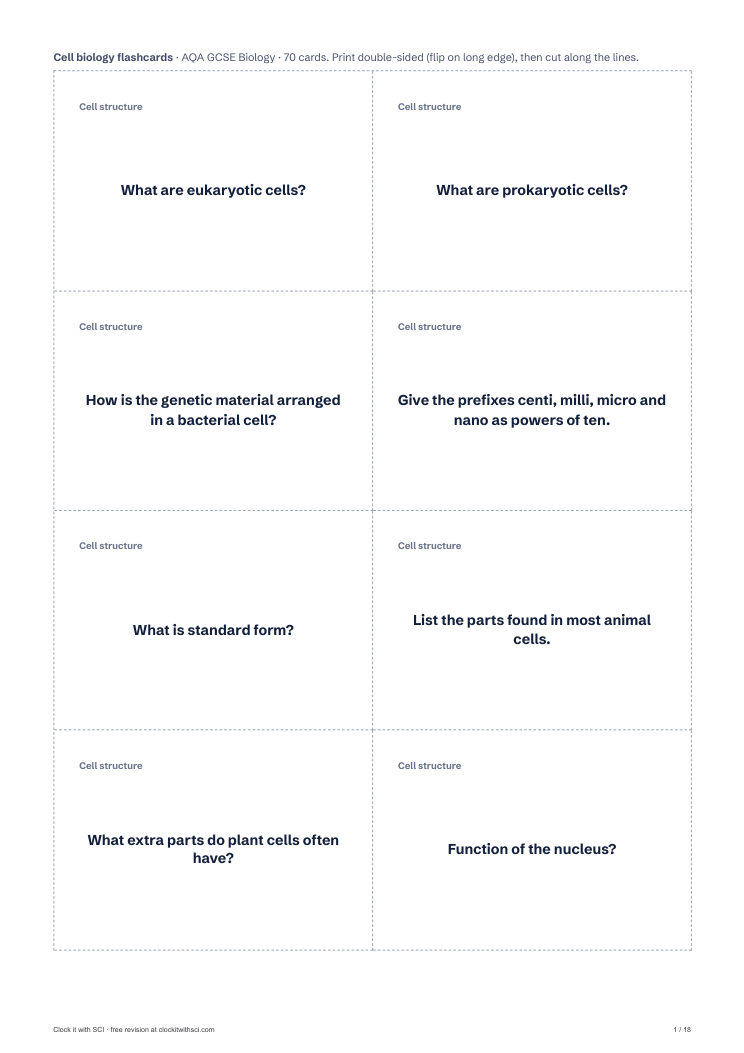
- What are eukaryotic cells?
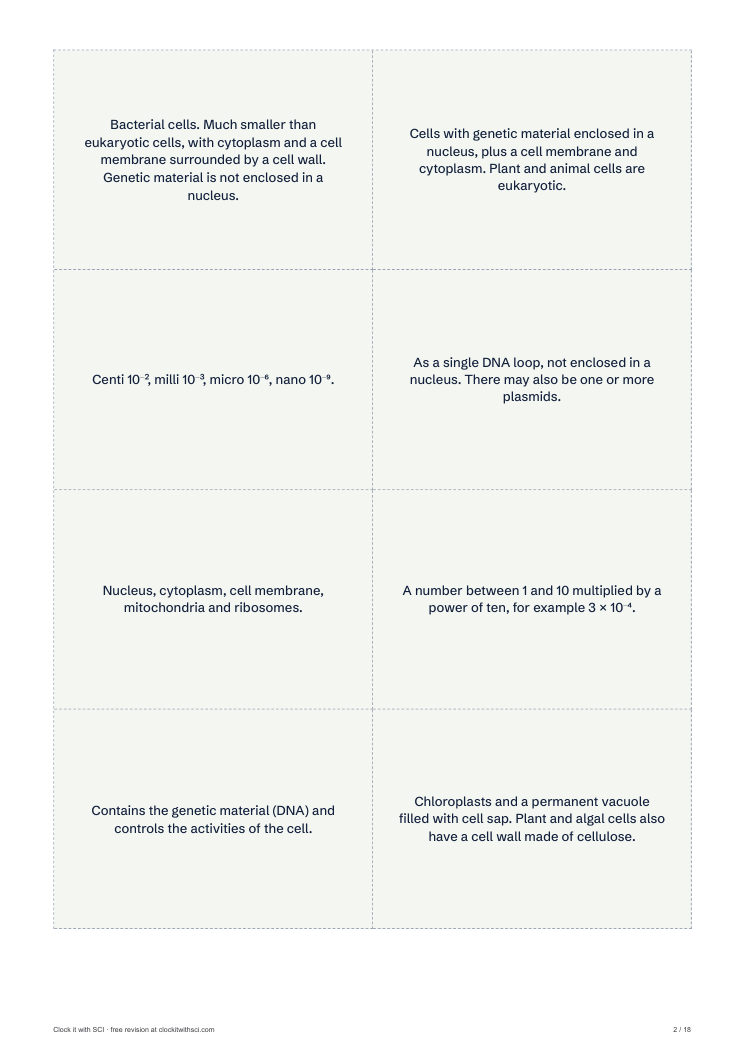
- Cells with genetic material enclosed in a nucleus, plus a cell membrane and cytoplasm. Plant and animal cells are eukaryotic.
- What are prokaryotic cells?
- Bacterial cells. Much smaller than eukaryotic cells, with cytoplasm and a cell membrane surrounded by a cell wall. Genetic material is not enclosed in a nucleus.
- How is the genetic material arranged in a bacterial cell?
- As a single DNA loop, not enclosed in a nucleus. There may also be one or more plasmids.
- Give the prefixes centi, milli, micro and nano as powers of ten.
- Centi 10⁻², milli 10⁻³, micro 10⁻⁶, nano 10⁻⁹.
- What is standard form?
- A number between 1 and 10 multiplied by a power of ten, for example 3 × 10⁻⁴.
- List the parts found in most animal cells.
- Nucleus, cytoplasm, cell membrane, mitochondria and ribosomes.
- What extra parts do plant cells often have?
- Chloroplasts and a permanent vacuole filled with cell sap. Plant and algal cells also have a cell wall made of cellulose.
- Function of the nucleus?
- Contains the genetic material (DNA) and controls the activities of the cell.
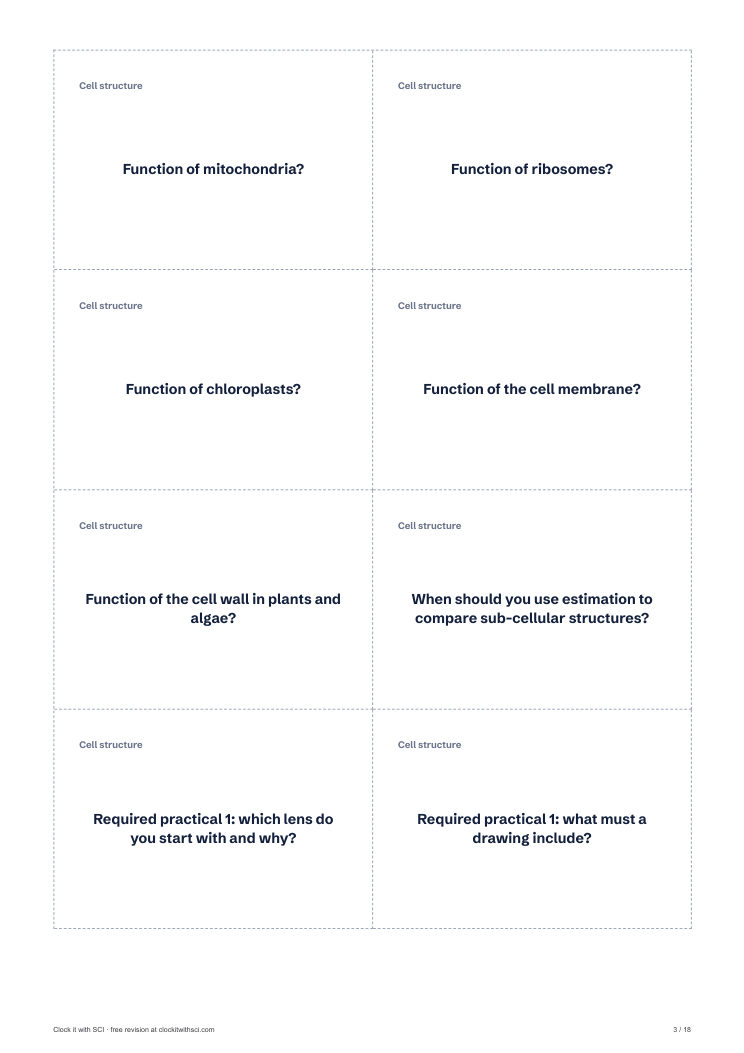
- Function of mitochondria?
- Where aerobic respiration takes place, releasing energy for the cell.
- Function of ribosomes?
- Where proteins are made (protein synthesis).
- Function of chloroplasts?
- They contain chlorophyll and absorb light energy for photosynthesis.
- Function of the cell membrane?
- Controls the movement of substances into and out of the cell.
- Function of the cell wall in plants and algae?
- Made of cellulose. It strengthens the cell.
- When should you use estimation to compare sub-cellular structures?
- When you only need to judge relative size or area, by rounding the measurements to easy numbers.
- Required practical 1: which lens do you start with and why?
- The lowest-power objective lens, to find the specimen and avoid the lens hitting the slide.
- Required practical 1: what must a drawing include?
- Clear labels, a title and a magnification scale, drawn in sharp pencil with no shading.
- How is a sperm cell adapted for its function?
- Tail to swim, many mitochondria for energy, streamlined head, and enzymes in the head to get into the egg.
- How is a nerve cell adapted for its function?
- It is long to carry impulses over long distances, and has branched connections at the ends to connect with other cells.
- How is a muscle cell adapted for its function?
- Protein fibres that shorten to contract the cell, and many mitochondria to release energy for contraction.
- How is a root hair cell adapted for its function?
- Long hair-like projection gives a large surface area to absorb water and mineral ions. Many mitochondria release energy for active transport.
- How is a xylem cell adapted for its function?
- Forms a hollow tube with no end walls, and strengthened walls, to carry water and mineral ions up the plant.
- How is a phloem cell adapted for its function?
- Elongated cells joined end to end into tubes. Pores in the end walls let cell sap with dissolved sugars move from cell to cell.
- What is cell differentiation?
- The process by which cells acquire different sub-cellular structures to carry out a particular function, becoming specialised.
- Why is differentiation important?
- It lets cells become specialised so they can carry out specific functions efficiently in a multicellular organism.
- When do most animal cells differentiate, compared with plant cells?
- Most animal cells differentiate at an early stage. Many plant cells keep the ability to differentiate throughout life.
- What is cell division mainly used for in mature animals?
- Repair and replacement.
- Why does an electron microscope show more detail than a light microscope?
- It has much higher magnification and resolving power.
- What is resolving power?
- The ability to distinguish between two points that are close together as separate points.
- What is the magnification equation?
- Magnification = size of image ÷ size of real object.
- How do bacteria reproduce? Triple only
- By simple cell division called binary fission, as often as once every 20 minutes with enough nutrients and a suitable temperature.
- How can bacteria be grown in the laboratory? Triple only
- In a nutrient broth solution, or as colonies on an agar gel plate.
- Why must Petri dishes and culture media be sterilised? Triple only
- To kill unwanted microorganisms and stop contamination.
- Why is an inoculating loop passed through a flame? Triple only
- To sterilise it, so only the intended microorganisms are transferred.
- Why is the lid of the Petri dish taped on and stored upside down? Triple only
- Tape stops microorganisms getting in or out. Upside down stops condensation dripping onto the culture.
- Why are school cultures incubated at 25 °C? Triple only
- To prevent the growth of pathogens that are harmful to humans.
- How do you find the number of bacteria after a given time? Triple only
- Divide total time by division time to get the number of divisions, then starting number × 2 to the power of divisions.
- Higher tier: how do you give a very large bacterial count in standard form? Triple onlyHigher tier
- Write a number between 1 and 10 × a power of ten, for example 16 777 216 = 1.7 × 10⁷ (2 s.f.).
- What is a zone of inhibition? Triple only
- The clear area around an antiseptic or antibiotic disc where bacteria have not grown. Bigger zone means more effective.
- How do you calculate the area of a clear zone? Triple only
- Area = πr², where the radius is half the diameter.
Cell division
- What are chromosomes?
- Structures in the nucleus made of DNA molecules. Each carries a large number of genes.
- How are chromosomes found in body cells?
- Normally in pairs.
- What are the three overall stages of the cell cycle?
- Growth and DNA replication; mitosis; division of the cytoplasm and cell membranes.
- What happens to the DNA before a cell divides?
- It replicates to form two copies of each chromosome.
- What happens in mitosis?
- One set of chromosomes is pulled to each end of the cell and the nucleus divides.
- Why is mitosis important in multicellular organisms?
- It is important for growth and development (and repair and replacement).
- What is a stem cell?
- An undifferentiated cell capable of giving rise to many more cells of the same type, and from which certain other cells can arise from differentiation.
- What can stem cells from human embryos do?
- They can be cloned and made to differentiate into most different types of human cell.
- What can stem cells from adult bone marrow do?
- Form many types of cell, including blood cells.
- What is meristem tissue?
- Tissue in plants whose stem cells can differentiate into any type of plant cell, throughout the life of the plant.
- What is therapeutic cloning?
- An embryo is produced with the same genes as the patient, so stem cells from it are not rejected by the patient's body.
- Give two risks or objections to using stem cells.
- Risk of transfer of viral infection; some people have ethical or religious objections.
- How can plant stem cells be used?
- To clone rare species to protect them from extinction, and to clone crop plants with desirable features such as disease resistance.
Transport in cells
- Define diffusion.
- The spreading out of the particles of any substance in solution, or particles of a gas, resulting in a net movement from an area of higher concentration to an area of lower concentration.
- Give three substances that move by diffusion in the body.
- Oxygen and carbon dioxide in gas exchange, and urea from cells into blood plasma.
- Name three factors that affect the rate of diffusion.
- Concentration gradient, temperature and surface area of the membrane.
- Why does a single-celled organism not need an exchange surface?
- It has a large surface area to volume ratio, so enough molecules can diffuse in and out.
- How do you calculate surface area to volume ratio?
- Surface area ÷ volume. For a cube: surface area = 6 × side², volume = side³.
- Why do large multicellular organisms need exchange surfaces and a transport system?
- Their surface area to volume ratio is small, so diffusion across the outside would not supply all cells.
- What makes an exchange surface more effective?
- Large surface area, thin membrane (short diffusion path), efficient blood supply (animals) and ventilation (animal gas exchange).
- How is the small intestine adapted for exchange?
- Villi give a large surface area, a thin wall gives a short diffusion path, and a good blood supply carries absorbed molecules away.
- How are the lungs adapted for gas exchange?
- Many alveoli give a large surface area, thin walls, a good blood supply and ventilation.
- How are the gills of a fish adapted for exchange?
- Many gill filaments with lamellae give a large surface area, thin, with a good blood supply and water flowing over them.
- How are roots and leaves adapted for exchange?
- Root hairs give a large surface area for water and ions. Leaves are flat and thin with air spaces and stomata for gas exchange.
- Define osmosis.
- The diffusion of water from a dilute solution to a concentrated solution through a partially permeable membrane.
- How do you calculate percentage change in mass?
- (final mass − initial mass) ÷ initial mass × 100.
- Osmosis required practical (RP3 Triple, RP2 Combined): what is measured and what is varied?
- Measure the mass of plant tissue before and after. Vary the concentration of salt or sugar solution.
- Osmosis required practical: what does a loss in mass show?
- Water moved out of the cells by osmosis because the solution was more concentrated than the cell contents.
- Define active transport.
- Movement of substances from a more dilute to a more concentrated solution, against a concentration gradient, using energy from respiration.
- Give two examples of active transport.
- Mineral ions into plant root hairs from the soil, and sugar from the gut into the blood.
- How does active transport differ from diffusion?
- It moves substances against the concentration gradient and needs energy from respiration.