

Keyboard: space to flip, 1 for not yet, 2 for got it, arrow keys to move.
See all 52 cards as a list
Photosynthesis
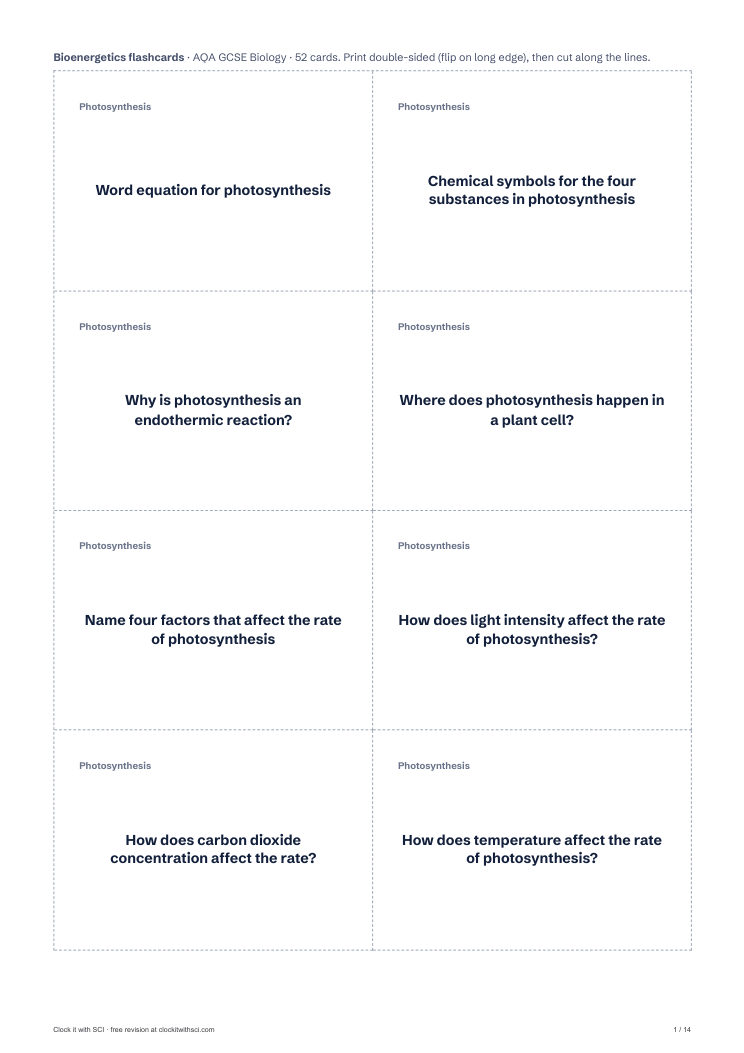
- Word equation for photosynthesis
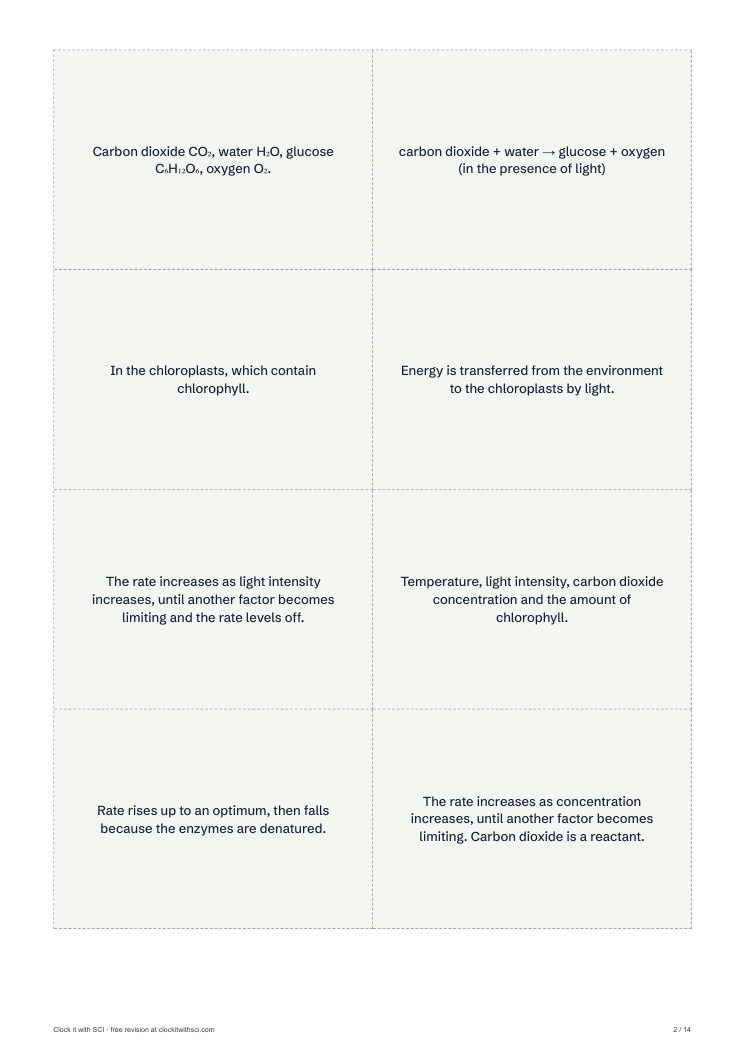
- carbon dioxide + water → glucose + oxygen (in the presence of light)
- Chemical symbols for the four substances in photosynthesis
- Carbon dioxide CO₂, water H₂O, glucose C₆H₁₂O₆, oxygen O₂.
- Why is photosynthesis an endothermic reaction?
- Energy is transferred from the environment to the chloroplasts by light.
- Where does photosynthesis happen in a plant cell?
- In the chloroplasts, which contain chlorophyll.
- Name four factors that affect the rate of photosynthesis
- Temperature, light intensity, carbon dioxide concentration and the amount of chlorophyll.
- How does light intensity affect the rate of photosynthesis?
- The rate increases as light intensity increases, until another factor becomes limiting and the rate levels off.
- How does carbon dioxide concentration affect the rate?
- The rate increases as concentration increases, until another factor becomes limiting. Carbon dioxide is a reactant.
- How does temperature affect the rate of photosynthesis?
- Rate rises up to an optimum, then falls because the enzymes are denatured.
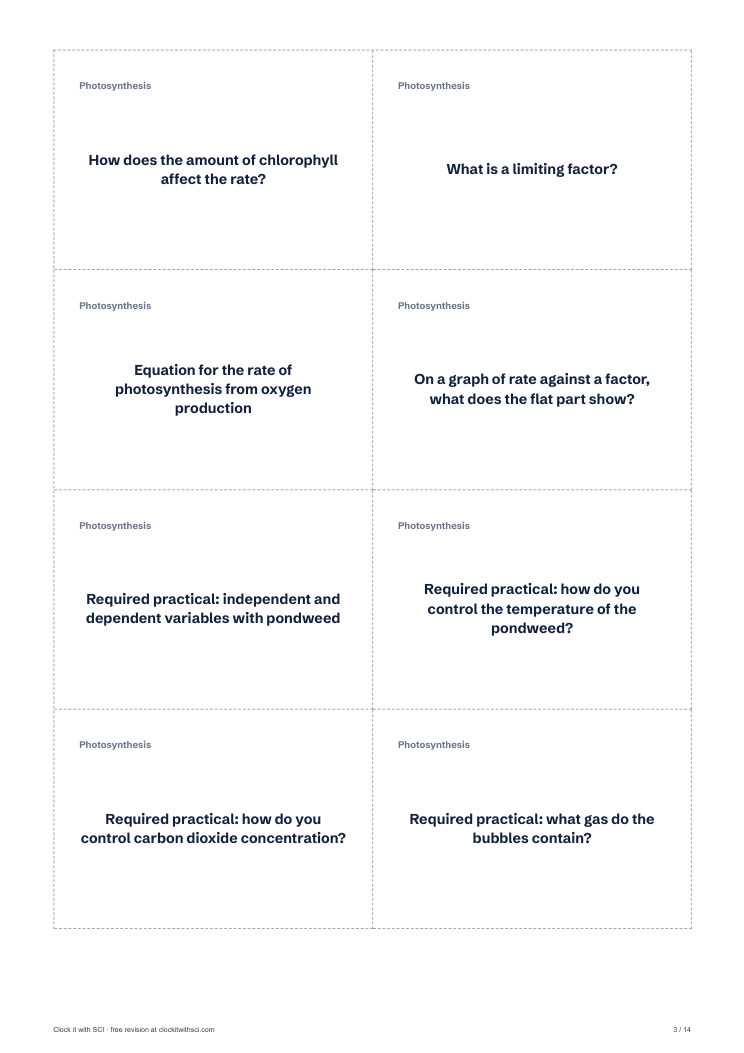
- How does the amount of chlorophyll affect the rate?
- Less chlorophyll means less light is absorbed, so the rate is lower.
- What is a limiting factor?
- The factor in shortest supply, which stops the rate from increasing even if other factors are increased.
- Equation for the rate of photosynthesis from oxygen production
- rate = volume of oxygen produced ÷ time
- On a graph of rate against a factor, what does the flat part show?
- The factor on the x-axis is no longer limiting. Another factor is limiting the rate.
- Required practical: independent and dependent variables with pondweed
- Independent: distance of lamp (light intensity). Dependent: bubbles, or volume of oxygen, per unit time.
- Required practical: how do you control the temperature of the pondweed?
- Use a water bath, or place a heat shield (a beaker of water) between the lamp and the pondweed. A cool LED lamp also helps.
- Required practical: how do you control carbon dioxide concentration?
- Dissolve sodium hydrogencarbonate in the water.
- Required practical: what gas do the bubbles contain?
- Oxygen, the product of photosynthesis.
- Why is the limiting factor idea important in a greenhouse? Higher tier
- Growers can add heat, light or carbon dioxide to gain the maximum rate of photosynthesis, but must still maintain a profit.
- Can any one factor limit photosynthesis? Higher tier
- Yes. The factors interact and any one of them may be the factor that limits photosynthesis.
- State the inverse square law for light intensity Higher tier
- Light intensity is inversely proportional to the square of the distance (∝ 1 ÷ distance²). Double the distance and intensity falls to one quarter.
- Light is 100 units at 10 cm. What is the intensity at 30 cm? Higher tier
- Distance ×3, so intensity ÷ 3² = 100 ÷ 9 = 11.1 units (to 1 decimal place).
- How do you explain a graph with two or three factors? Higher tier
- Find which factor is limiting in each part: the x-axis factor where the line rises, another factor where it is flat.
- Five uses of glucose made in photosynthesis
- Respiration, starch (storage), fat or oil (storage), cellulose (cell walls) and amino acids (protein synthesis).
- Why do plants need nitrate ions?
- To produce proteins: nitrate ions from the soil are used with glucose to make amino acids.
- Why is glucose stored as starch?
- Starch is insoluble, so it is suitable for storage.
- What does cellulose do for plant cells?
- It strengthens the cell wall.
Respiration
- Describe cellular respiration
- An exothermic reaction which is continuously occurring in living cells.
- What does exothermic mean?
- Energy is transferred to the surroundings / environment.
- What do organisms need energy from respiration for?
- Chemical reactions to build larger molecules, movement, and keeping warm.
- Word equation for aerobic respiration
- glucose + oxygen → carbon dioxide + water
- Symbol equation for aerobic respiration
- C₆H₁₂O₆ + 6O₂ → 6CO₂ + 6H₂O
- Equation for anaerobic respiration in muscles
- glucose → lactic acid
- Equation for anaerobic respiration in plant and yeast cells
- glucose → ethanol + carbon dioxide
- Why does anaerobic respiration transfer much less energy?
- The oxidation of glucose is incomplete.
- What is aerobic respiration?
- Respiration that uses oxygen.
- What is anaerobic respiration?
- Respiration without oxygen.
- What is fermentation?
- Anaerobic respiration in yeast cells.
- Why is fermentation economically important?
- It is used in the manufacture of bread and alcoholic drinks.
- Compare aerobic and anaerobic respiration in muscles
- Aerobic: oxygen needed, makes CO₂ and water, transfers much more energy. Anaerobic: no oxygen, makes lactic acid, transfers much less energy.
- What three things increase during exercise?
- Heart rate, breathing rate and breath volume, to supply the muscles with more oxygenated blood.
- What happens in muscles if insufficient oxygen is supplied?
- Anaerobic respiration takes place, causing a build-up of lactic acid.
- What is muscle fatigue?
- After long periods of vigorous activity, muscles stop contracting efficiently.
- What causes an oxygen debt to be created?
- The incomplete oxidation of glucose in anaerobic respiration, which builds up lactic acid.
- What happens to lactic acid after exercise? Higher tier
- Blood transports it from the muscles to the liver, where it is converted back into glucose.
- Define oxygen debt Higher tier
- The extra oxygen the body needs after exercise to react with the accumulated lactic acid and remove it from the cells.
- How could you investigate the effect of exercise on the body?
- Measure pulse or breathing rate at rest, after exercise, and during recovery, controlling the type and time of exercise.
- Define metabolism
- The sum of all the reactions in a cell or the body.
- What is the energy from respiration used for in metabolism?
- The continual enzyme controlled processes of metabolism that synthesise new molecules.
- Which carbohydrates can be made from glucose?
- Starch, glycogen and cellulose.
- What is a lipid made from?
- One molecule of glycerol and three molecules of fatty acids.
- How are proteins made in metabolism?
- Glucose and nitrate ions form amino acids, which are used to synthesise proteins.
- What is formed when excess proteins are broken down?
- Urea, for excretion.
- Which small molecules are used to build, and released when breaking down, carbohydrates, proteins and lipids?
- Sugars (carbohydrates), amino acids (proteins), and fatty acids and glycerol (lipids).