

The need to transport substancesSpec 8.1
Every cell in an organism needs a supply of some substances and must get rid of others. These substances have to be transported into and out of the organism and its cells.
| Substance | Direction | Why it is needed |
|---|---|---|
| Oxygen | Into cells | Used in aerobic respiration to release energy |
| Carbon dioxide | Out of cells | Waste product of respiration. It must be removed from the body |
| Water | Into and out of cells | Needed for cell reactions and to keep cells working. Water is also lost from the body, for example in urine and sweat |
| Dissolved food molecules | Into cells | Provide a source of energy and the materials for growth and repair, for example glucose and amino acids |
| Mineral ions | Into cells | Needed for many cell processes |
| Urea | Out of cells | A waste product that is made in the body. It is carried in the blood to the kidneys and removed in urine |
In a single-celled organism these substances can simply diffuse across the cell surface. In a large animal many cells are far from the outside world, so substances have to be moved over long distances. Blood is the transport medium in humans.
Exchange surfaces, transport systems and surface area : volume ratioSpec 8.2
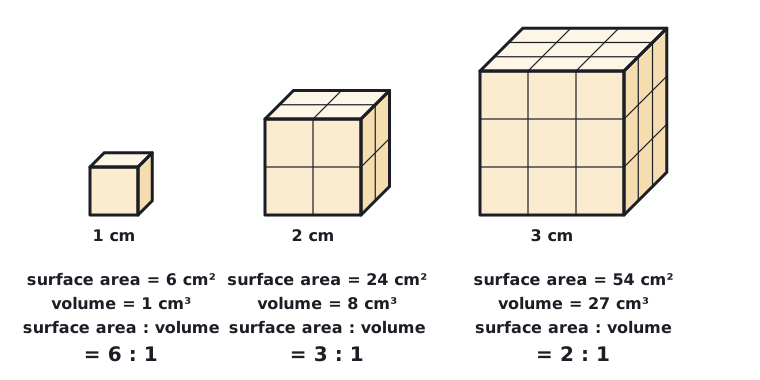
The surface area : volume ratio tells you how much surface an organism has compared with its size. The bigger the organism, the smaller this ratio becomes.
Surface area : volume ratio of a cube
A cube-shaped block of tissue has sides of 3 cm. Calculate its surface area : volume ratio.
- A cube has 6 faces. Area of one face = 3 × 3 = 9 cm².
- Surface area = 6 × 9 = 54 cm².
- Volume = 3 × 3 × 3 = 27 cm³.
- Ratio = 54 : 27. Divide both sides by 27.
Answer: 2 : 1
| Side of cube | Surface area | Volume | Surface area : volume |
|---|---|---|---|
| 1 cm | 6 cm² | 1 cm³ | 6 : 1 |
| 2 cm | 24 cm² | 8 cm³ | 3 : 1 |
| 3 cm | 54 cm² | 27 cm³ | 2 : 1 |
Single-celled and multicellular organisms
- A single-celled organism has a large surface area : volume ratio. Substances only have a short distance to diffuse, so diffusion across the surface is fast enough.
- A multicellular organism has a small surface area : volume ratio. Many cells are deep inside the body, so the diffusion distance is long and diffusion across the body surface is far too slow.
Multicellular organisms therefore need two things. An exchange surface has a large surface area so that enough oxygen can enter and enough carbon dioxide can leave. A transport system (the circulatory system in humans) then carries substances between the exchange surface and all the cells in the body.
 Tap to enlarge
Alveoli and gas exchangeSpec 8.3
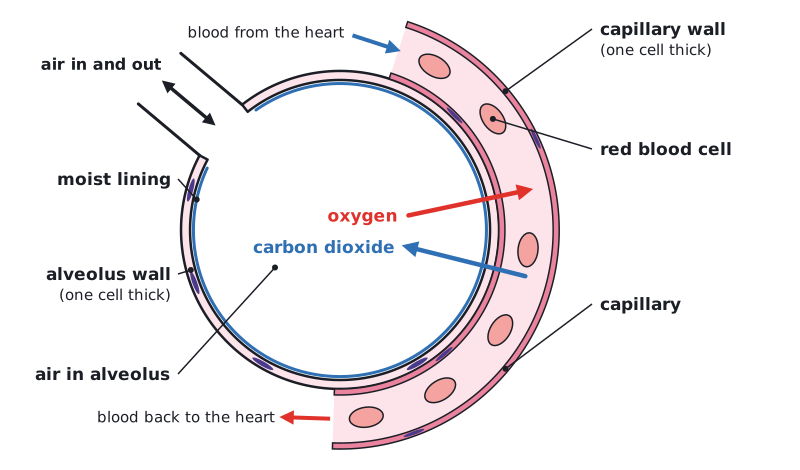
The lungs are the exchange surface for oxygen and carbon dioxide. Each lung contains millions of tiny air sacs called alveoli. Gases move between the air in the alveoli and the blood in the capillaries around them by diffusion.
- Oxygen diffuses from the air in the alveoli (high concentration) into the blood (low concentration).
- Carbon dioxide diffuses from the blood (high concentration) into the air in the alveoli (low concentration), and is breathed out.
| Adaptation | Why it helps |
|---|---|
| Millions of alveoli | Gives a very large surface area for diffusion |
| Walls only one cell thick | Short diffusion distance, so gases diffuse quickly |
| Capillary walls only one cell thick | Short diffusion distance between the air and the blood |
| Rich network of capillaries (good blood supply) | Blood carries oxygen away and brings carbon dioxide, keeping a steep concentration gradient |
| Moist lining | Gases dissolve, which helps them to diffuse |
| Ventilation (breathing in and out) | Keeps a high oxygen concentration in the alveoli and a low carbon dioxide concentration, which maintains the concentration gradient |
 Tap to enlarge
Quick check
Why must urea be transported out of the body's cells?
Show answer
It is a waste product that is carried in the blood to the kidneys and removed in urine.
Does a large animal have a larger or smaller surface area : volume ratio than a single cell?
Show answer
Smaller.
Why do multicellular organisms need a transport system?
Show answer
Many cells are far from the surface, so diffusion alone is too slow to supply them.
State two ways alveoli are adapted for gas exchange.
Show answer
Any two of: large surface area, walls one cell thick, moist lining, good blood supply, ventilation.