

Levels of organisationSpec 9.1
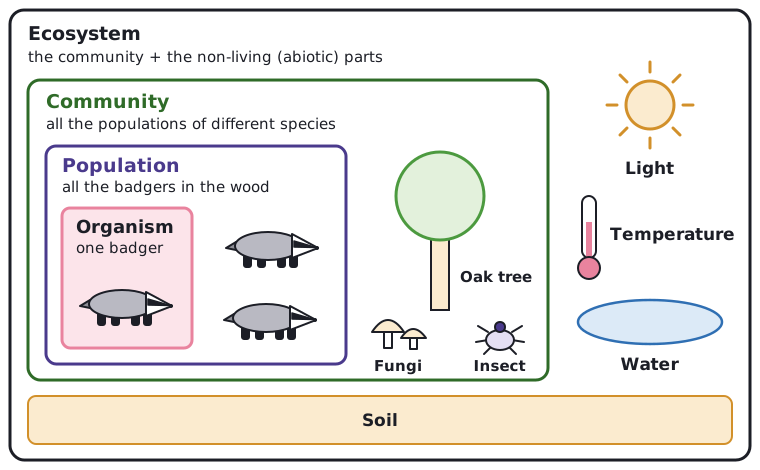
Living things can be described at different levels of organisation, from a single organism up to a whole ecosystem. Each level contains the one before it.
| Level | What it means | Example |
|---|---|---|
| Organism | A single living thing | One badger |
| Population | All the organisms of one species living in the same area | All the badgers in a wood |
| Community | All the populations of different species living in the same area | The badgers, foxes, oak trees, insects and fungi in the wood |
| Ecosystem | A community together with the non-living (abiotic) parts of its environment | The wood, including its soil, water, light and temperature |
An ecosystem is made of living (biotic) and non-living (abiotic) parts that interact with each other. Energy and materials move between them.
 Tap to enlarge
Abiotic and biotic factorsSpec 9.2
The organisms in a community are affected by abiotic factors (non-living) and biotic factors (living). Changes in either can change which species live in a community and how many there are.
| Type | Factor | How it can affect a community |
|---|---|---|
| Abiotic | Temperature | Affects the rate of enzyme-controlled reactions, so growth and survival. Species survive only within a range of temperatures. |
| Abiotic | Light | Plants need light for photosynthesis. Less light means fewer plants, and so less food for the animals that depend on them. |
| Abiotic | Water | All organisms need water. In dry conditions only organisms adapted to save water survive, so numbers and variety fall. |
| Abiotic | Pollutants | Pollutants such as sulfur dioxide in air or sewage in water can kill sensitive species, reducing the variety of organisms. |
| Biotic | Competition | Organisms of the same or different species compete for the same limited resources, such as food, water, light and space. |
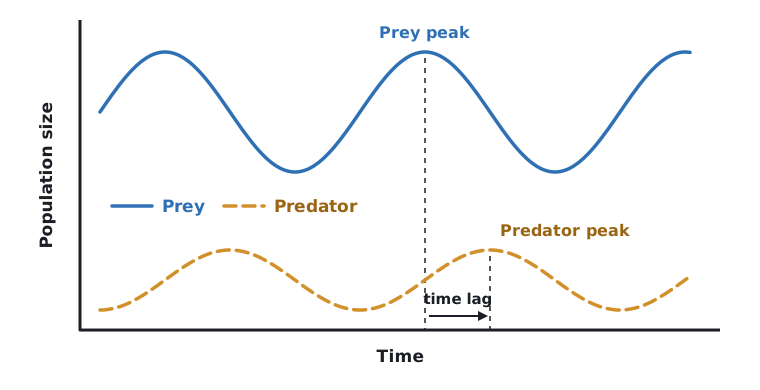
| Biotic | Predation | Predators eat prey, so predator and prey numbers affect each other. |
Competition
Competition happens when organisms need the same resource and there is not enough for all of them. Plants compete for light, water and mineral ions. Animals compete for food, water and territory. The better-adapted species gets more of the resource, so it survives and reproduces more, and the numbers of the other species may fall.
Predation
In a stable community, predator and prey numbers rise and fall in a repeating pattern. When prey numbers rise, predators have more food, so predator numbers rise. More predators eat more prey, so prey numbers fall. With less food, predator numbers then fall, and the prey can recover.
 Tap to enlarge
InterdependenceSpec 9.3
In a community, species depend on one another. This is interdependence. Organisms depend on other species for food, shelter, pollination and seed dispersal.
- Animals depend on plants and other animals for food.
- Plants depend on insects and other animals for pollination and seed dispersal.
- Many species depend on trees for shelter and nesting sites.
Because of this, a change to one population can affect many others. If a species is removed or its numbers fall, species that feed on it may starve, while species it feeds on may increase in number. A community with many different species is more stable, because the loss of one species is less likely to cause the whole community to fail.
Parasitism and mutualismSpec 9.4
The survival of some organisms depends on a close relationship with another species. Two important types are parasitism and mutualism.
| Parasitism | Mutualism | |
|---|---|---|
| Meaning | One organism (the parasite) lives on or in another organism (the host) and takes food from it | Two organisms of different species live closely together and both benefit |
| Who benefits | The parasite benefits and the host is harmed | Both benefit |
| Examples | A tapeworm in the human gut. A flea on a dog. | Nitrogen-fixing bacteria in the root nodules of legume plants. Cleaner fish that eat parasites off larger fish. |
In mutualism, nitrogen-fixing bacteria in root nodules get sugars from the legume plant, and the plant gets nitrogen compounds from the bacteria. Neither can do as well alone.
Quick check
Put in order from smallest to largest: ecosystem, population, organism, community.
Show answer
Organism, population, community, ecosystem.
Name two abiotic factors that affect communities.
Show answer
Any two of: temperature, light, water, pollutants.
What is meant by competition?
Show answer
Organisms needing the same limited resource, such as food, light or water.
What is the difference between parasitism and mutualism?
Show answer
In parasitism the parasite benefits and the host is harmed. In mutualism both organisms benefit.