

Plant tissuesSpec 4.2.3.1
You need to be able to explain how the structures of plant tissues are related to their functions. Plant tissues include epidermal tissues, palisade mesophyll, spongy mesophyll, xylem and phloem, and meristem tissue.
| Tissue | Structure | Function |
|---|---|---|
| Epidermal tissues | A thin layer of cells covering the surface. In the leaf it is covered by a waxy layer | Protects the plant and reduces water loss. The leaf epidermis lets light through |
| Palisade mesophyll | Tall, tightly packed cells near the top of the leaf, containing many chloroplasts | Photosynthesis: absorbs light |
| Spongy mesophyll | Rounded cells with air spaces between them | Air spaces let gases such as carbon dioxide diffuse through the leaf. Photosynthesis also occurs here |
| Xylem | Hollow tubes strengthened by lignin | Transports water and mineral ions |
| Phloem | Tubes of elongated cells | Transports dissolved sugars |
| Meristem tissue | Found at the growing tips of shoots and roots. Cells divide and can become different types of cell | Produces new cells for growth |
The leaf as an organSpec 4.2.3.1
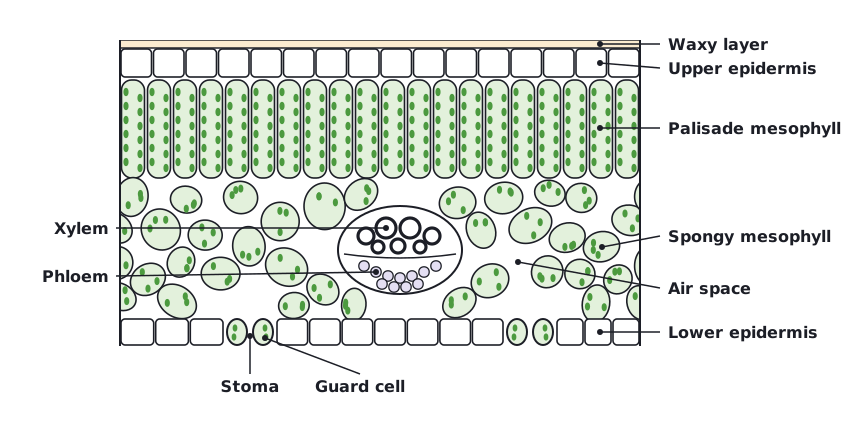
The leaf is a plant organ. It is made up of several tissues that work together. Knowledge is limited to the epidermis, palisade and spongy mesophyll, xylem and phloem, and guard cells surrounding stomata.
- The epidermis covers the leaf. The lower epidermis contains stomata.
- Palisade mesophyll lies below the upper epidermis. It is where most photosynthesis happens.
- Spongy mesophyll lies below the palisade layer. Its air spaces let gases move around.
- Xylem and phloem in the leaf veins bring water to the leaf and take sugars away.
- Guard cells surround each stomatal pore and control its opening.
 Tap to enlarge
Roots, xylem and phloemSpec 4.2.3.2
The roots, stem and leaves form a plant organ system for transport of substances around the plant.
Root hair cells
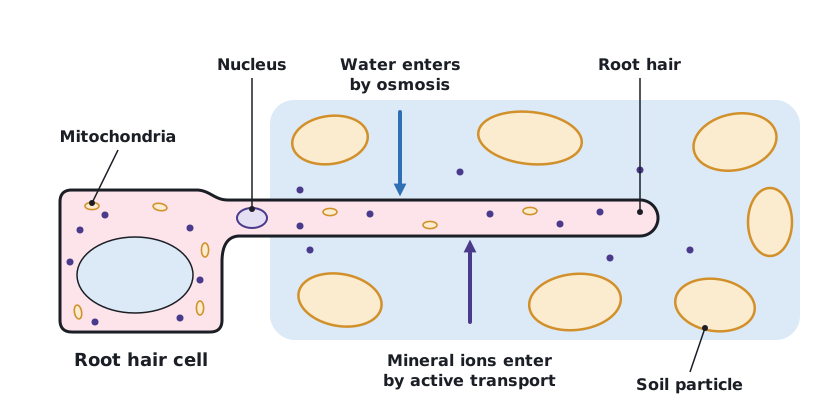
Root hair cells are adapted for the efficient uptake of water by osmosis and mineral ions by active transport.
- The long root hair gives a large surface area for taking in water and mineral ions.
- Mineral ions are usually at a lower concentration in the soil than in the cell, so they move into the cell against the concentration gradient by active transport. This needs energy from respiration, so root hair cells contain many mitochondria.
- Water moves in by osmosis.
Xylem
Xylem tissue transports water and mineral ions from the roots to the stems and leaves. It is composed of hollow tubes strengthened by lignin. It is adapted for the transport of water in the transpiration stream.
Phloem
Phloem tissue transports dissolved sugars from the leaves to the rest of the plant for immediate use or storage. The movement of food molecules through phloem tissue is called translocation.
Phloem is composed of tubes of elongated cells. Cell sap can move from one phloem cell to the next through pores in the end walls.
| Xylem | Phloem | |
|---|---|---|
| Transports | Water and mineral ions | Dissolved sugars |
| Direction | From the roots to the stems and leaves | From the leaves to the rest of the plant |
| Structure | Hollow tubes strengthened by lignin | Tubes of elongated cells with pores in the end walls |
| Process | Transpiration stream | Translocation |
 Tap to enlarge
Transpiration and stomataSpec 4.2.3.2
Transpiration is the loss of water vapour from the leaves. Water moves from the roots to the leaves in the xylem in a continuous flow called the transpiration stream.
- Water enters the root hair cells by osmosis.
- Water moves up through the xylem to the leaves.
- Water evaporates from the surface of the mesophyll cells into the air spaces in the leaf.
- Water vapour diffuses out of the leaf through the stomata.
The transpiration stream brings water and mineral ions to the leaves. Leaf cells need water and carbon dioxide for photosynthesis.
Stomata and guard cells
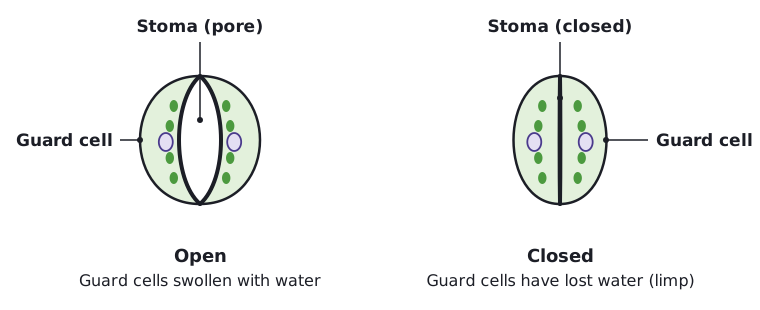
Stomata are small pores, mainly on the underside of the leaf. Each is surrounded by a pair of guard cells. The role of stomata and guard cells is to control gas exchange and water loss.
- When the guard cells take in water they swell and the stoma opens. Carbon dioxide can diffuse in for photosynthesis and oxygen can diffuse out. Water vapour is also lost.
- When the guard cells lose water the stoma closes, which reduces water loss.
There is a trade-off. Closing the stomata saves water but stops carbon dioxide getting in, so photosynthesis slows down.
 Tap to enlarge
Factors affecting the rate of transpirationSpec 4.2.3.2
You need to be able to explain the effect of changing temperature, humidity, air movement and light intensity on the rate of transpiration.
| Factor | Change | Effect on rate | Reason |
|---|---|---|---|
| Temperature | Increase | Increases | Water evaporates faster and diffuses out of the leaf faster |
| Humidity | Increase | Decreases | The air around the leaf already has a lot of water vapour, so the concentration gradient is smaller and diffusion is slower |
| Air movement | Increase | Increases | Moving air carries away water vapour from around the stomata, keeping a steep concentration gradient |
| Light intensity | Increase | Increases | Stomata open wider in the light, so more water vapour can escape |
The opposite change has the opposite effect: lower temperature, more humid air, still air and darkness all reduce the rate of transpiration.
Measuring the rate of transpiration
A potometer measures the uptake of water by a cut shoot. This is used as a measure of the rate of transpiration.
- Cut a shoot under water and fit it into the potometer, making sure the apparatus is full of water with no air bubbles.
- Dry the leaves and seal the joints so no air or water can leak.
- Introduce an air bubble into the capillary tube and record its starting position.
- Measure the distance the bubble moves in a set time.
- Change one factor, such as air movement from a fan, and repeat.
Rate of transpiration
An air bubble in a potometer moves 36 mm in 12 minutes. Calculate the rate of transpiration in mm per minute.
- Rate = distance ÷ time.
- Rate = 36 ÷ 12.
Answer: 3 mm/min
Volume of water taken up
The capillary tube has a cross-sectional area of 0.8 mm². The bubble moves 40 mm in 10 minutes. Calculate the volume of water taken up and the rate in mm³ per minute.
- Volume = cross-sectional area × distance = 0.8 × 40 = 32 mm³.
- Rate = volume ÷ time = 32 ÷ 10.
Answer: 32 mm³ of water; 3.2 mm³/min
Other maths skills
Repeat readings and find the arithmetic mean to reduce the effect of random errors. When you plot a graph, put the independent variable on the x-axis, choose scales that use most of the grid, label both axes with units and draw a line of best fit. The same ideas apply when you investigate the distribution of stomata by counting them in several fields of view (a sample) on a leaf.
Mean number of stomata
A student counts the stomata in three fields of view on the lower surface of a leaf: 24, 28 and 20. Calculate the mean.
- Add the counts: 24 + 28 + 20 = 72.
- Divide by the number of fields of view: 72 ÷ 3.
Answer: 24 stomata per field of view
Quick check
Which plant tissue transports water and mineral ions?
Show answer
Xylem.
What is translocation?
Show answer
The movement of dissolved sugars through phloem tissue from the leaves to the rest of the plant.
Why does an increase in humidity decrease the rate of transpiration?
Show answer
The concentration gradient of water vapour between the leaf and the air is smaller, so water vapour diffuses out more slowly.
What do guard cells control?
Show answer
The opening and closing of stomata, which controls gas exchange and water loss.