

VariationSpec 4.6.2.1
Differences in the characteristics of individuals in a population are called variation. Variation may be due to differences in:
- the genes they have inherited (genetic causes)
- the conditions in which they have developed (environmental causes)
- a combination of genes and the environment.
The phenotype of an organism develops from its genome and the way the genome interacts with the environment.
| Cause | Examples |
|---|---|
| Genetic | Eye colour, blood group |
| Environmental | A scar from an injury; a plant that grows poorly in poor soil |
| Both | Body mass or height: genes set a potential, but diet and lifestyle affect what is reached |
Mutations
There is usually extensive genetic variation within a population of a species. All variants arise from mutations. Of these:
- most have no effect on the phenotype
- some influence the phenotype
- very few determine the phenotype.
Mutations occur continuously. Very rarely a mutation leads to a new phenotype. If the new phenotype is suited to an environmental change, it can lead to a relatively rapid change in the species.
EvolutionSpec 4.6.2.2
- Evolution
- A change in the inherited characteristics of a population over time through a process of natural selection, which may result in the formation of a new species.
The theory of evolution by natural selection states that all species of living things have evolved from simple life forms that first developed more than three billion years ago.
How natural selection works
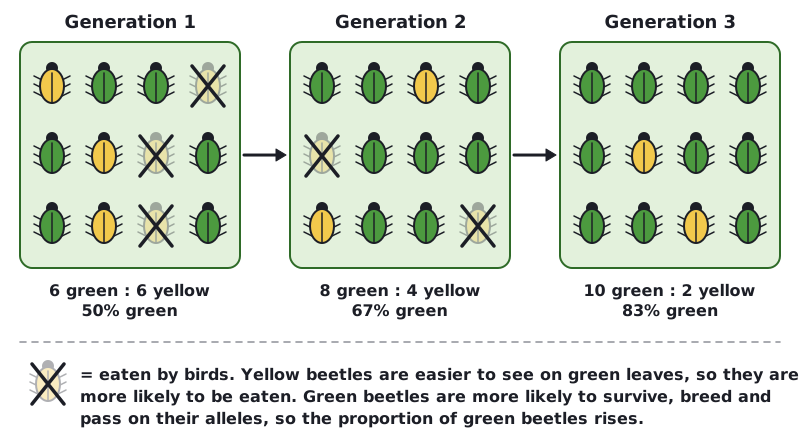
- Individuals in a population show variation in their phenotypes, caused by differences in their genes.
- The environment puts pressure on the population. For example, there may be predators, disease or competition for food.
- Individuals with phenotypes best suited to their environment are more likely to survive and breed.
- They pass on the alleles for the useful characteristic to their offspring.
- Over many generations, a greater proportion of the population has the characteristic.
New species
If two populations of one species become so different in phenotype that they can no longer interbreed to produce fertile offspring, they have formed two new species.
 Tap to enlarge
Selective breedingSpec 4.6.2.3
Selective breeding (artificial selection) is the process by which humans breed plants and animals for particular genetic characteristics. Humans have been doing this for thousands of years, since they first bred food crops from wild plants and domesticated animals.
- Choose parents with the desired characteristic from a mixed population.
- Breed them together.
- From the offspring, choose those with the desired characteristic and breed them together.
- Continue over many generations until all the offspring show the desired characteristic.
The characteristic can be chosen for usefulness or appearance. Examples:
- disease resistance in food crops
- animals which produce more meat or milk
- domestic dogs with a gentle nature
- large or unusual flowers.
Impact of selective breeding
| Benefits | Risks |
|---|---|
| Crops and animals that give higher yields of food | Can lead to inbreeding, where some breeds are particularly prone to disease or inherited defects |
| Disease-resistant crops | Reduces the number of different alleles in the population, because only a few individuals are bred |
| Animals or plants with useful or attractive features | Some people have ethical objections to animals being bred for human use |
Genetic engineeringSpec 4.6.2.4
- Genetic engineering
- A process which involves modifying the genome of an organism by introducing a gene from another organism to give a desired characteristic.
In genetic engineering, genes from the chromosomes of humans and other organisms can be 'cut out' and transferred to cells of other organisms.
- Plant crops have been genetically engineered to be resistant to diseases or to produce bigger, better fruits.
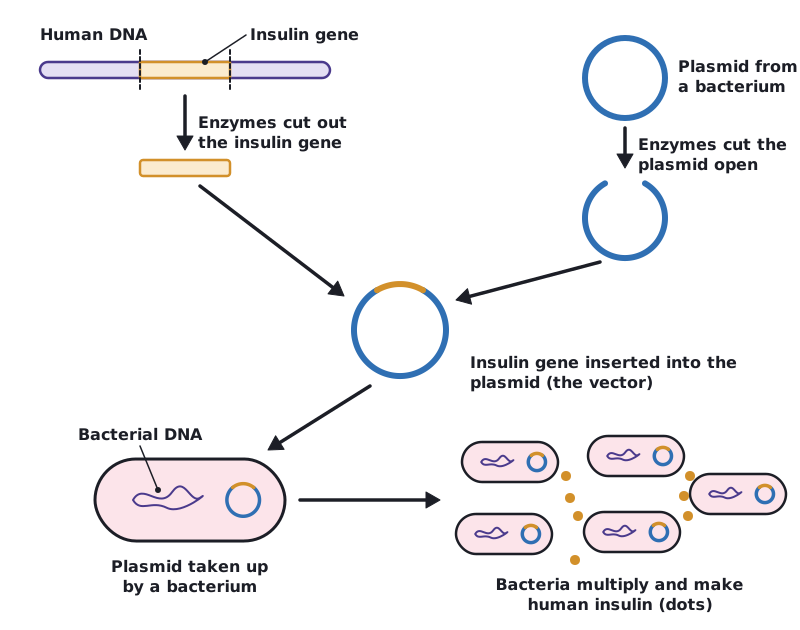
- Bacterial cells have been genetically engineered to produce useful substances such as human insulin to treat diabetes.
Crops that have had their genes modified in this way are called genetically modified (GM) crops. GM crops include ones that are resistant to insect attack or to herbicides. GM crops generally show increased yields.
Benefits, risks and objections
| Potential benefits | Potential risks and objections | |
|---|---|---|
| Agriculture | Increased yields; resistance to insects, herbicides or disease; bigger, better fruits | Effects on populations of wild flowers and insects; some people feel the effects of eating GM crops on human health have not been fully explored |
| Medicine | Bacteria can make useful substances such as human insulin; research is exploring genetic modification to overcome some inherited disorders | Some people object to altering the genes of organisms, especially humans; long-term effects may not be known |
Some people have objections to genetic engineering, even though it has huge potential benefits.
The main steps in genetic engineering
- Enzymes are used to isolate the required gene.
- The gene is inserted into a vector, usually a bacterial plasmid or a virus.
- The vector is used to insert the gene into the required cells.
- Genes are transferred to the cells of animals, plants or microorganisms at an early stage in their development, so that they develop with the desired characteristics.
 Tap to enlarge
CloningSpec 4.6.2.5Triple only
| Method | What happens | Used for |
|---|---|---|
| Tissue culture | Small groups of cells from part of a plant are used to grow identical new plants | Preserving rare plant species; commercially in nurseries |
| Cuttings | An older, but simple, method: a piece of the parent plant is used to grow a new plant | Gardeners producing many identical new plants from a parent plant |
| Embryo transplants | Cells from a developing animal embryo are split apart before they become specialised, then the identical embryos are transplanted into host mothers | Producing several identical animals |
| Adult cell cloning | See the steps below | Producing an animal with the same genes as an adult |
Adult cell cloning
- The nucleus is removed from an unfertilised egg cell.
- The nucleus from an adult body cell, such as a skin cell, is inserted into the egg cell.
- An electric shock stimulates the egg cell to divide to form an embryo.
- These embryo cells contain the same genetic information as the adult skin cell.
- When the embryo has developed into a ball of cells, it is inserted into the womb of an adult female to continue its development.
Benefits, risks and objections
| Potential benefits | Potential risks and objections |
|---|---|
| Many identical copies of plants or animals with a useful characteristic can be produced | Clones have the same genes, so there is less genetic variation and a single disease could affect them all |
| Rare plant species can be preserved | Some people have ethical objections to cloning animals |
| Plants can be produced quickly and cheaply, all with the desired characteristic | Cloned animals may be less healthy than normally produced animals |
Quick check
Give the three possible causes of variation.
Show answer
Genetic causes, environmental causes, or a combination of genes and the environment.
What do all variants arise from?
Show answer
Mutations.
When have two populations become two new species?
Show answer
When they are so different in phenotype that they can no longer interbreed to produce fertile offspring.
Name one problem caused by selective breeding.
Show answer
Inbreeding, where some breeds are prone to disease or inherited defects.
What is a GM crop?
Show answer
A crop that has had its genes modified by genetic engineering.