

Sexual and asexual reproductionSpec 4.6.1.1
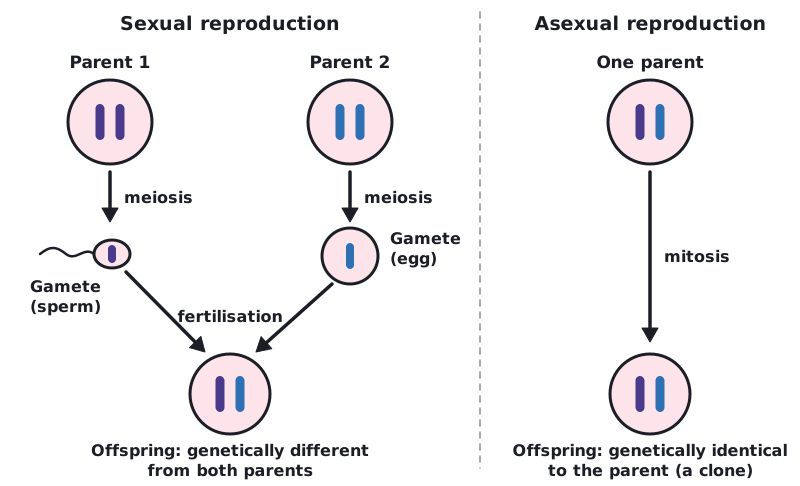
Sexual reproduction involves the joining (fusion) of male and female gametes. In animals the gametes are sperm and egg cells. In flowering plants they are pollen and egg cells.
In sexual reproduction there is mixing of genetic information, which leads to variety in the offspring. The formation of gametes involves meiosis.
Asexual reproduction involves only one parent and no fusion of gametes. There is no mixing of genetic information, so the offspring are genetically identical to the parent. Genetically identical offspring are called clones. Only mitosis is involved.
Meiosis leads to non-identical cells being formed. Mitosis leads to identical cells being formed.
| Sexual reproduction | Asexual reproduction | |
|---|---|---|
| Number of parents | Two | One |
| Fusion of gametes | Yes | No |
| Type of cell division used | Meiosis to make gametes | Mitosis only |
| Mixing of genetic information | Yes | No |
| Offspring | Genetically different from each other and from the parents | Genetically identical to the parent (clones) |
 Tap to enlarge
MeiosisSpec 4.6.1.2
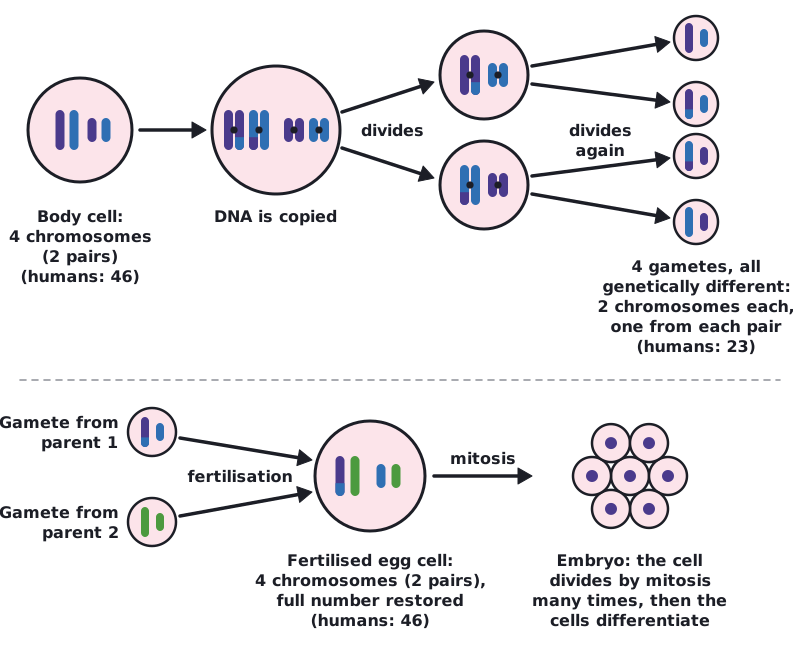
Cells in the reproductive organs divide by meiosis to form gametes. You need to be able to explain how meiosis halves the number of chromosomes in gametes and how fertilisation restores the full number.
- The cell copies its genetic information.
- The cell divides twice to form four gametes.
- Each gamete has a single set of chromosomes, so the chromosome number is halved.
- All the gametes are genetically different from each other.
Human body cells contain 23 pairs of chromosomes (46 in total). Each human gamete therefore has 23 chromosomes, one from each pair.
Gametes join at fertilisation to restore the normal number of chromosomes. The new cell divides by mitosis, so the number of cells increases. As the embryo develops, the cells differentiate.
 Tap to enlarge
Advantages and disadvantages of sexual and asexual reproductionSpec 4.6.1.3Triple only
| Sexual reproduction | Asexual reproduction |
|---|---|
| Produces variation in the offspring | Only one parent is needed |
| If the environment changes, variation gives a survival advantage by natural selection | More time and energy efficient, as there is no need to find a mate |
| Natural selection can be speeded up by humans in selective breeding to increase food production | Faster than sexual reproduction |
| Many identical offspring can be produced when conditions are favourable |
The spec lists the advantages. The disadvantages of each type are the converse of the advantages of the other. Sexual reproduction needs two parents, takes more time and energy because a mate must be found, and is slower. Asexual reproduction produces no variation, so if the environment changes, or a new disease appears, the whole population may be affected.
Organisms that use both methods
Some organisms reproduce by both methods, depending on the circumstances. You only need to know the examples below.
- Malarial parasites reproduce asexually in the human host, but sexually in the mosquito.
- Many fungi reproduce asexually by spores, but also reproduce sexually to give variation.
- Many plants produce seeds sexually, but also reproduce asexually by runners (strawberry plants) or bulb division (daffodils).
DNA and the genomeSpec 4.6.1.4
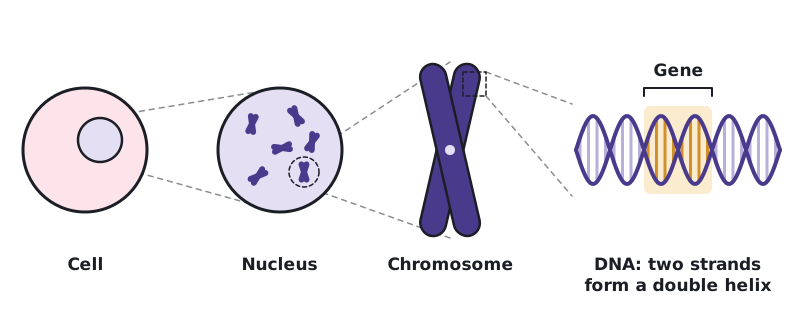
The genetic material in the nucleus of a cell is a chemical called DNA. DNA is a polymer made up of two strands forming a double helix. The DNA is contained in structures called chromosomes.
A gene is a small section of DNA on a chromosome. Each gene codes for a particular sequence of amino acids, to make a specific protein.
- Genome
- The entire genetic material of an organism.
- Gene
- A small section of DNA on a chromosome that codes for a particular sequence of amino acids, to make a specific protein.
- Chromosome
- A structure in the nucleus that contains DNA.
 Tap to enlarge
Why the human genome matters
The whole human genome has now been studied, and this will have great importance for medicine in the future. You need to be able to discuss its importance. This is limited to three areas.
- The search for genes linked to different types of disease. Knowing which genes are involved helps scientists understand diseases.
- Understanding and treatment of inherited disorders. Finding the genes involved in a disorder is the first step towards developing treatments.
- Tracing human migration patterns from the past. Comparing the genomes of different groups of people shows how they are related.
DNA structureSpec 4.6.1.5Triple only
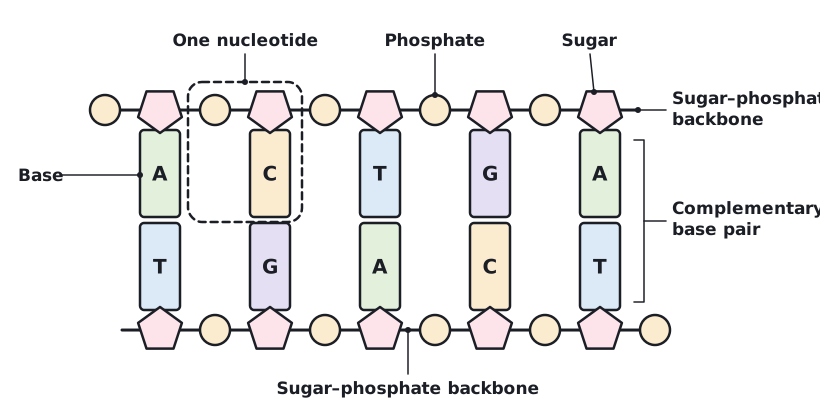
DNA is a polymer made from four different nucleotides. The DNA polymer is made up of repeating nucleotide units.
Each nucleotide consists of a common sugar and phosphate group, with one of four different bases attached to the sugar. The long strands of DNA have alternating sugar and phosphate sections, and one of the four bases is attached to each sugar.
DNA contains four bases: A, C, G and T. A sequence of three bases is the code for a particular amino acid. The order of bases controls the order in which amino acids are assembled to produce a particular protein.
 Tap to enlarge
Complementary base pairing
In the complementary strands, C is always linked to G on the opposite strand and T is always linked to A.
Protein synthesis
- Proteins are made on ribosomes, according to a template.
- Carrier molecules bring specific amino acids to add to the growing protein chain in the correct order.
- When the protein chain is complete, it folds up to form a unique shape.
- This unique shape lets the protein do its job, for example as an enzyme, a hormone, or a structure in the body such as collagen.
You are not expected to know or understand the structure of mRNA or tRNA, or the detailed structure of amino acids or proteins.
Mutations and their effects
A change in the structure of DNA changes the order of bases. This can change the order of amino acids, so a different protein can be made. Mutations occur continuously. Most do not alter the protein, or only alter it slightly, so its appearance or function is not changed.
A few mutations code for an altered protein with a different shape. An enzyme may no longer fit the substrate binding site, or a structural protein may lose its strength.
Non-coding DNA
Not all parts of DNA code for proteins. Non-coding parts of DNA can switch genes on and off, so variations in these areas may affect how genes are expressed.
Genetic variants may influence the phenotype in two ways: in coding DNA by altering the activity of a protein, and in non-coding DNA by altering how genes are expressed.
Genetic inheritanceSpec 4.6.1.6
- Gamete
- A sex cell (sperm, egg or pollen) that has a single set of chromosomes.
- Chromosome
- A structure in the nucleus made of DNA, carrying many genes.
- Gene
- A small section of DNA on a chromosome that codes for a particular protein.
- Allele
- A different form of the same gene.
- Dominant
- An allele that is always expressed, even if only one copy is present.
- Recessive
- An allele that is only expressed if two copies are present (so no dominant allele is present).
- Homozygous
- Having two alleles that are the same for a trait.
- Heterozygous
- Having two alleles that are different for a trait.
- Genotype
- The alleles present for a characteristic.
- Phenotype
- How the characteristic is expressed, such as black fur.
Some characteristics are controlled by a single gene, such as fur colour in mice and red-green colour blindness in humans. Each gene may have different forms called alleles. The alleles present (the genotype) operate at a molecular level to develop characteristics that are expressed as a phenotype.
Most characteristics are the result of multiple genes interacting, rather than a single gene.
Dominant alleles are shown with a capital letter (B) and recessive alleles with the same letter in lower case (b). A black-furred mouse could be BB or Bb. A brown mouse must be bb.
Genetic crosses
A Punnett square shows the possible combinations of alleles from the gametes. Each box is equally likely, so you can use it to predict probability and ratios. Probability tells you the chance of an outcome, not what will actually happen in a small family.
Cross between two heterozygous mice
In mice, black fur (B) is dominant to brown fur (b). Two black mice, both Bb, are crossed. Show the possible offspring, the ratio of phenotypes and the probability of a brown mouse.
- Gametes from one parent: B and b. Gametes from the other parent: B and b.
- Fill in the Punnett square: BB, Bb, Bb, bb.
- Three of the four boxes contain at least one B, so they are black. One box is bb, so it is brown.
- Ratio of black : brown = 3 : 1.
- Probability of brown = 1 out of 4.
Answer: Ratio 3 black : 1 brown. The probability of a brown mouse is 1 in 4, which is 0.25 or 25%.
Using a ratio
The cross above produces 80 offspring in total. About how many would you expect to be black?
- The ratio is 3 : 1, so there are 3 + 1 = 4 parts.
- One part = 80 ÷ 4 = 20.
- Black = 3 parts = 3 × 20 = 60.
Answer: About 60 black offspring.
You must be able to complete a Punnett square diagram and extract and interpret information from genetic crosses.
Higher tier students must also be able to construct a genetic cross by Punnett square diagram from scratch and use it to make predictions using the theory of probability.
Family trees
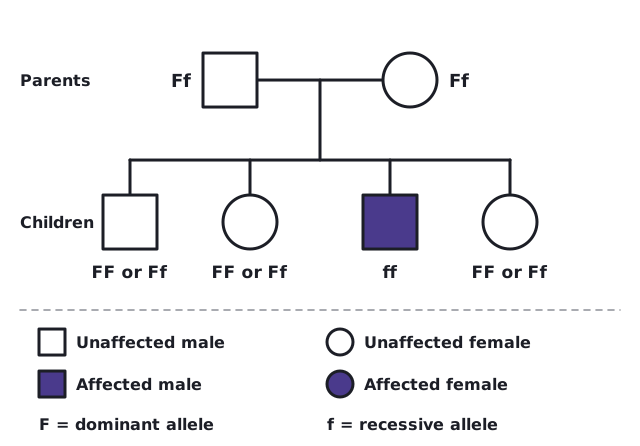
A family tree shows how a characteristic is passed through a family. Squares usually show males and circles show females, and shading shows people who have the characteristic. If two parents who do not show a characteristic have a child who does, the characteristic must be recessive, and both parents must be heterozygous.
 Tap to enlarge
Inherited disordersSpec 4.6.1.7
Some disorders are inherited. They are caused by the inheritance of certain alleles.
- Polydactyly (having extra fingers or toes) is caused by a dominant allele.
- Cystic fibrosis (a disorder of cell membranes) is caused by a recessive allele.
Polydactyly
Polydactyly is caused by a dominant allele (D). One parent has polydactyly and is Dd. The other parent does not have polydactyly. What is the chance that a child has polydactyly?
- A person without polydactyly must be dd (a dominant allele is always expressed).
- Gametes: D and d from one parent, d and d from the other.
- Offspring: Dd, Dd, dd, dd.
- Two of the four have a D allele, so two of the four have polydactyly.
Answer: The ratio of polydactyly : no polydactyly is 1 : 1, so the chance of a child having polydactyly is 1 in 2 (50%).
Cystic fibrosis
Cystic fibrosis is caused by a recessive allele (f). Two parents do not have cystic fibrosis but both are carriers (Ff). What is the chance that a child has cystic fibrosis?
- Gametes from each parent: F and f.
- Offspring: FF, Ff, Ff, ff.
- Only ff has two recessive alleles, so only ff has cystic fibrosis.
Answer: 1 in 4 (25%). The ratio of unaffected to affected is 3 : 1.
Embryo screening and gene therapy
Embryos can be screened for faulty alleles before they are implanted, so that only embryos without the disorder are used. Modern medical research is also exploring gene therapy, which is genetic modification to overcome some inherited disorders. Both may alleviate suffering, but they raise ethical issues.
You may be asked to make an informed judgement about the economic, social and ethical issues, using the information given.
| For | Against | |
|---|---|---|
| Ethical | Prevents suffering for the child and family | Embryos that would have the disorder are destroyed, which some people believe is wrong |
| Social | Fewer children born with serious disorders | May lead to pressure to choose other characteristics; people living with the disorder may feel devalued |
| Economic | May reduce the long-term cost of treatment and care | The screening itself is expensive and is not available to everyone |
Sex determinationSpec 4.6.1.8
Ordinary human body cells contain 23 pairs of chromosomes. 22 pairs control characteristics only, but one of the pairs carries the genes that determine sex.
- In females the sex chromosomes are the same: XX.
- In males the sex chromosomes are different: XY.
All eggs contain an X chromosome. Half of the sperm contain an X and half contain a Y. The sperm that fertilises the egg decides the sex of the baby.
Sex inheritance cross
Show the cross between a female (XX) and a male (XY) and state the ratio of female to male offspring.
- Gametes from the mother: X and X. Gametes from the father: X and Y.
- Punnett square: XX, XX, XY, XY.
- Two of the four boxes are XX (female) and two are XY (male).
Answer: Ratio of female : male = 1 : 1. The probability of each child being a girl, or a boy, is 50%.
Quick check
Why are the offspring of asexual reproduction genetically identical to the parent?
Show answer
There is only one parent and no fusion of gametes, and only mitosis is involved.
How does meiosis halve the number of chromosomes?
Show answer
The cell divides twice to form four gametes, each with a single set of chromosomes.
Define the genome of an organism.
Show answer
The entire genetic material of that organism.
What is the difference between genotype and phenotype?
Show answer
Genotype is the alleles present; phenotype is how the characteristic is expressed.
What are the sex chromosomes of a human female and male?
Show answer
Female XX, male XY.