

Theory of evolutionSpec 4.6.3.1Triple only
Charles Darwin proposed the theory of evolution by natural selection as a result of observations on a round the world expedition. His ideas were backed by years of experimentation and discussion, and linked to developing knowledge of geology and fossils.
- Individual organisms within a particular species show a wide range of variation for a characteristic.
- Individuals with characteristics most suited to the environment are more likely to survive to breed successfully.
- The characteristics that have enabled these individuals to survive are then passed on to the next generation.
Darwin published his ideas in On the Origin of Species (1859). There was much controversy about these revolutionary new ideas. The theory developed over time, using information gathered by many scientists.
Why the theory was only gradually accepted
- It challenged the idea that God made all the animals and plants that live on Earth.
- There was insufficient evidence at the time it was published to convince many scientists.
- The mechanism of inheritance and variation was not known until 50 years after the theory was published.
Lamarck
Other theories, including that of Jean-Baptiste Lamarck, are based mainly on the idea that changes that occur in an organism during its lifetime can be inherited. We now know that in the vast majority of cases this type of inheritance cannot occur.
SpeciationSpec 4.6.3.2Triple only
Alfred Russel Wallace independently proposed the theory of evolution by natural selection. He published joint writings with Darwin in 1858, which prompted Darwin to publish On the Origin of Species (1859) the following year.
Wallace worked worldwide gathering evidence for evolutionary theory. He is best known for his work on warning colouration in animals and his theory of speciation. More evidence over time has led to our current understanding of speciation.
The work of Darwin and Wallace had a big impact on biology. It gave a single explanation for how species change over time and how new species form, and it led to scientists collecting evidence to test the theory.
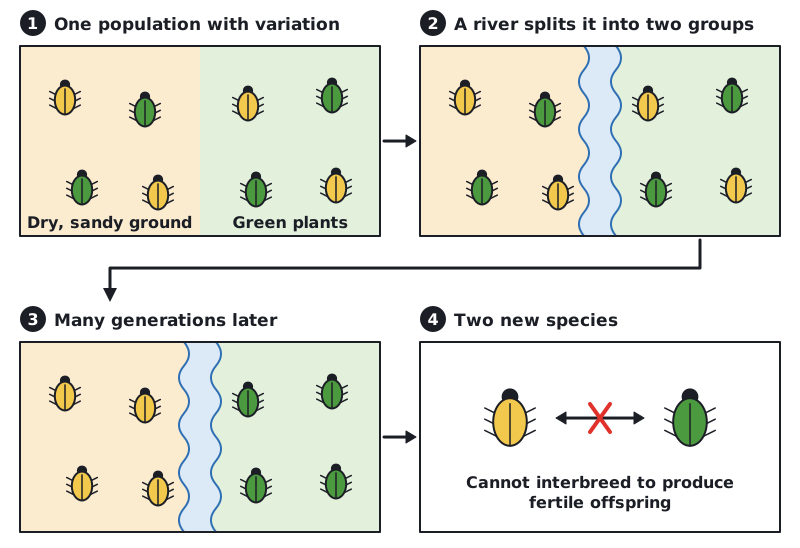
Steps that give rise to new species
- A population of one species becomes isolated (for example by a geographical barrier), so the two populations cannot interbreed.
- There is genetic variation in each population, arising from mutations.
- The two populations live in different environments, so natural selection acts differently on them. Individuals with characteristics best suited to each environment survive and breed.
- The alleles for these characteristics are passed on, so the populations change over many generations.
- Eventually the populations are so different in phenotype that they can no longer interbreed to produce fertile offspring. They are now two new species.
 Tap to enlarge
The understanding of geneticsSpec 4.6.3.3Triple only
Our current understanding of genetics has developed over time, from the work of many scientists. This led to the gene theory.
| When | What happened |
|---|---|
| Mid-19th century | Gregor Mendel carried out breeding experiments on plants. He observed that the inheritance of each characteristic is determined by 'units' that are passed on to descendants unchanged. |
| Late 19th century | The behaviour of chromosomes during cell division was observed. |
| Early 20th century | It was observed that chromosomes and Mendel's 'units' behaved in similar ways. This led to the idea that the 'units', now called genes, were located on chromosomes. |
| Mid-20th century | The structure of DNA was determined and the mechanism of gene function worked out. |
Why Mendel's work was not recognised until after his death
When Mendel published his results, the behaviour of chromosomes during cell division had not yet been observed. Nobody knew of any structure in cells that his 'units' could be, so there was no way to explain how they were passed on. The link between chromosomes and his 'units' was only made in the early 20th century, after his death. Few scientists read or understood his work at the time.
Evidence for evolutionSpec 4.6.3.4
The theory of evolution by natural selection is now widely accepted. Evidence for Darwin's theory is now available. You need to be able to describe the evidence, including fossils and antibiotic resistance in bacteria.
- It has been shown that characteristics are passed on to offspring in genes.
- The fossil record provides further evidence (see the next section).
- Knowledge of how resistance to antibiotics evolves in bacteria provides evidence that natural selection happens and can be seen in a short time (see Resistant bacteria).
FossilsSpec 4.6.3.5
Fossils are the 'remains' of organisms from millions of years ago, which are found in rocks.
How fossils may form
- From parts of organisms that have not decayed because one or more of the conditions needed for decay are absent.
- When parts of the organism are replaced by minerals as they decay.
- As preserved traces of organisms, such as footprints, burrows and rootlet traces.
We can learn from fossils how much or how little different organisms have changed as life developed on Earth.
Why the fossil record is incomplete
Many early forms of life were soft-bodied, which means that they have left few traces behind. What traces there were have been mainly destroyed by geological activity. This is why scientists cannot be certain about how life began on Earth.
Evolutionary trees
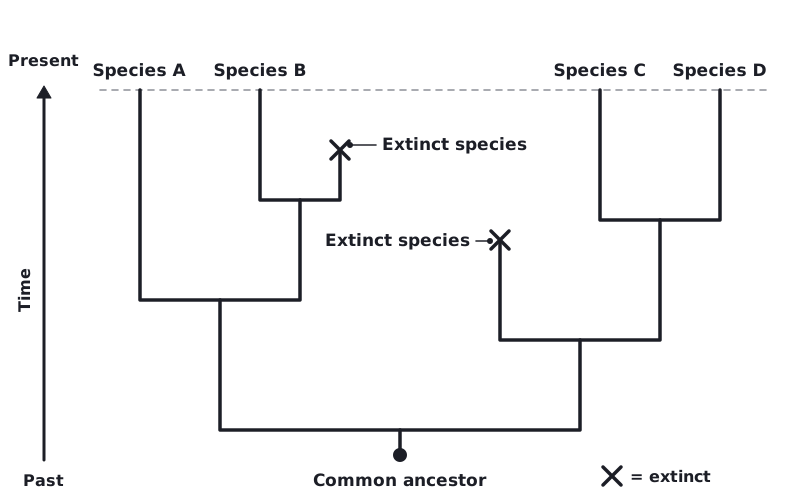
You may need to extract and interpret information from charts, graphs and tables, such as evolutionary trees. Evolutionary trees use fossil data for extinct organisms and current classification data for living organisms.
 Tap to enlarge
ExtinctionSpec 4.6.3.6
Extinction occurs when there are no remaining individuals of a species still alive.
You need to be able to describe factors that may contribute to the extinction of a species. A species may become extinct because of:
- a change to the environment over geological time
- new predators
- new diseases
- new, more successful competitors
- a single catastrophic event, such as a massive volcanic eruption or an asteroid collision.
Resistant bacteriaSpec 4.6.3.7
Bacteria can evolve rapidly because they reproduce at a fast rate. Mutations of bacterial pathogens produce new strains.
- A mutation produces a strain that is resistant to antibiotics.
- When antibiotics are used, non-resistant bacteria are killed. The resistant bacteria are not killed.
- The resistant bacteria survive and reproduce, so the population of the resistant strain rises.
- The resistant strain spreads, because people are not immune to it and there is no effective treatment.
MRSA is resistant to antibiotics.
Reducing the rate of development of resistant strains
- Doctors should not prescribe antibiotics inappropriately, such as for non-serious or viral infections.
- Patients should complete their course of antibiotics so all bacteria are killed and none survive to mutate and form resistant strains.
- The agricultural use of antibiotics should be restricted.
The development of new antibiotics is costly and slow. It is unlikely to keep up with the emergence of new resistant strains.
Quick check
Triple only Give two reasons why Darwin's theory was only gradually accepted.
Show answer
Any two of: it challenged the idea that God made all animals and plants; there was insufficient evidence; the mechanism of inheritance was not known.
Triple only Who published joint writings with Darwin in 1858?
Show answer
Alfred Russel Wallace.
Why is the fossil record incomplete?
Show answer
Early life was soft-bodied and left few traces, and many traces were destroyed by geological activity.
Why do resistant strains of bacteria spread so quickly?
Show answer
Bacteria reproduce quickly, people are not immune and there is no effective treatment.
Give one way to reduce the development of antibiotic resistance.
Show answer
Do not prescribe antibiotics inappropriately, complete the course, or restrict agricultural use.