

Trophic levelsSpec 4.7.4.1
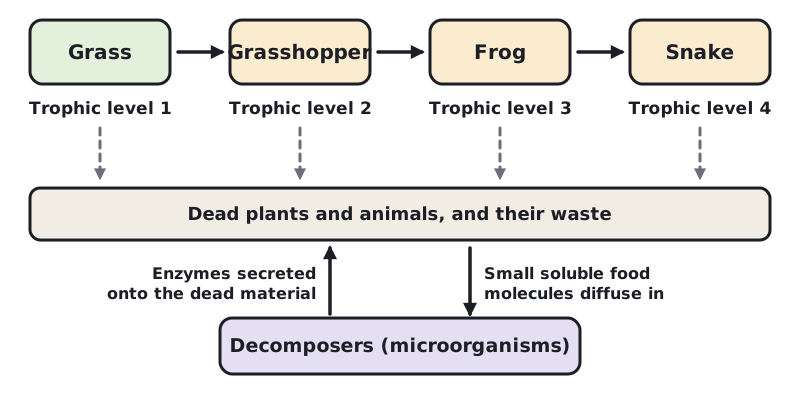
Trophic levels can be represented by numbers, starting at level 1 with plants and algae. Further trophic levels are numbered subsequently according to how far the organism is along the food chain.
| Trophic level | Organisms | Name |
|---|---|---|
| Level 1 | Plants and algae make their own food | Producers |
| Level 2 | Herbivores eat plants and algae | Primary consumers |
| Level 3 | Carnivores that eat herbivores | Secondary consumers |
| Level 4 | Carnivores that eat other carnivores | Tertiary consumers |
Apex predators are carnivores with no predators.
Decomposers
Decomposers break down dead plant and animal matter by secreting enzymes into the environment. Small soluble food molecules then diffuse into the microorganism.
 Tap to enlarge
Pyramids of biomassSpec 4.7.4.2
Pyramids of biomass can be constructed to represent the relative amount of biomass in each level of a food chain. Trophic level 1 is at the bottom of the pyramid.
Each bar is narrower than the one below it, because the biomass decreases at each higher trophic level. This gives the pyramid shape.
- Draw horizontal bars, one for each trophic level, with trophic level 1 at the bottom.
- Choose a scale so that the length of each bar is proportional to the biomass of that level.
- Centre the bars on a vertical line and label each bar with the organism or level.
Constructing a pyramid
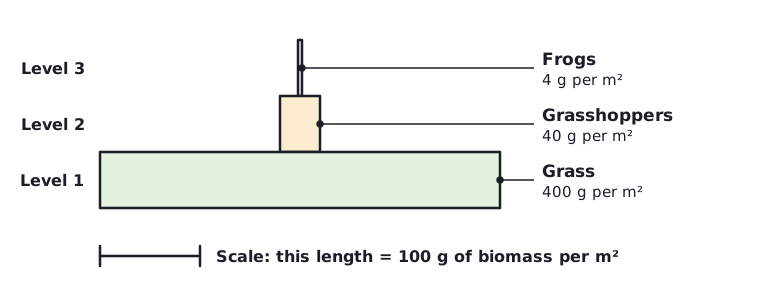
A food chain has biomass of 400 g per m² of grass, 40 g per m² of grasshoppers and 4 g per m² of frogs. Describe how to construct the pyramid using a scale of 1 mm = 4 g.
- Grass: 400 ÷ 4 = a bar 100 mm long, at the bottom.
- Grasshoppers: 40 ÷ 4 = a bar 10 mm long, above the grass.
- Frogs: 4 ÷ 4 = a bar 1 mm long, at the top.
Answer: Three centred bars of 100 mm, 10 mm and 1 mm, with grass at the bottom and frogs at the top.
 Tap to enlarge
Transfer of biomassSpec 4.7.4.3
Producers are mostly plants and algae which transfer about 1% of the incident energy from light for photosynthesis.
Only approximately 10% of the biomass from each trophic level is transferred to the level above it.
How biomass is lost
- Not all the ingested material is absorbed. Some is egested as faeces.
- Some absorbed material is lost as waste, such as carbon dioxide and water in respiration, and water and urea in urine.
- Large amounts of glucose are used in respiration.
Efficiency of biomass transfer
Efficiency of transfer
Caterpillars eat 250 g of leaves and their body mass increases by 20 g. Calculate the efficiency of biomass transfer.
- Biomass transferred = 20 g.
- Biomass available = 250 g.
- Efficiency = 20 ÷ 250 × 100 = 8%.
Answer: 8%
Effect on numbers of organisms
Because so much biomass is lost at each step, less biomass is available to each higher trophic level. This means fewer organisms can be supported at each higher trophic level, and food chains have only a few trophic levels.
Quick check
What is trophic level 1, and what are those organisms called?
Show answer
Plants and algae, called producers.
What is an apex predator?
Show answer
A carnivore with no predators.
How do decomposers break down dead material?
Show answer
They secrete enzymes into the environment and small soluble food molecules diffuse in.
Approximately what percentage of biomass passes to the next trophic level?
Show answer
About 10%.
Give two ways biomass is lost between trophic levels.
Show answer
Egested as faeces; lost as carbon dioxide and water in respiration, and as water and urea in urine.