

CommunitiesSpec 4.7.1.1
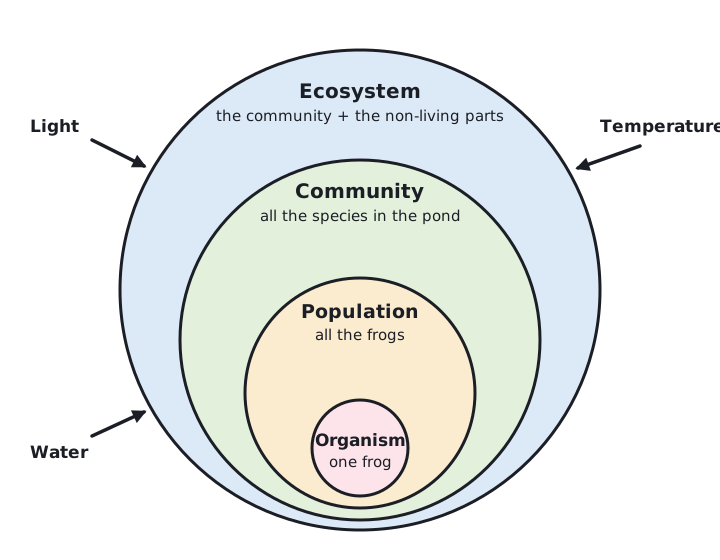
An ecosystem is the interaction of a community of living organisms (biotic) with the non-living (abiotic) parts of their environment.
Levels of organisation
| Level | What it means | Pond example |
|---|---|---|
| Individual organism | One living thing | One frog |
| Population | All the organisms of one species living in the same area | All the frogs in the pond |
| Community | All the populations of the different species living in the same area | All the plants, animals and microorganisms in the pond |
| Ecosystem | The community together with the non-living parts of the environment | The pond community plus the water, light and temperature |
 Tap to enlarge
To survive and reproduce, organisms need a supply of materials from their surroundings and from the other living organisms there.
Competition
Organisms in a community or habitat compete for the things they need when these are in short supply.
| Organisms | They often compete for |
|---|---|
| Plants | Light, space, water and mineral ions from the soil |
| Animals | Food, mates and territory |
Interdependence and stable communities
- Interdependence
- Within a community each species depends on other species for food, shelter, pollination, seed dispersal and so on. If one species is removed it can affect the whole community.
- Stable community
- A community where all the species and environmental factors are in balance so that population sizes remain fairly constant.
For example, if a plant species that is pollinated by one type of insect is removed, that insect loses its food, and the animals that eat the insect lose theirs. One change spreads through the community.
Abiotic factorsSpec 4.7.1.2
Abiotic (non-living) factors can affect a community. If one of them changes, the organisms that depend on it are affected, and so are the species that feed on or depend on those organisms.
| Abiotic factor | How a change could affect organisms |
|---|---|
| Light intensity | Less light means plants photosynthesise more slowly and grow less, so there is less food for the animals that eat them |
| Temperature | Changes the rate of enzyme-controlled reactions, so growth and reproduction speed up or slow down. Too hot or too cold and organisms may die or move away |
| Moisture levels | Plants and animals need water to survive. In drier conditions, fewer organisms can live there |
| Soil pH and mineral content | Plants only grow well in a suitable pH and need mineral ions for healthy growth. Poor soil means fewer plants |
| Wind intensity and direction | Strong wind can damage plants and increases water loss from them. It also affects how easily animals move and feed |
| Carbon dioxide levels for plants | Carbon dioxide is needed for photosynthesis. Lower levels slow the growth of plants |
| Oxygen levels for aquatic animals | Aquatic animals need oxygen for respiration. If levels fall, fewer animals can survive in the water |
To explain the effect of a change, link three steps: what changed, how it affects the organism, and what happens to the community.
Biotic factorsSpec 4.7.1.3
Biotic (living) factors can also change a community. The four you need to know are:
| Biotic factor | How a change could affect a community |
|---|---|
| Availability of food | Less food means more competition, so animal numbers fall. More food means numbers can rise |
| New predators arriving | Prey are eaten, so the prey population falls. Anything the prey ate may then increase |
| New pathogens | Disease can kill or weaken many organisms of a species, so the population falls |
| One species outcompeting another | The weaker competitor gets less of the food, light or space it needs. Its numbers may become no longer sufficient to breed, so the species can die out in that area |
A change in one population affects others. If a new predator reduces the number of prey, the predator's other food sources and the prey's food source are all affected.
AdaptationsSpec 4.7.1.4
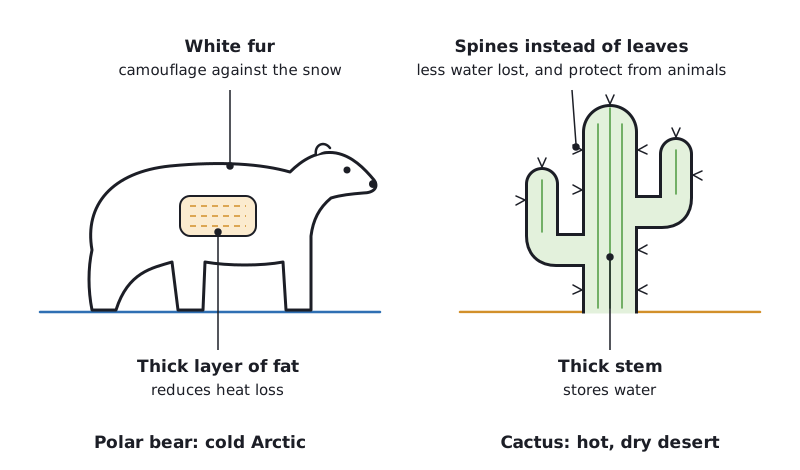
Organisms have features called adaptations that enable them to survive in the conditions in which they normally live. Adaptations may be structural, behavioural or functional.
| Type | What it is | Examples |
|---|---|---|
| Structural | A feature of the body's structure | A thick layer of fat and a white coat on a polar bear. Spines and a thick, water-storing stem on a cactus |
| Behavioural | The way an organism acts | Migrating to a warmer place for winter. Hunting at night to avoid the heat of the day |
| Functional | How a body process works | A camel producing very little, concentrated urine to save water |
 Tap to enlarge
Extremophiles
- Extremophile
- An organism that lives in an environment that is very extreme, such as at high temperature, pressure or salt concentration. Bacteria living in deep sea vents are extremophiles.
When you explain an adaptation, you are given information about the environment. Name the feature, then say how it helps survival.
Quick check
Put in order, smallest to largest: community, organism, ecosystem, population.
Show answer
Organism, population, community, ecosystem.
What do plants often compete for?
Show answer
Light, space, water and mineral ions from the soil.
What do animals often compete for?
Show answer
Food, mates and territory.
What is a stable community?
Show answer
One where all the species and environmental factors are in balance so population sizes remain fairly constant.
What is an extremophile?
Show answer
An organism that lives in very extreme conditions, such as high temperature, pressure or salt concentration.