

The Linnaean system and binomial namesSpec 4.6.4
Traditionally, living things have been classified into groups depending on their structure and characteristics, in a system developed by Carl Linnaeus.
Linnaeus classified living things into: kingdom, phylum, class, order, family, genus and species. Organisms are named by the binomial system of genus and species.
| Level | Name |
|---|---|
| Genus | Homo |
| Species | sapiens |
| Binomial name | Homo sapiens |
In a binomial name, the genus is written first with a capital letter, and the species second with a lower-case letter. Binomial names are written in italics or underlined.
Developments in classificationSpec 4.6.4
As evidence of internal structures became more developed due to improvements in microscopes, and the understanding of biochemical processes progressed, new models of classification were proposed.
Due to evidence available from chemical analysis, there is now a three-domain system developed by Carl Woese. In this system, organisms are divided into:
| Domain | Description |
|---|---|
| Archaea | Primitive bacteria, usually living in extreme environments |
| Bacteria | True bacteria |
| Eukaryota | Includes protists, fungi, plants and animals |
Evolutionary trees
Evolutionary trees are a method used by scientists to show how they believe organisms are related. They use current classification data for living organisms and fossil data for extinct organisms. The more recently two branches split from a common ancestor, the more closely related the organisms are.
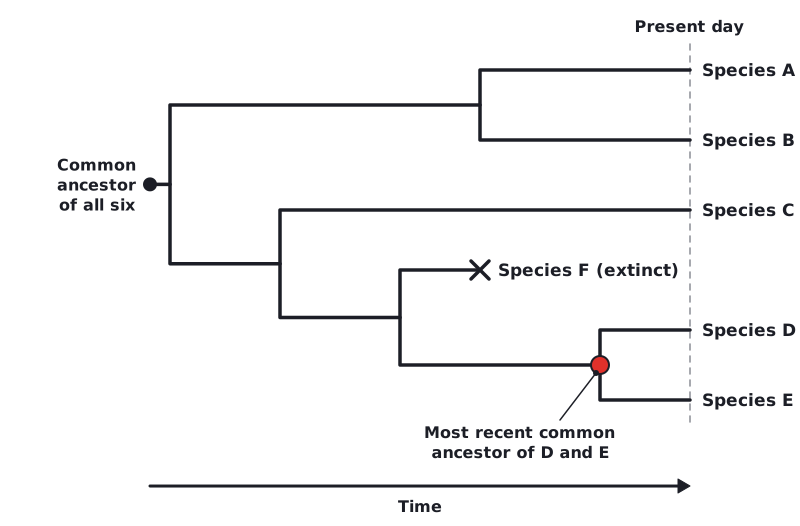 Tap to enlarge
Quick check
List the Linnaean groups from largest to smallest.
Show answer
Kingdom, phylum, class, order, family, genus, species.
Which two groups make up a binomial name?
Show answer
Genus and species.
Name the three domains in Woese's system.
Show answer
Archaea, bacteria and eukaryota.
What data are used to build evolutionary trees?
Show answer
Current classification data for living organisms and fossil data for extinct organisms.