

The photosynthetic reactionSpec 4.4.1.1
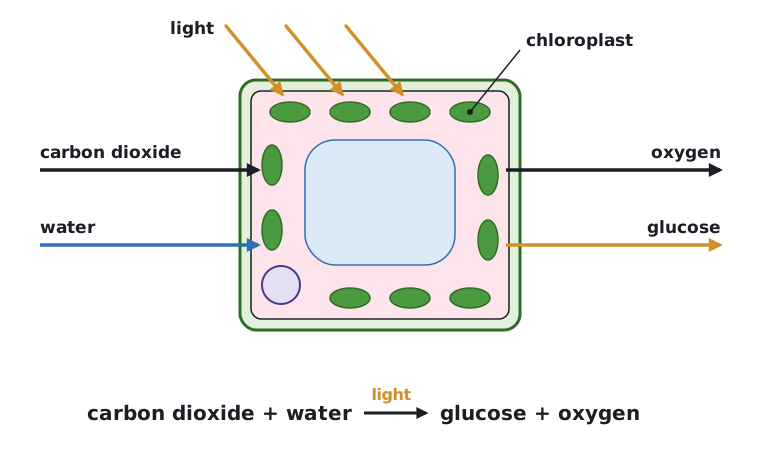
Plants make their own food by photosynthesis. In plants it happens in the chloroplasts, which contain the green pigment chlorophyll.
Photosynthesis is represented by the equation:
| Substance | Symbol |
|---|---|
| Carbon dioxide | CO₂ |
| Water | H₂O |
| Glucose | C₆H₁₂O₆ |
| Oxygen | O₂ |
Photosynthesis is an endothermic reaction. Energy is transferred from the environment to the chloroplasts by light. This is why the reaction needs a constant supply of light to keep going.
In an endothermic reaction, energy is taken in from the surroundings. The energy ends up stored in the glucose that is made.
 Tap to enlarge
Factors that affect the rate of photosynthesisSpec 4.4.1.2
Four factors affect the rate of photosynthesis. If one of them is in short supply, it limits the rate. Raising any other factor will make no difference until the limiting factor is increased.
| Factor | Effect on rate | Why |
|---|---|---|
| Light intensity | Rate increases as light intensity increases, up to a point | Light provides the energy for the reaction. When light is no longer the limiting factor, the rate levels off. |
| Carbon dioxide concentration | Rate increases as concentration increases, up to a point | Carbon dioxide is a reactant. When it is no longer limiting, the rate levels off. |
| Temperature | Rate increases as temperature increases up to an optimum, then falls | Photosynthesis is controlled by enzymes. Warmer particles move faster and collide more often. Above the optimum, the enzymes denature and the rate drops quickly. |
| Amount of chlorophyll | Less chlorophyll means a lower rate | Chlorophyll absorbs the light. Fewer chloroplasts or damaged leaves (for example from disease) absorb less light. |
Measuring and calculating the rate
You can measure the rate of photosynthesis by finding how much oxygen is made, or how many bubbles are released, in a set time. The bigger the volume or number of bubbles, the faster the rate.
Calculating a rate
A piece of pondweed produced 24 cm³ of oxygen in 8 minutes. Calculate the rate of photosynthesis in cm³ per minute.
- rate = volume ÷ time
- rate = 24 ÷ 8
Answer: 3 cm³ per minute
Rearranging the equation
A different piece of pondweed photosynthesises at 2.5 cm³ per minute. How long will it take to produce 15 cm³ of oxygen?
- rate = volume ÷ time, so time = volume ÷ rate
- time = 15 ÷ 2.5
Answer: 6 minutes
Plotting and reading graphs
- Put the factor you change (the independent variable) on the x-axis and the rate on the y-axis.
- Choose a scale that uses more than half of the grid, with equal steps on each axis.
- Label both axes with the quantity and the unit.
- Plot the points accurately and draw a smooth line or curve of best fit.
- To read a graph, find the value on one axis and follow it across to the line, then down or across to the other axis. You can then write the values in a table, or draw a graph from a table.
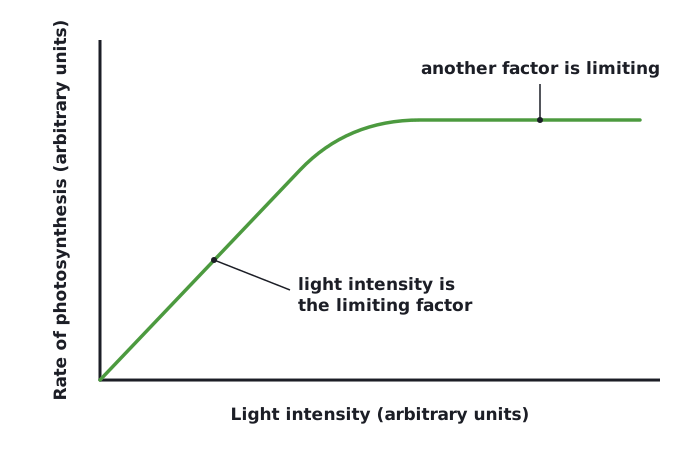
For a graph with one limiting factor, the rate rises steeply, then curves over and becomes flat. In the rising part the factor on the x-axis is limiting. In the flat part another factor is limiting.
 Tap to enlarge
Interacting factors and the inverse square lawSpec 4.4.1.2Higher tier
These factors interact, and any one of them may be the factor that limits photosynthesis. Which one is limiting can change with conditions, for example from the middle of a summer day to a winter morning.
To explain a graph with two or three factors, follow these steps:
- Look at the lines (or curves) for each set of conditions.
- Find the part where a curve is still rising. The factor on the x-axis is limiting there.
- Find the part where a curve is flat. A factor that is not on the x-axis is limiting there.
- If a line is higher because another factor was increased (for example a higher carbon dioxide concentration or temperature), that other factor was limiting the lower line.
- Where two lines are on top of each other, the factor on the x-axis is limiting both, so changing the other factor has no effect there.
Light intensity and the inverse square law
Light intensity is inversely proportional to the square of the distance from the light source. This is the inverse square law. If you move a lamp twice as far away, the light intensity is one quarter as much, not one half.
Using the inverse square law
A lamp 10 cm from a plant gives a light intensity of 64 units. What is the light intensity when the lamp is moved to 40 cm?
- Distance has increased by a factor of 40 ÷ 10 = 4
- Light intensity falls by a factor of 4² = 16
- New intensity = 64 ÷ 16
Answer: 4 units
If light is the limiting factor, the rate of photosynthesis is roughly proportional to light intensity. So halving the distance gives four times the light intensity, and four times the rate (provided nothing else becomes limiting).
Limiting factors and greenhouses
Limiting factors are important in the economics of enhancing the conditions in greenhouses. Growers can add heat, light or carbon dioxide to gain the maximum rate of photosynthesis, so that plants grow faster and yield more.
But each addition costs money for fuel, electricity or carbon dioxide. The grower must still maintain a profit. It is only worth adding a factor if it is the limiting factor, and if the extra crop is worth more than the cost of adding it. Increasing a factor that is not limiting is a waste of money.
Required practical: light intensity and the rate of photosynthesisSpec 4.4.1.2
Aim: to find how the distance of a lamp from pondweed affects the rate at which it photosynthesises.
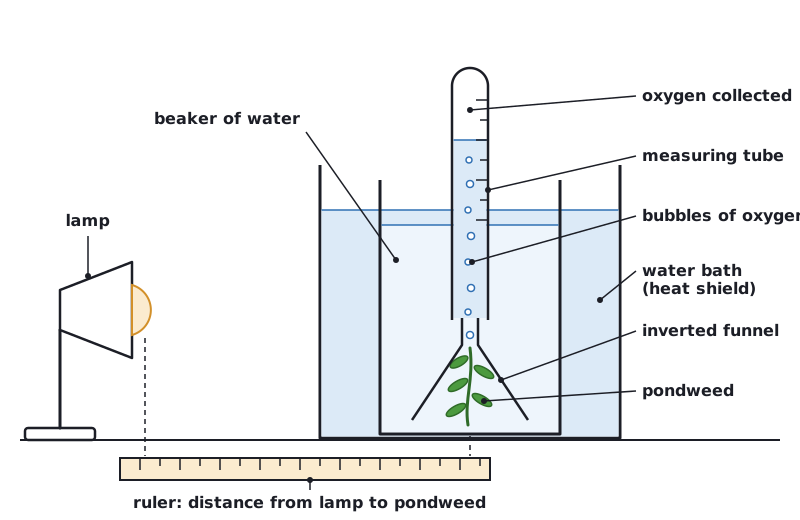
- Set up a beaker of water with a piece of pondweed and a lamp.
- Use a ruler to place the lamp a set distance from the pondweed, for example 10 cm.
- Leave the pondweed for a short time to adjust to the new light.
- Count the number of bubbles of oxygen released from the cut end of the stem in a set time (for example one minute), or collect the gas in a gas syringe or upside-down measuring tube and measure its volume.
- Repeat the count at least twice more at the same distance and calculate a mean.
- Move the lamp to a new distance (for example 20, 30, 40 and 50 cm) and repeat.
- Calculate the rate at each distance and plot a graph.
| Type | Variable |
|---|---|
| Independent (changed) | Distance of the lamp from the pondweed, which changes the light intensity |
| Dependent (measured) | Number of bubbles, or volume of oxygen, in a set time |
| Control (kept the same) | Temperature of the water, carbon dioxide concentration, the same piece of pondweed, the same lamp, time period |
- Control temperature by placing the beaker inside a larger beaker of water that acts as a heat shield, or by using a water bath. A cool LED lamp also keeps the water temperature steady.
- Control carbon dioxide by dissolving sodium hydrogencarbonate in the water.
- Do the experiment in a dim room so that light from the lamp is the main light source.
Typical results: the closer the lamp, the higher the light intensity and the more bubbles are produced. At first the rate rises steeply as the lamp moves closer. At high light intensity, the rate levels off because another factor (such as carbon dioxide concentration or temperature) becomes limiting.
Because the light intensity is proportional to 1 ÷ distance², you can plot rate against 1 ÷ distance² to get a straight line through the origin while light is limiting.
- Safety: keep electrical equipment (the lamp) away from water and wipe up any spills.
- Safety: lamps get hot, so do not touch them, and handle glassware carefully.
 Tap to enlarge
Uses of glucose from photosynthesisSpec 4.4.1.3
The glucose produced in photosynthesis may be:
- used for respiration
- converted into insoluble starch for storage
- used to produce fat or oil for storage
- used to produce cellulose, which strengthens the cell wall
- used to produce amino acids for protein synthesis.
To produce proteins, plants also use nitrate ions that are absorbed from the soil. Glucose alone contains only carbon, hydrogen and oxygen, so plants need nitrate ions as a source of nitrogen to make amino acids.
| Use | Product | Purpose |
|---|---|---|
| Respiration | Energy transferred | Supplies the energy for living processes |
| Storage | Starch | Insoluble, so suitable for storage |
| Storage | Fat or oil | Stored for later use |
| Cell walls | Cellulose | Strengthens the cell wall |
| Protein synthesis | Amino acids (with nitrate ions) | Used to build proteins |
Quick check
Write the word equation for photosynthesis.
Show answer
carbon dioxide + water → glucose + oxygen (in the presence of light)
Name the four factors that affect the rate of photosynthesis.
Show answer
Temperature, light intensity, carbon dioxide concentration and the amount of chlorophyll.
In the pondweed practical, what is the independent variable?
Show answer
The distance of the lamp from the pondweed (which changes the light intensity).
Why do plants need nitrate ions?
Show answer
To make proteins, as nitrate ions are used with glucose to make amino acids.
Why is photosynthesis described as endothermic?
Show answer
It takes in energy from the environment, transferred to the chloroplasts by light.